All Articles

United States Declaration Of Independence

United States Declaration Of Independence Facts For Kids

The Declaration of Independence is the founding document of the United States, declaring the thirteen colonies free from British rule and emphasizing the principles of equality and unalienable rights.

🎨 Reading age for 6-8
Background blob
United States Declaration Of Independence
Facts for Kids!

Do more with AI

Introduction

The Declaration of Independence is a very important document in American history! 📜It was adopted on July 4, 1776, and it announced that the thirteen American colonies were no longer under British rule. Instead, they wanted to be their own country, called the United States of America! 🇺🇸 This document was written to tell King George III of Britain that the colonies wanted freedom and self-government. It explains that all people are equal and should have rights like life, liberty, and the pursuit of happiness. The Declaration is celebrated every July 4th, known as Independence Day! 🎆

Images of United States Declaration Of Independence

Declaration of Independence (painting)

Declaration of Independence (painting)

Thomas Jefferson, the principal author of the Declaration

Thomas Jefferson, the principal author of the Declaration

The Thirteen Colonies as they existed on July 4, 1776, when the Second Continental Congress unanimously approved the text of the Declaration of Independence. (Most border disputes omitted. Some colonies had already declared independence; see Territorial evolution of the United States § 1776–1784 (American Revolution).)

The Thirteen Colonies as they existed on July 4, 1776, when the Second Continental Congress unanimously approved the text of the Declaration of Independence. (Most border disputes omitted. Some colonies had already declared independence; see Territorial evolution of the United States § 1776–1784 (American Revolution).)

The Assembly Room in Independence Hall in Philadelphia, where the Second Continental Congress unanimously adopted the Declaration of Independence

The Assembly Room in Independence Hall in Philadelphia, where the Second Continental Congress unanimously adopted the Declaration of Independence

Writing the Declaration of Independence, 1776, a 1900 portrait by Jean Leon Gerome Ferris depicting Franklin, Adams, and Jefferson working on the Declaration[47]
Writing the Declaration of Independence, 1776, a 1900 portrait by Jean Leon Gerome Ferris depicting Franklin, Adams, and Jefferson working on the Declaration[47]

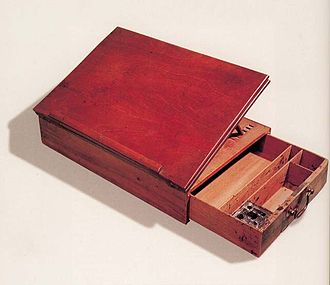
The portable writing desk on which Jefferson drafted the Declaration of Independence

The portable writing desk on which Jefferson drafted the Declaration of Independence

Declaration House, the reconstructed boarding house at Market and South 7th Streets in Philadelphia, where Jefferson wrote the Declaration in June 1776

Declaration House, the reconstructed boarding house at Market and South 7th Streets in Philadelphia, where Jefferson wrote the Declaration in June 1776

The opening of the Declaration's original printing on July 4, 1776, under Jefferson's supervision, engrossed and signed in August 1776 includes slightly edited phrasing to its opening lines, including the pointed addition of the word "unanimous", reflecting that each of the 56 delegates of the Second Continental Congress signed it.[3]

The opening of the Declaration's original printing on July 4, 1776, under Jefferson's supervision, engrossed and signed in August 1776 includes slightly edited phrasing to its opening lines, including the pointed addition of the word "unanimous", reflecting that each of the 56 delegates of the Second Continental Congress signed it.[3]

Declaration of Independence (painting)

Declaration of Independence (painting)

Thomas Jefferson, the principal author of the Declaration

Thomas Jefferson, the principal author of the Declaration

The Thirteen Colonies as they existed on July 4, 1776, when the Second Continental Congress unanimously approved the text of the Declaration of Independence. (Most border disputes omitted. Some colonies had already declared independence; see Territorial evolution of the United States § 1776–1784 (American Revolution).)Image by Golbez, licensed under Creative Commons Attribution-Share Alike 4.0

The Thirteen Colonies as they existed on July 4, 1776, when the Second Continental Congress unanimously approved the text of the Declaration of Independence. (Most border disputes omitted. Some colonies had already declared independence; see Territorial evolution of the United States § 1776–1784 (American Revolution).)

The Assembly Room in Independence Hall in Philadelphia, where the Second Continental Congress unanimously adopted the Declaration of IndependenceImage by Rdsmith4, licensed under Creative Commons Attribution-Share Alike 2.5

The Assembly Room in Independence Hall in Philadelphia, where the Second Continental Congress unanimously adopted the Declaration of Independence

Writing the Declaration of Independence, 1776, a 1900 portrait by Jean Leon Gerome Ferris depicting Franklin, Adams, and Jefferson working on the Declaration[47]

Writing the Declaration of Independence, 1776, a 1900 portrait by Jean Leon Gerome Ferris depicting Franklin, Adams, and Jefferson working on the Declaration[47]

The portable writing desk on which Jefferson drafted the Declaration of Independence

The portable writing desk on which Jefferson drafted the Declaration of Independence

Declaration House, the reconstructed boarding house at Market and South 7th Streets in Philadelphia, where Jefferson wrote the Declaration in June 1776Image by Beyond My Ken, licensed under Creative Commons Attribution-Share Alike 4.0

Declaration House, the reconstructed boarding house at Market and South 7th Streets in Philadelphia, where Jefferson wrote the Declaration in June 1776

The opening of the Declaration's original printing on July 4, 1776, under Jefferson's supervision, engrossed and signed in August 1776 includes slightly edited phrasing to its opening lines, including the pointed addition of the word "unanimous", reflecting that each of the 56 delegates of the Second Continental Congress signed it.[3]

The opening of the Declaration's original printing on July 4, 1776, under Jefferson's supervision, engrossed and signed in August 1776 includes slightly edited phrasing to its opening lines, including the pointed addition of the word "unanimous", reflecting that each of the 56 delegates of the Second Continental Congress signed it.[3]

A 1697 portrait of English political philosopher John Locke

A 1697 portrait of English political philosopher John Locke

Historical Context

Before the Declaration, the thirteen colonies were part of the British Empire. The British government made many decisions without asking the colonists, like taxes on tea and paper. ☕📜 The colonists felt this was unfair, leading to protests like the Boston Tea Party in 1773. 🛶As tensions grew, the colonies wanted to unite against British rule. Leaders like George Washington and Thomas Jefferson believed in freedom and the right to choose their own government. Before the Declaration, the colonies held the First and Second Continental Congress meetings to discuss their ideas and plans for independence. 🗳️

Key Figures Involved

Several key figures shaped the Declaration of Independence! Thomas Jefferson was the main writer and is often called the "Author of Independence." 🖊️ Other important leaders included John Adams, who helped guide the writing, and Benjamin Franklin, who brought wisdom and ideas. 🦅These men, along with many others, represented the thirteen colonies, including Virginia, Massachusetts, and New York. The Declaration was officially approved by the Continental Congress, which met in Philadelphia, Pennsylvania. This gathering of leaders played a key role in deciding to become a free country! 🏛️

International Reactions

When the Declaration of Independence was announced, people from other countries took notice! 🌍Many Europeans, including those from France and Spain, were happy to see a group stand up against British power. Some believed it could inspire their own quests for freedom. 🇫🇷 France, especially, became an ally to the new United States and later assisted in the Revolutionary War. Still, the British responded with anger, sending more troops to the colonies to suppress the rebellion. The world was watching as this new country fought for its rights and independence! 🔥

Notable Quotes And Phrases

One of the most famous quotes from the Declaration of Independence is "We hold these truths to be self-evident, that all men are created equal." 🗨️ This powerful phrase emphasizes the idea of equality for all. It also states that everyone has the right to "life, liberty, and the pursuit of happiness." These words have inspired many people throughout history. They remind us that we all have dreams and the right to achieve them! The Declaration’s strong and inspiring language continues to resonate today, reminding us of the importance of freedom. ✨

Major Principles And Ideals

The Declaration of Independence is based on some big ideas! First, it says that all people are created equal. This means everyone deserves equal rights and opportunities. ✨The document also mentions "unalienable rights," which are rights that cannot be taken away. These rights include life, liberty, and the pursuit of happiness! 🎉The Declaration also emphasizes the importance of government and that it gets its power from the people. If the government doesn't protect the rights of the people, they have the right to change or get rid of it. This was a revolutionary idea at the time! 🚀

Commemoration And Observances

Every year, Americans celebrate Independence Day on July 4th! 🎆This holiday marks the adoption of the Declaration of Independence. Families gather for barbecues, parades, and fireworks, expressing their love for freedom and the nation. 🇺🇸 Many towns host fun events like reading the Declaration in public spaces. Schools often teach students about its importance and the history behind it. This spirit of independence and patriotism brings people together, reminding everyone of the values of liberty and justice for all! 🥳Independence Day is a special time for reflection and celebration!

The Signing Of The Declaration

On July 4, 1776, the Declaration of Independence was officially adopted at the Pennsylvania State House, which is now called Independence Hall! 🏛️ The signing was an important moment for America’s future. Fifty-six delegates of the Continental Congress signed the document, with John Hancock being the first. His large signature is famous for being bold! ✍️ The signers risked their lives for their beliefs, as they could be punished by the British for their actions. The Declaration sent a strong message: the colonies wanted to be a free and independent nation. 📣

Events Leading To The Declaration

Before the Declaration, several events stirred the desire for independence. One major event was the Stamp Act of 1765, which taxed printed materials. 🌍This upset many colonists, leading to protests. In 1770, the Boston Massacre occurred, where British soldiers killed five colonists during a confrontation, increasing anger. 🪖In 1773, the Boston Tea Party took place, where colonists dumped British tea into the harbor to protest unfair taxes! Then, in 1775, the Battles of Lexington and Concord marked the start of the Revolutionary War. These events and others sparked the colonies to unite and seek independence! 🔥

Impact On The American Revolution

The Declaration of Independence greatly impacted the American Revolution! ⚔️ It united the colonies in their fight against British rule and inspired soldiers and supporters. People felt a renewed sense of purpose and pride! The Declaration also helped other countries understand the reasons for the conflict, gaining support from France and Spain. The ideas expressed in it also motivated the colonists to fight harder and stand together. The Declaration symbolized their strong desire for freedom and helped shape the course of the war until victory in 1783! 🎊

Legacy And Influence On Future Documents

The Declaration of Independence is one of the most important documents in American history! 🏛️ Its ideas influenced many other important documents, like the U.S. Constitution and the Bill of Rights. 📜The Declaration inspired movements for freedom around the world, encouraging people to seek democracy and equality. Countries like France and Latin American nations drew inspiration from its principles during their struggles for liberty. The Declaration continues to be a symbol of freedom and democracy, reminding everyone of the importance of rights and self-governance! 🌟

United States Declaration Of Independence Quiz

Q1
Question 1 of 10

Learn more about United States Declaration Of Independence

Ready to create?

Make

To create a safe space for kid creators worldwide!

Create

Vibe Coding

Kids GPT

All Tools

Kibu

Learn

Worksheets

Courses

Skills

Resources

SafeTube

Blog

FAQ

Pricing

Account

Log-in

Sign-up

Data Deletion

Company

About

Community Guidelines

Privacy Policy

Terms of Service

2025, URSOR LIMITED. All rights reserved. DIY is in no way affiliated with Minecraft™, Mojang, Microsoft, Roblox™ or YouTube. LEGO® is a trademark of the LEGO® Group which does not sponsor, endorse or authorize this website or event. Made with love in San Francisco.