All Articles

Spleen

Spleen Facts For Kids

The spleen is an organ in the human body that plays crucial roles in blood filtration, immune response, and the recycling of certain cellular components.
🎨 Reading age for 6-8
Background blob
Spleen
Spleen
Facts for Kids!
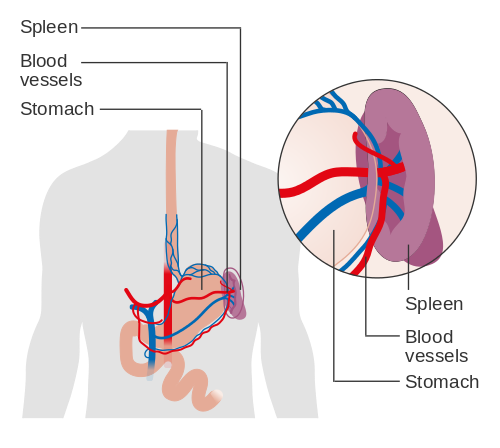
Image by Cancer Research UK uploader, licensed under Creative Commons Attribution-Share Alike 4.0

Do more with AI

Introduction

The spleen is an important organ in your body! It’s located behind your stomach on the left side. 🌟It is shaped like a fist and is about 4 to 5 inches long! The spleen is part of the lymphatic system, which helps protect us from sickness. Did you know? Every year, over 7 million people in the world visit doctors to learn more about their spleen! This little organ does a big job helping keep you healthy! 💪

Images of Spleen

A 3D medical animation still of spleen structure and exact locationImage by https://www.scientificanimations.com, licensed under Creative Commons Attribution-Share Alike 4.0

A 3D medical animation still of spleen structure and exact location

Photos of SpleenImage by Ptrump16, licensed under Creative Commons Attribution-Share Alike 4.0
Photos of Spleen
Prone anatomical view: selected organs and structures of human mid-torso (T9-sacrum). Depicts (labeled): spleen, left and right kidney, and right lung and pleural space. Depicts (unlabeled): ribs 9-12, spine, sacrum, pelvis, and ureters.

Prone anatomical view: selected organs and structures of human mid-torso (T9-sacrum). Depicts (labeled): spleen, left and right kidney, and right lung and pleural space. Depicts (unlabeled): ribs 9-12, spine, sacrum, pelvis, and ureters.

Visión lateral del tórax , mostrando la localización del bazo (verde), pulmón|pulmones (púrpura) y pleura (azul).

Visión lateral del tórax , mostrando la localización del bazo (verde), pulmón|pulmones (púrpura) y pleura (azul).

Visceral surface of the spleen

Visceral surface of the spleen

Micrograph of splenic tissue showing the red pulp (red), white pulp (blue nuclei in lighter background) and a thickened inflamed capsule (mostly pink – top of image). H&E stain.Image by Nephron, licensed under Creative Commons Attribution-Share Alike 3.0

Micrograph of splenic tissue showing the red pulp (red), white pulp (blue nuclei in lighter background) and a thickened inflamed capsule (mostly pink – top of image). H&E stain.

The spleen contains two different tissues, white pulp (A) and red pulp (B). The white pulp functions in producing and growing immune and blood cells. The red pulp functions in filtering blood of antigens, microorganisms, and defective or worn-out red blood cells.Image by Senioritisisreal, licensed under Creative Commons Attribution-Share Alike 4.0

The spleen contains two different tissues, white pulp (A) and red pulp (B). The white pulp functions in producing and growing immune and blood cells. The red pulp functions in filtering blood of antigens, microorganisms, and defective or worn-out red blood cells.

Thalassemia-enlarged spleen taken after splenectomyImage by Almazi, licensed under Creative Commons Attribution-Share Alike 4.0

Thalassemia-enlarged spleen taken after splenectomy

Laparoscopic view of a horse's spleen (the purple and grey mottled organ)Image by Malcolm Morley (my own image), licensed under Creative Commons Attribution-Share Alike 3.0

Laparoscopic view of a horse's spleen (the purple and grey mottled organ)

A 3D medical animation still of spleen structure and exact locationImage by https://www.scientificanimations.com, licensed under Creative Commons Attribution-Share Alike 4.0

A 3D medical animation still of spleen structure and exact location

Photos of SpleenImage by Ptrump16, licensed under Creative Commons Attribution-Share Alike 4.0
Photos of Spleen
Prone anatomical view: selected organs and structures of human mid-torso (T9-sacrum). Depicts (labeled): spleen, left and right kidney, and right lung and pleural space. Depicts (unlabeled): ribs 9-12, spine, sacrum, pelvis, and ureters.

Prone anatomical view: selected organs and structures of human mid-torso (T9-sacrum). Depicts (labeled): spleen, left and right kidney, and right lung and pleural space. Depicts (unlabeled): ribs 9-12, spine, sacrum, pelvis, and ureters.

Visión lateral del tórax , mostrando la localización del bazo (verde), pulmón|pulmones (púrpura) y pleura (azul).

Visión lateral del tórax , mostrando la localización del bazo (verde), pulmón|pulmones (púrpura) y pleura (azul).

Visceral surface of the spleen

Visceral surface of the spleen

Micrograph of splenic tissue showing the red pulp (red), white pulp (blue nuclei in lighter background) and a thickened inflamed capsule (mostly pink – top of image). H&E stain.Image by Nephron, licensed under Creative Commons Attribution-Share Alike 3.0

Micrograph of splenic tissue showing the red pulp (red), white pulp (blue nuclei in lighter background) and a thickened inflamed capsule (mostly pink – top of image). H&E stain.

The spleen contains two different tissues, white pulp (A) and red pulp (B). The white pulp functions in producing and growing immune and blood cells. The red pulp functions in filtering blood of antigens, microorganisms, and defective or worn-out red blood cells.Image by Senioritisisreal, licensed under Creative Commons Attribution-Share Alike 4.0

The spleen contains two different tissues, white pulp (A) and red pulp (B). The white pulp functions in producing and growing immune and blood cells. The red pulp functions in filtering blood of antigens, microorganisms, and defective or worn-out red blood cells.

Thalassemia-enlarged spleen taken after splenectomyImage by Almazi, licensed under Creative Commons Attribution-Share Alike 4.0

Thalassemia-enlarged spleen taken after splenectomy

Laparoscopic view of a horse's spleen (the purple and grey mottled organ)Image by Malcolm Morley (my own image), licensed under Creative Commons Attribution-Share Alike 3.0

Laparoscopic view of a horse's spleen (the purple and grey mottled organ)

Anatomy Of The Spleen

The spleen has two main parts: the red pulp and the white pulp. The red pulp, filled with blood, filters out old or damaged red blood cells. 🩸The white pulp helps your body fight off germs and infections! It’s like a soldier ready to defend you! The spleen is also surrounded by a tough capsule to protect it. This organ has blood vessels that connect to the heart to keep the blood flowing. ❤️ Isn’t it amazing how it all works together?

Functions Of The Spleen

The spleen has several important functions! First, it filters your blood to remove old red blood cells. This is like cleaning up a messy room! 🧹Next, it helps store healthy blood and platelets, which help you heal from cuts. 🩹Finally, it produces white blood cells, like soldiers, that fight germs to keep you safe. The spleen also helps recycle important materials like iron, so your body can make new red blood cells. How cool is that? 😄

Spleen In Different Organisms

Did you know that many animals have spleens too? 🐶Most mammals, like dogs, cats, and elephants, have spleens that work similarly to ours! Even some birds and reptiles have spleens, but theirs might be different in size and function. For example, birds have a smaller spleen to help them fly better! 🕊️ Fish have spleens too, which help filter their blood, but they have different roles in their bodies. Isn’t it fascinating how life connects us all through similar organs? 🌍

Diagnostic Tests For Spleen Health

Doctors have special tests to check if your spleen is healthy! One common test is an ultrasound. 🖥️ This uses sound waves to create images of your spleen. Another test is a CT scan, which gives detailed pictures of the spleen and surrounding areas! 🎥Sometimes, doctors take blood tests to see how well your blood is working with the spleen. All these tests help your doctor understand if your spleen is doing its job and if you need help! 🩺

Interesting Facts About The Spleen

Here are some cool facts about the spleen! 🤩The spleen can hold up to 30% of your body’s platelets! It’s known as the "graveyard" for old blood cells. The spleen is also one of the few organs that can regenerate itself if part is removed. How amazing is that? 🔄Lastly, some animals, like jellyfish, don’t have spleens at all! Each organ in our bodies is unique and plays an essential role in keeping us alive! ❤️

The Spleen's Role In The Immune System

The spleen is a superhero for your immune system! 🦸‍♂️ It fights against bacteria and viruses to keep you from getting sick. The white blood cells created by the spleen act like tiny defenders. When germs enter your body, these cells jump into action! They capture and destroy the invaders, helping you stay strong and healthy. 💥If your spleen isn’t working well, it can make it easier for you to get infections. That’s why it’s important to keep it healthy!

Treatment Options For Spleen Conditions

If there’s something wrong with your spleen, there are different treatment options! Sometimes, medications help reduce swelling or infection. 💊Other times, if it’s very sick, doctors may suggest surgery to remove part or all of the spleen. If you do have your spleen removed, you can still live a healthy life, but you may need to take extra care to avoid infections! Always listen to your doctors and let them help you feel better. 🌟

Diseases And Disorders Related To The Spleen

Sometimes, the spleen can get sick or hurt. A common problem is called splenomegaly, where the spleen gets swollen and might hurt. 😟This can happen if you have infections, like mononucleosis (often called "mono"). Sometimes, injuries from sports can hurt the spleen too! ⚽If it’s damaged badly, doctors might need to remove it – a surgery called a splenectomy. It’s important to take care of your spleen to keep it healthy and happy! 🌈

Spleen Quiz

Q1
Question 1 of 10

Learn more about Spleen

Ready to create?

Make

To create a safe space for kid creators worldwide!

Create

Vibe Coding

Kids GPT

All Tools

Kibu

Resources

Worksheets

SafeTube

Blog

FAQ

Account

Pricing

Log-in

Sign-up

Data Deletion

Company

About

Community Guidelines

Privacy Policy

Terms of Service

2025, URSOR LIMITED. All rights reserved. DIY is in no way affiliated with Minecraft™, Mojang, Microsoft, Roblox™ or YouTube. LEGO® is a trademark of the LEGO® Group which does not sponsor, endorse or authorize this website or event. Made with love in San Francisco.