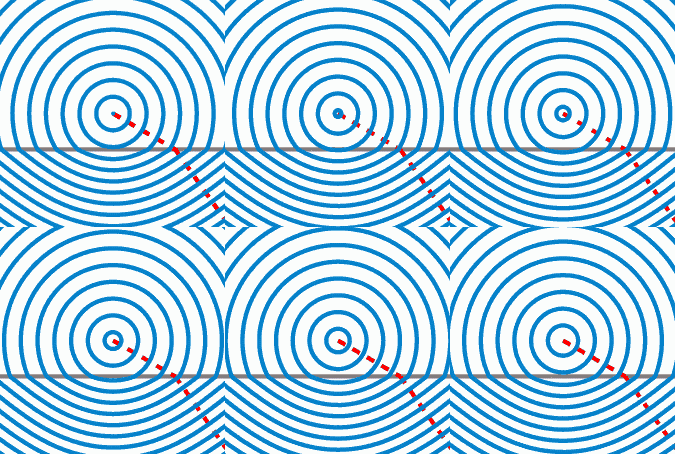
Snell's Law describes how light changes direction when moving between different materials, explaining phenomena like refraction and optical effects.

Set reading age
View for Kids
Easy to read and understand
View for Students
Clear, detailed explanations
View for Scholars
Deep dives and big ideas
Snell's Law is a special rule in science that helps us understand how light behaves when it moves from one material to another. 🌊✨ For example, when light travels from air to water, it bends! This bending is called "refraction." Snell's Law tells us the angles at which light bends. It was named after Dutch scientist Willebrord Snellius, who discovered this amazing principle in 1621. Today, scientists and engineers use Snell's Law to create cool technology, from eyeglasses to cameras! 👓📷 Learning about Snell’s Law helps us see the magic of light in our everyday lives!
Refraction is a fascinating phenomenon! 🌈It happens when light travels from one medium to another, like from air to water or glass. When light moves from a faster material to a slower one, it bends toward the normal line—a line that is imagined perpendicular to the surface. 🛑If it goes the other way, it bends away from the normal. Think of a straw in a glass of water—it looks bent! 🥤This bending creates many magical effects, like making things appear closer or larger. It's why rainbows happen too! The light bends in raindrops, splitting into colors. 🌈
Willebrord Snellius, a curious scientist from the Netherlands, first described this bending of light in 1621. Born in 1580, he loved math and astronomy! ⭐Snellius was trying to explain how light changes direction when it moves between air and water. He recorded his findings in a book, but it took many years for people to really understand and appreciate his work. Snell's Law became important for scientists around the world! People like Isaac Newton built upon his discoveries. Today, we celebrate Snell's work because understanding light helps us learn so much more about our universe! 🌌
Deriving Snell's Law means figuring out where it comes from! 📚✨ Imagine light traveling in a straight line until it hits a surface like water. When it hits that surface, it bends. To understand why, scientists look at how light travels, using angles and materials. When light enters different materials, like air to water, each material has a different speed for light. 🏃♂️💨 Snellius realized that the relation between the angle of incoming light and the angle of the light after it bends can be explained using a simple equation. This is how Snell's Law was discovered!
To see Snell's Law in action, scientists do experiments! 🔭One fun experiment uses a clear glass block and a laser pointer. First, shine the laser in air. Then, move the laser to shine into the glass at an angle. The light will bend! By measuring the angles and using the formula, scientists can verify Snell's Law. 📐💡 It's also done with water! This hands-on activity makes learning fun and shows how real-life science is. These experiments help everyone understand that Snell's Law is not just theory; it's something you can see with your own eyes! 👀
The formula of Snell's Law is written as \( n_1 \sin(\theta_1) = n_2 \sin(\theta_2) \). Let's break it down! 📐Here, \( n_1 \) and \( n_2 \) are numbers that show how a material bends light. These numbers are called "refractive indices." 🤔 \( \theta_1 \) is the angle at which light hits the new material, while \( \theta_2 \) is the angle it bends into. For example, in air, light has a refractive index of about 1, while in water, it's about 1.33. Using these values, we can find out how much light will bend!
Snell's Law is super useful! Scientists and engineers use it in many exciting ways. 🛠️👓 For instance, when making glasses, they want light to hit the lenses correctly so people can see clearly. Cameras and smartphones also use this law to take better pictures! 📸Snell's Law helps design fiber optic cables, which carry information through light, making our internet faster! 🌐🏃♀️ Even in creating Lasers, this law is important! By understanding light's bending, we can create tools and technology that help people every day!
Snell's Law has made a big impact on optics and engineering! 🔧👓 Optics is the study of light, and thanks to Snell’s discoveries, we know how to control it. For example, in designing lenses for cameras, the bending of light is crucial to take clear pictures! 🎥Engineers use this knowledge to create telescopes, microscopes, and many other cool gadgets that help us explore the world around us. 🌍Snell’s Law helps us understand light’s behavior, which leads to advancements in science and technology that make our lives easier and more interesting! 🚀
Refraction happens all around us, and it can be really fun! 🌊💦 When you put a pencil in a glass of water, it looks bent where it enters the water. That’s because of refraction! 🥤Another cool example is rainbows. ☔When sunlight passes through raindrops, light bends and splits into colors, creating a beautiful rainbow! 🌈Also, when you look at fish in water, they seem closer than they actually are due to light bending. Snell's Law explains these fascinating examples, helping us appreciate how light changes direction every day!
Some people think light always travels in straight lines, but that’s not true! 🌟Light can bend when moving to different materials. Another misconception is that refraction happens only in water. In reality, it happens in many materials, like glass and even air! 🪟Sometimes kids think Snell's Law is complicated, but it’s just a fun way to see light bending! 🌈Remember, understanding light helps us explore the world around us, so don’t be scared to dive into it! Learning about Snell's Law opens up a whole new world of science and wonder! ✨
Snell's Law is one special rule for understanding how light bends, but it's not the only one! 📜There are other laws related to refraction. One is called Fermat's Principle, discovered by Pierre de Fermat. It says light travels the path that takes the least time! ⏱️ Another is Brewster's Law, which explains how light reflects and refracts at certain angles, creating polarized light that reduces glare. 🕶️ Snell's Law is a simple way to see the relationship between angles, while these other laws explore more complex ideas about light's behavior. Together, they help us understand the amazing world of light!


DIY is a creative community where kids draw, build, explore ideas, and share.
No credit card required