Scandium Facts For Kids
Scandium is a lightweight, silvery-white metal used primarily in aluminum alloys and specialized applications such as lighting and fuel cells.
Select reading age
Scandium Facts For Kids
Videos & Quizzesincluded
About this topic
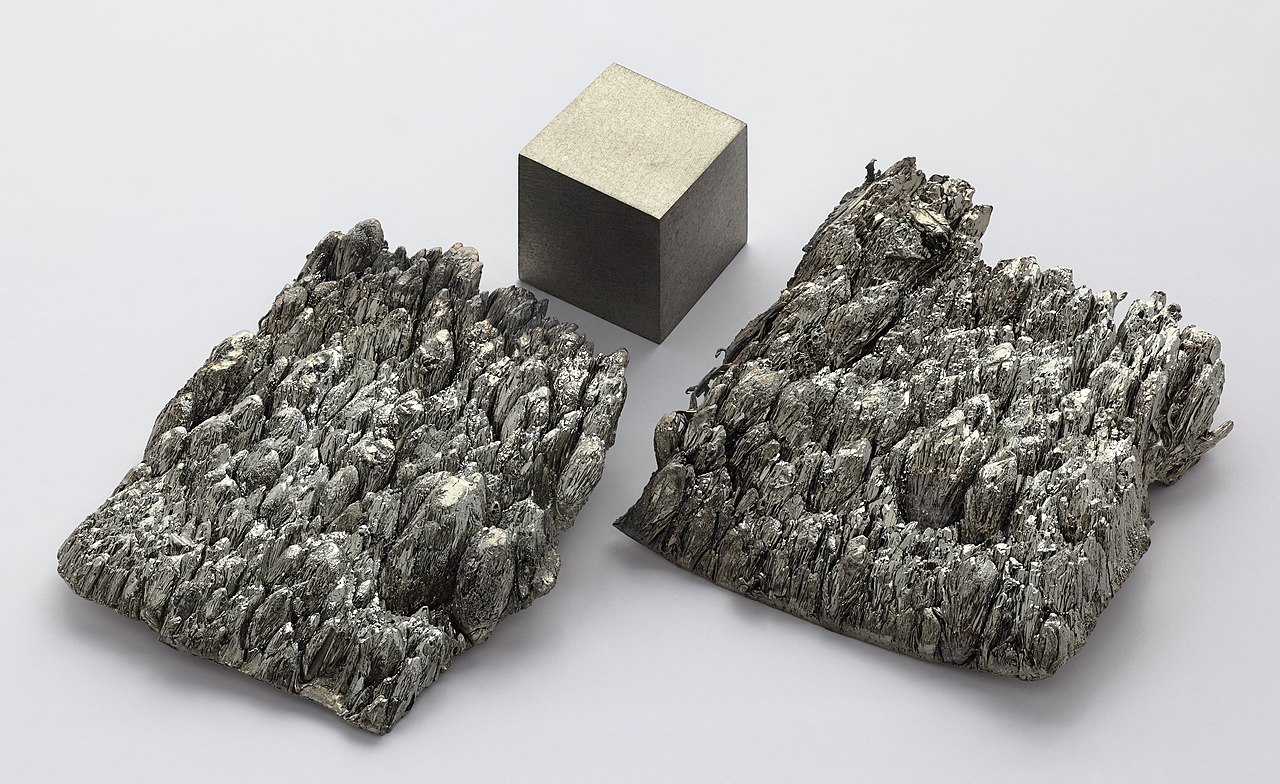
Scandium is a shiny, silver-white metal that belongs to a special group on the periodic table called "rare earth elements." It has the symbol "Sc" and a atomic number of 21. Discovered in 1879 by Swedish chemist Lars Fredrik Nilson, scandium is very light and is often used to make strong materials. Although it is not very common in the Earth's crust, it plays a crucial role in various technologies! 🌍🔬
Explore with ChatDinoKey Points
The future looks bright for scandium!
Scandium is like an adventurous metal!
In 1879, Lars Fredrik Nilson discovered scandium while studying minerals from Sweden.
Scandium is a pretty friendly metal when it comes to the environment!
Isotopes are different versions of an element, and scandium has several!
Scandium doesn't sit in big piles on the ground.
Scandium is unique because it's both lightweight and strong.
Scandium is a superhero in the world of science and technology!
Photos of Scandium
![Parts of the MiG-29 are made from Al-Sc alloy.[53]](https://upload.wikimedia.org/wikipedia/commons/thumb/4/4f/Mig-29_on_landing.jpg/960px-Mig-29_on_landing.jpg)
Parts of the MiG-29 are made from Al-Sc alloy.[53]
🔮 Future Prospects
The future looks bright for scandium! 🔮As technology continues to advance, its applications are likely to expand even more. Scientists are excited about developing new uses in energy storage and electronics. Companies are exploring ways to make scandium more available, which could lead to groundbreaking inventions! Let's keep our eyes on this shiny metal! 🚀✨
Go deeper⚗️ Chemical Reactions
Scandium is like an adventurous metal! It reacts with air to form a thin layer of oxide, which protects it from further reactions. When it meets acids, like hydrochloric acid, it forms scandium ions. This process can even make bubbles of hydrogen gas! ⚗️💥 It's important to handle scandium with care, but it's not as reactive as some other elements.
Go deeper📜 History Of Scandium
In 1879, Lars Fredrik Nilson discovered scandium while studying minerals from Sweden. He named it after Scandia, which is a fancy name for Scandinavia! 📜🌲 Scandium wasn't easy to find right away, but scientists eventually learned how to extract it from ores in the 20th century. Its use in industries has grown over the years, making it a valuable metal today. 🔍
Go deeper🌿 Environmental Impact
Scandium is a pretty friendly metal when it comes to the environment! 🌿It doesn't harm the Earth very much, especially when used in small amounts. Recycling scandium from products is also good for our planet, helping reduce waste and conserve resources. Even though mining can be tough on nature, using scandium in lightweight materials can save energy and reduce pollution! 🌎♻️
Go deeper🧪 Isotopes Of Scandium
Isotopes are different versions of an element, and scandium has several! The most common one is Sc-45, which makes up nearly all of the scandium found in nature. It has 22 neutrons. These isotopes can help scientists understand more about the element's properties. Isn't that cool? 🧪🌟
Go deeper🌎 Occurrence And Sources
Scandium doesn't sit in big piles on the ground. Instead, it is found together with other minerals. The largest sources of scandium are in countries like Russia, Ukraine, and China. It's often discovered in ores like thortveitite and bazzite. Did you know? Scandium is so rare that there are only about 0.0024% of it in Earth's crust! 🌎🔍
Go deeper⚖️ Properties Of Scandium
Scandium is unique because it's both lightweight and strong. It has a melting point of about 1541 °C (2806 °F) and a boiling point of 2836 °C (5137 °F). This means it can handle really high temperatures! Scandium is also flexible, which means it can bend without breaking. Its density is about 2.985 grams per cubic centimeter. This makes it lighter than aluminum! ⚖️✨
Go deeper🦸♂️ Applications Of Scandium
Scandium is a superhero in the world of science and technology! 🦸♂️ It's used to make special alloys, which are mixtures of metals that are stronger and lighter. For example, when combined with aluminum, it helps to create materials for airplanes and bicycles. Scandium is also used in projectors and LED lights, making our world brighter! 💡✈️
Go deeper