All Articles

Roman Senate

Roman Senate Facts For Kids

The Roman Senate was the highest governing body in ancient Rome, composed of elite members who made critical decisions impacting laws, finances, and foreign affairs.

๐ŸŽจ Reading age for 6-8
Background blob
Roman Senate
Roman Senate
Facts for Kids!
Image by Ssolbergj, licensed under Creative Commons Attribution 3.0

Do more with AI

Introduction

The Roman Senate was like a big group of important leaders in ancient Rome! ๐ŸŒŸIt was founded around 753 BC and continued to have power for many years. The Senate helped make decisions about laws, wars, and money for the city. Senators were usually wealthy men, and they held meetings in a special building called the Curia. The Senate was a big part of the government, playing a major role in Roman life. Over time, it was a mix of advisors and lawmakers, helping shape the future of Rome. The Senate showed how teamwork could lead to great decisions!

Images of Roman Senate

Representation of a sitting of the Roman senate: Cicero attacks Catiline, from a 19th-century fresco in Palazzo Madama, Rome, house of the Italian Senate. It is worth noting that idealistic medieval and subsequent artistic depictions of the Senate in session are almost uniformly inaccurate. Illustrations commonly show the senators arranged in a semicircle around an open space where orators were deemed to stand; in reality the structure of the existing Curia Julia building, which dates in its current form from the Emperor Diocletian, shows that the senators sat in straight and parallel lines on either side of the interior of the building. In modern media depictions in film this is shown correctly in The Fall of the Roman Empire, and incorrectly in, for example, Spartacus.

Representation of a sitting of the Roman senate: Cicero attacks Catiline, from a 19th-century fresco in Palazzo Madama, Rome, house of the Italian Senate. It is worth noting that idealistic medieval and subsequent artistic depictions of the Senate in session are almost uniformly inaccurate. Illustrations commonly show the senators arranged in a semicircle around an open space where orators were deemed to stand; in reality the structure of the existing Curia Julia building, which dates in its current form from the Emperor Diocletian, shows that the senators sat in straight and parallel lines on either side of the interior of the building. In modern media depictions in film this is shown correctly in The Fall of the Roman Empire, and incorrectly in, for example, Spartacus.

The so-called "Togatus Barberini", a statue depicting a Roman senator holding the imagines (effigies) of deceased ancestors in his hands; marble, late 1st century BC; head (not belonging): mid-1st century BC
The so-called "Togatus Barberini", a statue depicting a Roman senator holding the imagines (effigies) of deceased ancestors in his hands; marble, late 1st century BC; head (not belonging): mid-1st century BC

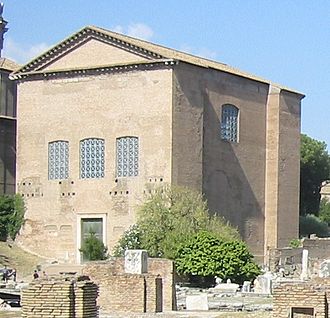
The Curia Julia in the Roman Forum, the seat of the imperial Senate

The Curia Julia in the Roman Forum, the seat of the imperial Senate

The Palazzo Senatorio, originally built to house the revived Senate during the Roman Commune period

The Palazzo Senatorio, originally built to house the revived Senate during the Roman Commune period

Representation of a sitting of the Roman senate: Cicero attacks Catiline, from a 19th-century fresco in Palazzo Madama, Rome, house of the Italian Senate. It is worth noting that idealistic medieval and subsequent artistic depictions of the Senate in session are almost uniformly inaccurate. Illustrations commonly show the senators arranged in a semicircle around an open space where orators were deemed to stand; in reality the structure of the existing Curia Julia building, which dates in its current form from the Emperor Diocletian, shows that the senators sat in straight and parallel lines on either side of the interior of the building. In modern media depictions in film this is shown correctly in The Fall of the Roman Empire, and incorrectly in, for example, Spartacus.

Representation of a sitting of the Roman senate: Cicero attacks Catiline, from a 19th-century fresco in Palazzo Madama, Rome, house of the Italian Senate. It is worth noting that idealistic medieval and subsequent artistic depictions of the Senate in session are almost uniformly inaccurate. Illustrations commonly show the senators arranged in a semicircle around an open space where orators were deemed to stand; in reality the structure of the existing Curia Julia building, which dates in its current form from the Emperor Diocletian, shows that the senators sat in straight and parallel lines on either side of the interior of the building. In modern media depictions in film this is shown correctly in The Fall of the Roman Empire, and incorrectly in, for example, Spartacus.

The so-called "Togatus Barberini", a statue depicting a Roman senator holding the imagines (effigies) of deceased ancestors in his hands; marble, late 1st century BC; head (not belonging): mid-1st century BCImage by Carlo Dell'Orto, licensed under Creative Commons Attribution-Share Alike 4.0

The so-called "Togatus Barberini", a statue depicting a Roman senator holding the imagines (effigies) of deceased ancestors in his hands; marble, late 1st century BC; head (not belonging): mid-1st century BC

The Curia Julia in the Roman Forum, the seat of the imperial Senate

The Curia Julia in the Roman Forum, the seat of the imperial Senate

The Palazzo Senatorio, originally built to house the revived Senate during the Roman Commune period

The Palazzo Senatorio, originally built to house the revived Senate during the Roman Commune period

Significant Senators

Many famous senators left their mark in history! ๐Ÿ—บ๏ธ One of the most known was Julius Caesar, who was a brave military leader and changed Rome forever. Another important senator was Cicero, who was a great speaker and wrote many beautiful speeches. Then, we have Cato, who always stood up for what he believed in. These leaders helped shape laws and ways of thinking in ancient Rome. Their stories are still told today, reminding us of their contributions to history. Each of these senators made decisions that impacted the lives of many Romans!

Decline Of The Senate

Over time, the Senate lost much of its power. ๐Ÿ“‰By the 3rd century AD, emperors ruled with an iron fist and made decisions without consulting senators. Many senators became more like advisors rather than lawmakers. The Senate struggled to keep its influence as new challenges arose, such as invasions and economic problems. Eventually, the Senate became less important, and its meetings became rare. However, even in decline, it continued to represent some traditions of Roman governance. The once-great Senate became a shadow of its former self as changes swept across the Empire.

Legacy Of The Roman Senate

The Roman Senate left a wonderful legacy! ๐ŸŒIt was one of the first examples of a governing body that helped balance the power between leaders and the people. Many ideas about law and politics from the Senate still influence governments today. For instance, todayโ€™s parliaments often have similar roles in decision-making. The Senate taught values of debate, discussion, and teamwork that we still use in modern politics. Its history shows how important it is for leaders to listen to their citizens. The Senate remains an exciting part of Rome's rich history!

Structure And Organization

The Roman Senate had a special way of organizing its members. ๐Ÿคต๐Ÿ‘จโ€โš–๏ธ It started with 100 senators, but this number grew to around 900 over time! Senators were chosen from powerful families and often served for life! Meetings were held to discuss important issues. The leader of the Senate was called the Consul, who guided the discussions. Senators wore special togas to show their status. The senate had various committees to handle different topics, like finances or military issues. This organization helped senators focus on what mattered most to the Roman people!

History Of The Roman Senate

The Roman Senate started back when Rome was just a small village. ๐Ÿ›๏ธ In 509 BC, after the last king was overthrown, the Senate was officially formed. It represented the wealthy families of Rome, called patricians. For many centuries, senators discussed and made decisions about the city. Some famous senators lived during the Punic Wars (264-146 BC), a time when Rome fought against Carthage! The Senate grew in importance, especially during the Republic when everyone wanted a voice in the decisions. It was a place for debate and discussion on what was best for Rome and its people.

Powers And Responsibilities

The Roman Senate had many important jobs! ๐Ÿฅ‡They helped create laws and advised the Consuls on what to do. They controlled money and decided how to spend it on things like roads, temples, and the army. Sometimes, they even made decisions about going to war! Senators would debate issues, and they needed to work together to find solutions. They also could provide advice to future leaders. Their main responsibility was to ensure Rome was strong and safe, making their role in the government crucial for everyone living in the city!

Senate And The Roman Republic

The Senate was a crucial part of the Roman Republic! ๐Ÿ‡ฎ๐Ÿ‡น When the Republic began in 509 BC, the Senate became a powerful force. It worked alongside elected officials to create laws. Senators were respected leaders in society and represented the wealthy families who helped Rome grow. People looked to the Senate for guidance during tough times, like wars or economic struggles. The Senate also helped protect the rights of citizens. Although the Senate had great power, they had to listen to the voices of the people, balancing their interests within the Republic!

Senate During The Roman Empire

As Rome grew into an empire, the Senate changed too! ๐Ÿ›๏ธ During the time of emperors, like Augustus, the Senateโ€™s power started to decline. Emperors held the real authority and made most of the important decisions. Even so, senators still advised the emperor and played a role in governance. Some emperors listened to the Senate's advice, while others ignored them. Many senators were still important figures, helping to keep Roman traditions alive. The Senate experienced a mix of power and restrictions, showing how it adapted during the Empire's expansion!

Political Influence And Decision-making

Senators had a lot of power in ancient Rome! ๐Ÿ’ชThey influenced leaders and were key in decision-making. When issues arose, senators would meet to discuss their ideas. They shared their thoughts and tried to convince each other to support their plans. This was all about teamwork! Sometimes, the Senate could disagree, creating exciting debates. Their decisions could change laws or create new ones, which made Senate meetings important for every Roman citizen. So their ability to work together shaped Romeโ€™s future and helped guide the Republic!

Comparative Analysis With Modern Legislatures

Today, many countries have legislatures that are similar to the Roman Senate! ๐Ÿ›๏ธ In the U.S., Congress has two parts: the Senate and the House of Representatives. Just like the Roman Senate, these modern groups discuss laws and advise the government. Senators today can serve for long terms and represent their states. The idea of having a group of leaders to help make decisions evolved from the Senate's practices. By comparing these institutions, we can see how ancient systems influenced our modern way of governing, allowing us to learn from history!

Roman Senate Quiz

Q1
Question 1 of 10

Learn more about Roman Senate

Ready to create?

Make

To create a safe space for kid creators worldwide!

Create

Vibe Coding

Kids GPT

All Tools

Kibu

Resources

Worksheets

SafeTube

Blog

FAQ

Account

Pricing

Log-in

Sign-up

Data Deletion

Company

About

Community Guidelines

Privacy Policy

Terms of Service

2025, URSOR LIMITED. All rights reserved. DIY is in no way affiliated with Minecraftโ„ข, Mojang, Microsoft, Robloxโ„ข or YouTube. LEGOยฎ is a trademark of the LEGOยฎ Group which does not sponsor, endorse or authorize this website or event. Made with love in San Francisco.