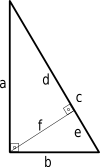
A right triangle is a type of triangle that contains one right angle (90 degrees) and is characterized by its relationship between side lengths and angles, making it essential for various applications in mathematics and real-world scenarios.
Set reading age
View for Kids
Easy to read and understand
View for Students
Clear, detailed explanations
View for Scholars
Deep dives and big ideas
Welcome to the world of right triangles! 🌟A right triangle is a special type of triangle that has one angle measuring exactly 90 degrees, which is known as a right angle. Imagine a corner of a piece of paper; that’s a right angle! Right triangles are everywhere, from the rooftops of houses to the ramps we see at parks. They help us understand shapes and are important in math, engineering, and even in nature. So, let's dive deeper into this exciting shape! 📐✨
Solving right triangles means finding unknown side lengths or angles! 🔍If you know one side and one angle (besides the right angle), you can use the Pythagorean Theorem and trigonometric ratios to discover the others. For example, if you know one leg is 4 cm and the angle is 30 degrees, you can calculate the hypotenuse and the other leg. 📐It’s like a fun math puzzle that you can solve!
The Pythagorean Theorem is a magic formula for right triangles! 🪄It states that if you take the length of the hypotenuse (the longest side) and square it (multiply it by itself), it will equal the sum of the squares of the other two sides. Mathematically, it's written as: a² + b² = c², where c is the hypotenuse and a and b are the other two sides. 📏This famous theorem helps builders, architects, and even pilots navigate their designs!
There are two main types of right triangles based on the lengths of their sides! The first type is called an isosceles right triangle, where the two legs are equal in length. ✏️ For example, if each leg is 5 cm, they look like a perfect triangle! The second type is called a scalene right triangle where all three sides have different lengths. 🌟So, whether the legs are equal or not, as long as it has that 90-degree angle, it's a right triangle!
Right triangles have some fascinating properties! 🥳One important property is that the sum of all three triangle angles is always 180 degrees! So, if one angle is 90 degrees, the other two must equal 90 degrees together. 😮Also, in a right triangle, the square of the length of the hypotenuse is equal to the sum of the squares of the lengths of the other two sides. This is a special relationship that helps us solve many problems in math!
A right triangle has three sides: the longest side is called the hypotenuse, and the other two are called legs. 🤔One leg is usually vertical, while the other is horizontal. When the legs are put together, they form that special right angle. To check if a triangle is a right triangle, just find a 90-degree angle! If it has one, it’s a right triangle! 🌈Remember, right triangles are unique and are used in many cool calculations!
Right triangles are useful everywhere! They help engineers build bridges, make ramps, and design buildings. 🏗️ For example, when creating a ramp for wheelchairs, right triangles ensure it’s safe and comfortable to use. They also appear in sports, like helping players figure out the best angle to shoot a basketball! 🏀So, that simple triangle plays a big role in many exciting fields of life!
Right triangles pop up all around us! 🌍Have you ever seen a ladder against a wall? It forms a right triangle between the ground, the wall, and the ladder itself! 🔼Sailboats use right triangles to measure their sails, and roofs of houses definitely have some right triangles in their structure. Even in video games, characters often jump at right angles! 🎮Look around, and you’ll discover right triangles everywhere, just waiting for you to spot them!
Trigonometric ratios help us understand the angles and sides of right triangles! 🤓There are three main ratios: sine (sin), cosine (cos), and tangent (tan). For a right triangle, sine is the ratio of the length of the opposite side to the hypotenuse. Cosine is the adjacent side to the hypotenuse, and tangent is the opposite side to the adjacent side. ✏️ These ratios help with finding missing angles and sides!


DIY is a creative community where kids draw, build, explore ideas, and share.
No credit card required