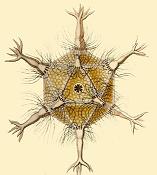
Radiolaria, also called Radiozoa, are tiny, unicellular eukaryotes found in ocean environments, known for their beautiful silica shells and role in marine ecosystems.

Set reading age
View for Kids
Easy to read and understand
View for Students
Clear, detailed explanations
View for Scholars
Deep dives and big ideas
Radiolaria, or Radiozoa, are tiny, single-celled organisms that can be found in the water 🌊. They measure about 0.1 to 0.2 millimeters in size, which is smaller than a grain of sand! These little creatures come in beautiful shapes, often resembling intricate glass sculptures! 🌟Most live in the ocean, helping to create the fascinating underwater world we see today. They need to be seen under a microscope to appreciate their stunning forms and patterns. There are over 6,000 known species of Radiolaria, making them exciting subjects for scientists to study! 🦠
With over 6,000 known species of Radiolaria, they showcase a fantastic variety! 🎨Some are beautifully symmetrical, while others have unique shapes that make them stand out. They can be divided into two main groups: the "polycystine" with ornate silica tests and the "pachycystine," which have simpler designs. This diversity allows them to adapt to many marine environments, from shallow waters to the deep ocean. 🌊Exploring these different species helps scientists understand how life on Earth has evolved! Radiolaria’s diverse forms make them an exciting topic for study! 🔍
Radiolaria are great at catching tiny food particles from the water, like bacteria and plankton! 🦠They use their pseudopodia (the hair-like arms) to create a sticky net that traps food, much like a fisherman using a net. 🌊The pseudopodia can stretch out to grab food and bring it back into the cell to eat. This feeding strategy is quite effective and allows them to survive in sometimes challenging ocean environments. With these clever techniques, Radiolarians are skilled at finding meals to sustain their tiny bodies! 🍽️
Radiolaria play an essential role in ocean ecosystems! 🌊As tiny creatures, they contribute to the movement of nutrients through the water, helping larger animals survive. When Radiolarians die, their silica shells sink to the ocean floor and create sediment. 🏴☠️ These shells help form rock structures called siliceous ooze, which is important for ocean health. Moreover, Radiolarians are a food source for larger marine animals like fish and whales! 🐋By supporting food chains, they help maintain a healthy underwater environment everywhere they go!
Radiolaria reproduce mainly through a process called binary fission, which means they split in half to create two identical cells! 🌱This method allows them to multiply quickly. Some Radiolarians also reproduce sexually, where two cells join together to create offspring! 👫This combination of asexual and sexual reproduction helps them survive in different environments. By adopting different strategies, Radiolaria can adapt, grow, and ensure their populations thrive in the vast oceans! Their amazing ability to reproduce helps keep them abundant in marine ecosystems!
Radiolaria mainly live in the ocean 🌊, from the warm surface waters to the deep-sea realms! You can find them in many oceans around the world, including the Pacific and Atlantic Oceans. 🌏They thrive in areas with plenty of sunlight, like coastal regions, where they can get energy from the sun! These tiny creatures play a big role in the ocean’s food web, helping to feed larger organisms. Some even live in the deep sea, where they face harsh conditions. Thus, these little wonders come in various types and habitats! 🎉
Radiolaria have unique shapes that look like stars ⭐, spirals, or even tiny jellyfish! Each has a hard, glass-like shell called a test, made of silica. This test helps protect them! 🛡️ The inside of a Radiolarian has a jelly-like substance called cytoplasm where all the cellular activities happen. They also have tiny hair-like structures called pseudopodia that help them move and catch food. 🐟Radiolarians come in different sizes and designs, showcasing nature's creativity! Each species has its own special look, making them fun to study for scientists and nature lovers!
Scientists love studying Radiolaria because they provide insights into marine ecosystems and climate change! 📈Researchers look at Radiolaria fossils to learn about ancient ocean conditions, helping us understand how our planet has changed over time. Through studies, they can track how ocean health and life respond to shifting climate patterns. 🌡️ Healthier Radiolaria populations indicate strong marine ecosystems, whereas decreases can signal trouble ahead! Their unique qualities make them essential in scientific research, helping protect our oceans for the future! 🌍
Climate change is affecting Radiolaria and their ocean habitat. 🌡️ Rising temperatures and ocean acidification, caused by increased carbon dioxide, can harm their silica shells. This means that fewer Radiolaria may survive in the future, which can impact the rest of the ocean food web! 🐠Changes in ocean temperatures can also shift where these tiny organisms live and how they reproduce. Scientists are closely monitoring these changes because Radiolaria are like indicators of ocean health. Protecting our planet will ensure these fascinating creatures continue to thrive! 🌱
Radiolaria have been around for millions of years! 🦕Their tiny glass shells leave behind fossils, which scientists discover in rocks today. These fossils provide important information about Earth’s history, showing us how oceans have changed over time. They help scientists learn about past climates and environments! 🌍Radiolarian fossils can be found in sedimentary rocks and are sometimes used in oil drilling to find buried oil deposits. The study of these ancient shells helps researchers understand our planet's geological past, making Radiolaria superstars of scientific research! 📚
Radiolaria have inspired artists and cultures through their unique shapes and beauty! 🎨Their intricate silica shells are often depicted in art pieces, jewelry, and crafts. Some scientists even consider them so beautiful that they compare them to art! 🌌For example, famous naturalists like Ernst Haeckel illustrated Radiolaria in the 19th century, showcasing their forms in stunning artwork. The mystery and beauty of Radiolaria capture our imagination, leading many to appreciate these tiny organisms both in science and the arts! 🌟


DIY is a creative community where kids draw, build, explore ideas, and share.
No credit card required