Pythagoras was an ancient Greek mathematician and philosopher best known for his contributions to mathematics, particularly the Pythagorean theorem.

Set reading age
View for Kids
Easy to read and understand
View for Students
Clear, detailed explanations
View for Scholars
Deep dives and big ideas
Pythagoras was a smart thinker from ancient Greece, born around 570 BC on the island of Samos. 🌅He loved math and believed that numbers held secrets about life! Pythagoras started a group called the Pythagoreans, where he taught his ideas about math, science, and even music! 🎶He is best known for something called the Pythagorean Theorem, which helps us understand right triangles. Imagine a triangle with one angle that’s a perfect corner! His ideas are still important today, making Pythagoras a very cool guy in the world of math! 📏✨
Pythagoras's ideas changed the world! 🌍His work is still taught in schools everywhere, helping kids learn about math and its magic! ✨Many famous scientists and mathematicians, like Isaac Newton and Albert Einstein, were inspired by Pythagorean thoughts! 📏Pythagoras's teachings also influenced art, astronomy, and even religion! His belief that math could explain the universe affects our lives today, from buildings to music! 🎨🏰 So when you use math every day, think of Pythagoras and how his ideas shaped our world! 🎉📐
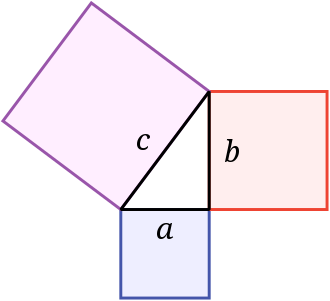
The Pythagorean Theorem is a special math rule for right triangles! 📐If you have a right triangle, one corner looks like an “L.” The rule says if you square the lengths of the two shorter sides (called legs), you get the same number as squaring the longest side (called the hypotenuse). The formula is: a² + b² = c²! 🌟For example, if one leg is 3 cm and the other is 4 cm, then 3² + 4² = 5² (because 9 + 16 = 25). This helps in construction and many other areas! 🏗️🛤️
Pythagorean triples are groups of three numbers that fit perfectly into the Pythagorean Theorem! 🌟The most famous triple is (3, 4, 5). When you use 3 and 4 as the legs of a triangle, 5 is the hypotenuse! 🎊Other good examples are (5, 12, 13) and (8, 15, 17). These sets of numbers help us find right triangles without measuring! 🥳Pythagorean triples are useful for architects and builders, making sure buildings have the right angles. They show how fun and magical math can be! ✨🔺
Pythagoras traveled a lot during his life, studying in Egypt and Babylon. 🇪🇬📜 He learned about math and science from different cultures. Around 530 BC, he settled in Italy and founded a school! 🏫Pythagoras taught his students many things, but he especially liked to teach them about numbers and shapes. People said he could even talk to numbers like they were friends! 👩🏫 He believed that understanding math could lead to a better life and even happiness. Pythagoras died around 495 BC, but his ideas are still remembered today! 🌍💫
Pythagoras wasn't just about numbers; he liked to think deeply! 💭He believed math was the key to understanding the universe. Pythagoras and his followers thought everything in the world could be explained through numbers! 🌌They even believed that the universe was built on harmony. Pythagoras taught that living a good life meant understanding and respecting these mathematical principles, like balance and order. ⚖️ His ideas led to the study of philosophy, helping future thinkers explore questions about life, reality, and knowledge! Philosophy and math became best buddies thanks to him! 📚☀️
Pythagoras changed how people view math! 🎉Before him, math was mainly about counting and trade. His work opened up a whole world of geometry! 📊He introduced the idea that numbers can not only measure things but also explain shapes and patterns. This inspired many later mathematicians, including Euclid and Archimedes, who learned from his ideas. 📖✍️ Thanks to Pythagoras, we now have lots of fun math concepts such as fractions, ratios, and even theories about infinity! 🌀His influence means math is everywhere we look!
Pythagoras and his followers, known as the Pythagoreans, formed a close-knit community. 🧑🤝🧑 They believed in the importance of living a disciplined life and practicing harmony. One of their big ideas was that everything in the universe was connected through numbers! 🌌Pythagoreans also believed in reincarnation, which means they thought souls could be born again in new forms. They even had secret handshakes and rituals! 🤝🔒 This made belonging to their group special. They shared knowledge, practiced math, and encouraged each other to be better people. It's a fun mix of math and friendship! 🌟🥳
Did you know Pythagoras loved music too? 🎵He noticed something special about sounds. When you play notes that are a certain distance apart, they create harmony! Pythagoras studied how different musical intervals relate to numbers. 🎼For example, if you double a string's length, you get a sound a little higher! 🎶This idea is the basis for scales and harmony in music. His theories helped musicians understand how to make beautiful music, showing that math and music are connected! Now, every time you sing or play, you can thank Pythagoras! 🎤🎸
📏 Pythagoras is best known for the Pythagorean theorem, which relates the lengths of the sides of a right triangle.
🔭 He founded a philosophical and religious school known as the Pythagorean School in Croton, Italy.
🎶 Pythagoras believed that mathematics could explain musical harmony, famously relating the lengths of strings to pitch.
🌌 He contributed to the understanding of the cosmos, asserting that the Earth is a sphere and the center of the universe.
📜 Pythagoras is often credited with the idea that 'all is number,' emphasizing the importance of numerical relationships.
🧘♂️ He practiced a way of life that included communal living, vegetarianism, and strict rules for his followers.
🔢 Pythagorean triples, sets of three integers that satisfy the Pythagorean theorem, are named in his honor.
✈️ Pythagoras' ideas laid the groundwork for future mathematicians and philosophers, influencing Plato and Euclid.
⚖️ He introduced the concept of mathematical proof, helping to establish logic in mathematical reasoning.
🌱 Pythagoras is sometimes considered one of the first mathematicians to explore the relationship between numbers and nature.


DIY is a creative community where kids draw, build, explore ideas, and share.
No credit card required