All Articles

Penicillin

Penicillin Facts For Kids

Penicillins are a group of β-lactam antibiotics originally obtained from Penicillium moulds, principally P, and are used to treat various bacterial infections.

🎨 Reading age for 6-8
Background blob
Penicillin
Penicillin
Facts for Kids!

Do more with AI

Introduction

Penicillin is a special medicine that helps us fight germs! 🦠It was discovered from a type of mold called Penicillium. This incredible medicine can stop infections caused by bacteria, which are tiny germs that can make us sick. Penicillin is one of the first antibiotics ever found, and it has saved millions of lives since its discovery. Do you know that even a little bit of penicillin can be a superhero against harmful bacteria? 🦸‍♂️ It’s cool that something from nature, like mold, can protect us and keep us healthy!

Images of Penicillin

Chemical structure of Penicillin G. The sulfur and nitrogen of the five-membered thiazolidine ring are shown in yellow and blue respectively. The image shows that the thiazolidine ring and fused four-membered β-lactam are not in the same plane.

Chemical structure of Penicillin G. The sulfur and nitrogen of the five-membered thiazolidine ring are shown in yellow and blue respectively. The image shows that the thiazolidine ring and fused four-membered β-lactam are not in the same plane.

Gram-negative bacteria that attempt to grow and divide in the presence of penicillin fail to do so, and instead end up shedding their cell walls.[52]Image by Shudde, licensed under Creative Commons Attribution-Share Alike 3.0

Gram-negative bacteria that attempt to grow and divide in the presence of penicillin fail to do so, and instead end up shedding their cell walls.[52]

Penicillin and other β-lactam antibiotics act by inhibiting penicillin-binding proteins, which normally catalyse cross-linking of bacterial cell walls.Image by Mcstrother, licensed under Creative Commons Attribution 3.0

Penicillin and other β-lactam antibiotics act by inhibiting penicillin-binding proteins, which normally catalyse cross-linking of bacterial cell walls.

Sample of penicillium mould presented by Alexander Fleming to Douglas Macleod, 1935Image by Science Museum London / Science and Society Picture Library, licensed under Creative Commons Attribution-Share Alike 4.0

Sample of penicillium mould presented by Alexander Fleming to Douglas Macleod, 1935

Howard Florey (pictured), Alexander Fleming and Ernst Chain shared a Nobel Prize in Physiology or Medicine in 1945 for their work on penicillin.

Howard Florey (pictured), Alexander Fleming and Ernst Chain shared a Nobel Prize in Physiology or Medicine in 1945 for their work on penicillin.

A lab technician spraying penicillin mould into flasks of corn steep liquor, England, 1943

A lab technician spraying penicillin mould into flasks of corn steep liquor, England, 1943

A World War II-era poster from a construction site for a penicillin factory. A military grave emphasizes the site's importance, as penicillin was urgently needed in wartime.

A World War II-era poster from a construction site for a penicillin factory. A military grave emphasizes the site's importance, as penicillin was urgently needed in wartime.

Photos of Penicillin
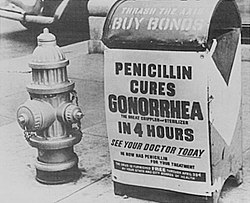
A poster attached to a curbside mailbox offering advice to World War II servicemen: Penicillin cures gonorrhea in 4 hours .
A poster attached to a curbside mailbox offering advice to World War II servicemen: Penicillin cures gonorrhea in 4 hours .

Photos of Penicillin
Chemical structure of Penicillin G. The sulfur and nitrogen of the five-membered thiazolidine ring are shown in yellow and blue respectively. The image shows that the thiazolidine ring and fused four-membered β-lactam are not in the same plane.

Chemical structure of Penicillin G. The sulfur and nitrogen of the five-membered thiazolidine ring are shown in yellow and blue respectively. The image shows that the thiazolidine ring and fused four-membered β-lactam are not in the same plane.

Gram-negative bacteria that attempt to grow and divide in the presence of penicillin fail to do so, and instead end up shedding their cell walls.[52]Image by Shudde, licensed under Creative Commons Attribution-Share Alike 3.0

Gram-negative bacteria that attempt to grow and divide in the presence of penicillin fail to do so, and instead end up shedding their cell walls.[52]

Penicillin and other β-lactam antibiotics act by inhibiting penicillin-binding proteins, which normally catalyse cross-linking of bacterial cell walls.Image by Mcstrother, licensed under Creative Commons Attribution 3.0

Penicillin and other β-lactam antibiotics act by inhibiting penicillin-binding proteins, which normally catalyse cross-linking of bacterial cell walls.

Sample of penicillium mould presented by Alexander Fleming to Douglas Macleod, 1935Image by Science Museum London / Science and Society Picture Library, licensed under Creative Commons Attribution-Share Alike 4.0

Sample of penicillium mould presented by Alexander Fleming to Douglas Macleod, 1935

Howard Florey (pictured), Alexander Fleming and Ernst Chain shared a Nobel Prize in Physiology or Medicine in 1945 for their work on penicillin.

Howard Florey (pictured), Alexander Fleming and Ernst Chain shared a Nobel Prize in Physiology or Medicine in 1945 for their work on penicillin.

A lab technician spraying penicillin mould into flasks of corn steep liquor, England, 1943

A lab technician spraying penicillin mould into flasks of corn steep liquor, England, 1943

A World War II-era poster from a construction site for a penicillin factory. A military grave emphasizes the site's importance, as penicillin was urgently needed in wartime.

A World War II-era poster from a construction site for a penicillin factory. A military grave emphasizes the site's importance, as penicillin was urgently needed in wartime.

Photos of Penicillin
A poster attached to a curbside mailbox offering advice to World War II servicemen: Penicillin cures gonorrhea in 4 hours .

A poster attached to a curbside mailbox offering advice to World War II servicemen: Penicillin cures gonorrhea in 4 hours .

Photos of Penicillin

Impact On Medicine

Penicillin has had a huge impact on medicine and our lives! 🏥Before it was discovered, many infections caused serious problems, and people often got very sick. Penicillin changed all that, helping to cure diseases and save countless lives. 🌍It not only helps people who are sick but also makes surgeries safer! With the power of penicillin, doctors can treat infections quickly, which keeps patients safe. Thanks to this amazing discovery, we can enjoy healthier lives and go back to doing things we love sooner! 🎉

Mechanism Of Action

Penicillin works like a little soldier! ⚔️ It attacks bacteria by breaking down their walls, making them weak. You can think of bacteria as tiny balloons filled with air. 🎈When penicillin gets in, it pops the balloons! Without strong walls, bacteria can't survive, and they die. This means that the infection can go away, and a person can feel better! Doctors give penicillin through a shot or as a pill, so the medicine can reach the bacteria quickly. It’s like sending in a rescue team to save the body from those nasty germs! 🏥

Types Of Penicillin

There are different types of penicillin, each designed to fight different germs! 🦠Some well-known types include penicillin G and penicillin V. Penicillin G is often used in hospitals and is very powerful. 🏨It's given through injections. On the other hand, penicillin V can be taken as a pill, which makes it easier for people to take at home. There are also other penicillins, like amoxicillin, which is one of the most commonly used and is great for fighting infections like strep throat. 🎤Each type of penicillin has its own special job to do in keeping us healthy!

Future Of Antibiotics

Scientists are always working on new antibiotics like penicillin! 🔬They want to find better medicines to fight germs that are becoming resistant. Some researchers are looking into using other molds or even plants! 🌿There’s also a push to educate everyone on the importance of using antibiotics responsibly. That way, we can keep antibiotics working for a long time! The future of antibiotics looks promising, and we can’t wait to see what new discoveries will help keep us healthy in the years to come! 🚀

History Of Penicillin

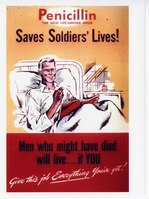
Penicillin was discovered in 1928 by a scientist named Alexander Fleming. 🧪While working in his lab in London, he noticed that a mold called Penicillium notatum was killing bacteria in one of his petri dishes. This amazing discovery led to the development of the first antibiotic. By the 1940s, doctors started using penicillin to treat sick soldiers during World War II. 🌍It was a game-changer! People who had serious infections were suddenly able to get better thanks to this incredible medicine. Fleming’s work helped save many lives, making penicillin a true hero of medicine! 🎖️

Resistance To Penicillin

Some bacteria can outsmart penicillin and become resistant! 🦠💪 This means that the medicine doesn’t work on them anymore. It’s like a game of hide-and-seek; these sneaky bacteria find a way to hide from penicillin! This resistance can happen if people don’t take their antibiotics properly, like not finishing all their medicine. 🍽️ It's important to always follow the doctor’s instructions when taking penicillin. Scientists are always looking for new ways to stay ahead of these tricky bacteria. Together, we can keep our bodies healthy and help fight against infections! 🦸‍♀️

Side Effects And Allergies

Sometimes, taking penicillin can cause some side effects! 😟Not everyone will have problems, but some people might feel sick to their stomach or get a rash on their skin. A very small number of people may also have an allergy to penicillin, which can make them feel itchy or have trouble breathing. 🚨If that happens, they should see a doctor right away. That's why it’s important for people to tell their doctors if they have had any reactions to medicines in the past. Doctors make sure everyone gets the right treatment without any problems!

Medical Uses And Applications

Penicillin is used to help treat many kinds of infections. 🏥It works against illnesses like pneumonia (which affects our lungs), strep throat, and skin infections! 🩹Doctors often prescribe penicillin when they find bacteria that can be fought with this medicine. It's really important because before antibiotics like penicillin, many people got very sick and didn't have a way to get better. Thanks to penicillin, we have a powerful tool to fight off these infections! 🌟With penicillin's help, we can recover and play again soon!

Penicillin Production And Harvesting

Penicillin is made from the mold Penicillium! 🍄Farmers grow this mold in big containers called bioreactors. Then, the mold produces the penicillin, which is collected through special processes. Scientists carefully monitor the conditions like temperature and food for the mold to thrive. 🌡️ After the mold does its job, chemists purify the penicillin to make sure it’s safe for people to use. This fascinating process shows how we can take something from nature, like mold, and turn it into a lifesaving medicine to help us fight germs! ⚗️

Penicillin Quiz

Q1
Question 1 of 10

Learn more about Penicillin

Ready to create?

Make

To create a safe space for kid creators worldwide!

Create

Vibe Coding

Kids GPT

All Tools

Kibu

Learn

Worksheets

Courses

Skills

Resources

SafeTube

Blog

FAQ

Pricing

Account

Log-in

Sign-up

Data Deletion

Company

About

Community Guidelines

Privacy Policy

Terms of Service

2025, URSOR LIMITED. All rights reserved. DIY is in no way affiliated with Minecraft™, Mojang, Microsoft, Roblox™ or YouTube. LEGO® is a trademark of the LEGO® Group which does not sponsor, endorse or authorize this website or event. Made with love in San Francisco.