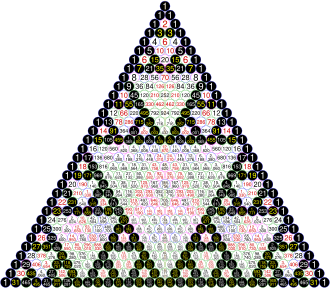
Pascal's Triangle is a triangular array of numbers where each number is the sum of the two directly above it, representing binomial coefficients.

Set reading age
View for Kids
Easy to read and understand
View for Students
Clear, detailed explanations
View for Scholars
Deep dives and big ideas
Pascal's Triangle is a special arrangement of numbers that looks like a triangle! 🟡It starts with the number 1 at the top. Each number below it is made by adding the two numbers directly above it. For example, the second row is made of two 1s, and the third row has the numbers 1, 2, and 1. This triangle grows bigger and bigger, and it can help with lots of math ideas! 🎉
Did you know that Pascals' Triangle is everywhere? 🌍It even helps find Fibonacci numbers! If you add the diagonals, you get numbers from the Fibonacci sequence (1, 1, 2, 3, 5, 8,...). Also, in the year 2023, mathematicians are still discovering new things about Pascal's Triangle! Keep your eyes open for patterns and use it to solve your math problems! ✨
Pascal's Triangle is special because of its magical math properties! 🪄Each number in the triangle is the sum of the two numbers directly above it. The first few rows look like this:
```
1
1 1
1 2 1
1 3 3 1
```
As you go down the rows, the numbers get bigger! You can also find patterns like even and odd numbers, and how the edges of the triangle are always 1. 🎈
One of the fun things about Pascal's Triangle is its patterns and symmetries! 💖If you fold it in half, the left side matches the right side perfectly! You also can see diagonal patterns: the first diagonal shows all 1s, the second shows counting numbers (1, 2, 3...), and the third gives us triangular numbers (1, 3, 6...). Patterns make math exciting! 🌈
Pascal's Triangle was named after a French mathematician named Blaise Pascal, who lived in the 17th century. 🇫🇷 But did you know that it was known in many cultures before him? Chinese mathematicians were using it back in 130 AD! 📜The triangle has been discovered and used by people all around the world, including Indians and Persians. They all created their own versions before Pascal made it famous!
Combinatorics is a fancy word for counting different groups or arrangements! 🎲Pascal's Triangle helps us figure out how many ways we can choose things. For example, if you have 4 friends and want to choose 2 to go to the park, you can use the triangle to find that there are 6 ways! The numbers in the triangle tell you how many combinations you can make.
In probability, we use Pascal's Triangle to understand chance. 🎰For example, if you flip a coin 4 times, the triangle helps you figure out how likely it is to get heads or tails! The numbers in the triangle tell us how many different ways each combination can occur. So, if you wanted 2 heads and 2 tails, you can find that there are 6 ways!
The numbers in Pascal's Triangle are also called Binomial Coefficients. 📊They help us solve problems like (a + b)² = a₂ + 2ab + b₂. The coefficients, or numbers, come from Pascal's Triangle! This means that the triangle helps with algebra, which is like using letters for numbers. Isn't that cool? 🎓
Believe it or not, Pascal's Triangle is important in computer science too! 💻Programmers use it to analyze algorithms, which are step-by-step guides to solving problems. It helps organize data structures and keeps track of different combinations when calculating. So, when you play games or use apps, Pascal's Triangle is often working behind the scenes! 🎮


DIY is a creative community where kids draw, build, explore ideas, and share.
No credit card required