Okapi Facts For Kids
The okapi is a unique mammal known for its distinct stripes and close relation to the giraffe, primarily found in the rainforests of central Africa.
Select reading age

Okapi Facts For Kids
Videos & Quizzesincluded
About this topic
The okapi is a fascinating mammal found in the rainforests of the Democratic Republic of the Congo 🌳. This remarkable creature looks like a mix between a zebra and a giraffe due to its long neck and striped legs. Scientists discovered the okapi as a unique species in 1901, although local people had known about it for centuries! The okapi is known for its graceful movements and gentle nature. Adults can weigh between 440 to 700 pounds (200 to 320 kg) and stand about 4 to 5 feet (1.2 to 1.5 meters) tall at the shoulder. It's truly a wonder of the animal kingdom!
Explore with ChatDinoKey Points
Here are some fun facts about okapis: 1.
The okapi is listed as an endangered species 🌿 by the International Union for Conservation of Nature (IUCN).
The okapi is an important symbol in the culture of the Congo!
The okapi was discovered by scientists in the early 20th century, specifically by Sir Harry Johnston, a British explorer 🌍.
Okapis live in the lush rainforests of the Congo Basin 🏞️.
Okapis have some incredible physical features that make them special!
Did you know that okapis are herbivores?
Okapis have a very special way of having babies!
Photos of Okapi

Okapi — photo 1

Illustration from an original painting by Sir Harry Johnston, based on preserved skins (1901)

Despite the vast difference in neck length, the okapi (left) and the giraffe (right) both have seven cervical vertebrae (as do all mammals except for manatees and sloths).

Male okapi displaying his striking horizontal stripes

Head of a male okapi with damaged ossicones

The long tongue of the okapi
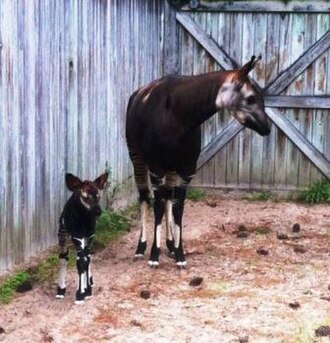
A female okapi with her calf at White Oak Conservation

Okapi at Disney's Animal Kingdom
🌿 Fun Facts
Here are some fun facts about okapis:
1. Secretive Creatures: Okapis are shy and prefer to stay hidden in the dense forest. You might not see one on your first visit! 🌿
2. Long Tongue: Their tongue is not just long for reaching food; they use it to clean themselves too! 🦷
3. Relative of Giraffes: Even though they look like a cross between a zebra and a giraffe, okapis are actually more closely related to giraffes!
4. Communication: Okapis communicate with each other using low sounds called "bleats" and by making different facial expressions! 🐾
5. Stripes for Camouflage: Their striped legs help them hide in the forest from predators like leopards!
Go deeper1. Secretive Creatures: Okapis are shy and prefer to stay hidden in the dense forest. You might not see one on your first visit! 🌿
2. Long Tongue: Their tongue is not just long for reaching food; they use it to clean themselves too! 🦷
3. Relative of Giraffes: Even though they look like a cross between a zebra and a giraffe, okapis are actually more closely related to giraffes!
4. Communication: Okapis communicate with each other using low sounds called "bleats" and by making different facial expressions! 🐾
5. Stripes for Camouflage: Their striped legs help them hide in the forest from predators like leopards!
🌿 Conservation Status
The okapi is listed as an endangered species 🌿 by the International Union for Conservation of Nature (IUCN). Their numbers have decreased significantly due to habitat loss, poaching, and civil unrest in their native areas. It's estimated that fewer than 20,000 okapis remain in the wild! Protecting the rainforests and supporting conservation efforts is crucial for their survival. Many organizations are working hard to raise awareness and help preserve this unique animal before it's too late!
Go deeper🌍 Cultural Significance
The okapi is an important symbol in the culture of the Congo! 🌍In many local tribes, it represents mystery and beauty due to its unique appearance. The okapi is also featured in art, folktales, and traditional stories. It’s sometimes called the "zebra giraffe," a name that shows how unique it is! Wild okapis have become a symbol for wildlife conservation because of their endangered status. Many schools and organizations teach about the okapi to inspire people to help protect this beautiful creature!
Go deeper🌍 Research And Discovery
The okapi was discovered by scientists in the early 20th century, specifically by Sir Harry Johnston, a British explorer 🌍. Before that, it was a mystery to the outside world! Scientists studied the okapi's bones, teeth, and even DNA to learn more about its connection with other animals, including the giraffe 🦒. Field studies in the rainforests are still ongoing to better understand the okapi’s behavior, habitat, and role in the ecosystem. Thanks to research, we know what we need to do to help protect these incredible animals and their rainforest homes!
Go deeper🏞️ Habitat And Distribution
Okapis live in the lush rainforests of the Congo Basin 🏞️. This area has many trees and thick foliage, providing the perfect shady hiding spots. They prefer to stay near rivers and streams, where they can find fresh water. The okapi is mainly found in protected areas like the Okapi Wildlife Reserve, which was created in 1992 to help save this unique animal! 🌍The rainforest is home to many other species too, making it an important natural habitat. Unfortunately, their habitat is shrinking due to deforestation and human activities.
Go deeper🦒 Physical Characteristics
Okapis have some incredible physical features that make them special! 🦒Their bodies are mostly brown, which helps them blend into the forest. They have large ears that can swivel independently, just like a rabbit's! 👂This helps them hear sounds from far away. The most striking feature is their legs, which have black and white stripes similar to those of zebras. These stripes help camouflage them in the dappled light of the forest! Overall, the okapi can reach a length of up to 8 feet (2.5 meters) from its head to its tail.
Go deeper🥬 Diet And Feeding Behavior
Did you know that okapis are herbivores? 🥬This means they only eat plants! Their diet mainly consists of leaves, fruits, and flowers from around 100 different types of plants. They are picky eaters and often choose the most nutritious leaves. Okapis have a long tongue (up to 12 inches) which helps them reach and grab food high in the trees 🌳. They can also eat tough plants that other animals can't! By munching on various plants, they help the forest stay healthy and diverse.
Go deeper💖 Reproduction And Lifespan
Okapis have a very special way of having babies! 💖Female okapis usually give birth to one calf after a gestation period of about 14-16 months. The calf is born with a light brown color, which changes to dark brown as it grows. Baby okapis can stand and walk just a few hours after birth! They will stay with their mothers for about a year before becoming independent. In the wild, okapis can live for 20 years, but in zoos, they might live even longer—up to 30 years!
Go deeper