Nova Facts For Kids
A nova is an astronomical event where a star suddenly brightens dramatically and then fades over weeks or months.
Select reading age
Nova Facts For Kids
Videos & Quizzesincluded
About this topic
Hey, young space explorers! 🚀Did you know that sometimes, when we look at the night sky, a star can suddenly get super bright and then fade away? This incredible event is called a "nova." The word "nova" means "new" in Latin. Novae (that's the plural!) can shine brightly for weeks or even months before going back to their normal brightness. They're not new stars; instead, they're exciting explosions in space, reminding us of the colorful fireworks in the sky! 🎆Keep your eyes peeled for these amazing light shows from outer space!
Explore with ChatDinoKey Points
There are different kinds of novae, which makes space super exciting!
A nova is like a cosmic surprise!
Humanity has been practicing stargazing for thousands of years!
Space scientists use telescopes to watch for novae happening in the sky!
Scientists are always asking questions about space and stars!
Stars are born, live, and die like us!
When a nova happens, it doesn't just light up the sky; it can also change its surroundings!
Nuclear fusion is pretty cool—it's how stars make energy!
You might be wondering how a nova compares to other cosmic events like supernovae!
Photos of Nova

Nova Eridani 2009 (apparent magnitude ~8.4)

GK Persei: Nova of 1901

Nova in Andromeda Galaxy
🌠 Types Of Novae
There are different kinds of novae, which makes space super exciting! 🌠The most common type is called "classical novae," which happens in binary star systems—where two stars are close together. Another type is "recurrent novae," which can happen several times, like a star that keeps coming back for more! 🌌Last but not least, there are "dwarf novae," which are versions that appear much more frequently but are less bright than classical novae. Each type of nova has its own special story in the universe!
Go deeper🌟 Definition Of A Nova
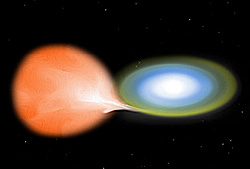
A nova is like a cosmic surprise! 🌟It happens when a white dwarf star, which is a tiny but super-hot star leftover from bigger stars, steals gas from a nearby star. When it gathers enough gas, a big explosion happens! This explosion makes the white dwarf shine extremely bright, almost like a new star appearing in the sky. Over time, the brightness fades, but don't worry, the white dwarf isn't gone forever! The event teaches us about how stars live and die, which is a cool part of space science!
Go deeper🌟 Historical Novae Observations
Humanity has been practicing stargazing for thousands of years! 🌟In 1054, ancient Chinese astronomers saw a bright nova in the constellation Taurus. This event was so bright that it could be seen during the day! Isn’t that amazing? 🐉They called it "Guest Star." This nova created the Crab Nebula, a super beautiful remnant we can see today! Many cultures kept records of these bright star explosions, helping scientists learn about our universe's history and the changes in the sky over time.
Go deeper🔭 Observational Evidence Of Novae
Space scientists use telescopes to watch for novae happening in the sky! 🔭When a nova occurs, it leaves behind some clues, like light and energy signatures. Astronomers take pictures and collect data to figure out what happened during the explosions. For example, in 1934, a nova called "Nova Herculis" was spotted and lit up the sky! ☄️ By keeping an eye on these bright stars, scientists learn more about how stars work and what makes them so magical!
Go deeper🔬 Future Research Directions On Novae
Scientists are always asking questions about space and stars! 🔬In the future, they want to learn more about how novae work and what happens during these explosions. Researchers use new technology, like powerful space telescopes, to catch more details about each nova event. 🌠They are also looking for more discoveries about how novae create new stars. By investigating these cosmic fireworks, scientists hope to unlock the mysteries of our universe and share the excitement of exploration with everyone! 🌌✨
Go deeper🌌 The Lifecycle Of A White Dwarf Star
Stars are born, live, and die like us! 🌌The lifecycle of a white dwarf star starts when a massive star burns its fuel and expands. Eventually, it shrinks and leaves behind its core, which becomes the white dwarf. This tiny star is about the size of Earth but super heavy! When this white dwarf pulls in gas from nearby stars, it can ignite in a nova explosion. This cycle continues in space, and the white dwarf's fate can change, leading to even bigger fireworks in the sky!
Go deeper🌌 Impact Of Novae On Surrounding Space
When a nova happens, it doesn't just light up the sky; it can also change its surroundings! 🌌The explosion sends out shockwaves, pushing gas and dust into space. These materials can spark the birth of new stars, kind of like spreading seeds to grow flowers! 🌻So, when a nova occurs, it's not just a pretty light show—it's helping to create new stars and heavenly bodies in the cosmos! How cool is that? Scientists study these impacts to understand star formation better!
Go deeper☀️ The Process Of Nuclear Fusion In Novae
Nuclear fusion is pretty cool—it's how stars make energy! ☀️ In a nova, the white dwarf star pulls in hydrogen gas from a partner star. This gas creates a lot of pressure and heat on the white dwarf's surface. When it gets hot enough, the hydrogen begins to fuse into helium, releasing energy like a massive firework! 💥This energy causes the white dwarf to brighten and explode, making the nova appear. Once the dust settles, the white dwarf can catch more gas and go through the process again!
Go deeper🌟 Comparison Of Novae To Other Stellar Explosions
You might be wondering how a nova compares to other cosmic events like supernovae! 🌟Supernovae are way brighter and happen when massive stars explode at the end of their lives. They can even create black holes or neutron stars! 💥In contrast, novae are smaller explosions from white dwarfs and don’t destroy the star. So think of a nova as a big firework, while a supernova is like a gigantic party finale! 🎉Both events teach us about the life and death of stars, making our universe an exciting place!
Go deeper