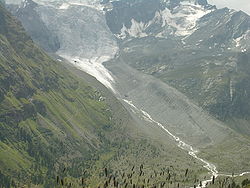
A moraine is an accumulation of debris left behind by glaciers, consisting of dirt, rocks, and other materials, which tells us about Earth's climatic history.
Set reading age
View for Kids
Easy to read and understand
View for Students
Clear, detailed explanations
View for Scholars
Deep dives and big ideas
A moraine is a pile of rocks and dirt that is left behind by glaciers. 🌨️ When glaciers move, they carry materials with them. When they melt, they drop those materials, forming a moraine. Moraines can be found in places where glaciers used to be. For example, in the United States, the Rocky Mountains have lots of moraines! They tell us about the history of the Earth and how glaciers have shaped our landscape. 📏Exploring moraines can be lots of fun—imagine finding rocks that have traveled thousands of miles!
There are different types of moraines, each named for where they are found! 🏔️ The first type is a terminal moraine, which forms at the end of a glacier. Another type is called a lateral moraine, which forms on the sides of a glacier. Finally, there's the ground moraine, which is a flatter area of debris left behind as a glacier melts. Each type tells a story about how the glacier moved and changed over time. 🌬️ Exploring these types can help us understand the big changes Earth has gone through!
Moraines form when glaciers move and grind up the ground beneath them. ❄️ The heavy ice carries rocks, soil, and gravel along for the ride. When the glacier starts to melt, it drops off all the materials it was carrying. This makes heaps of dirt and stones! 🌍Over time, these heaps become moraines. If you're wondering how big they can be, some moraines can be as tall as a two-story house! They come in different shapes depending on how the glacier moved and how fast it melted. So, moraines are like nature's trash piles left by glaciers!
Moraines are also crucial in understanding climate change! 🍂Scientists can analyze moraines to see how glaciers have shrunk over time due to warming temperatures. By studying the dirt and rocks in moraines, researchers learn about past and present climates. This helps people understand how the Earth is changing today! 🌍Climate change affects glaciers, and seeing how moraines change over time shows us how serious this issue is. So, moraines are like little time capsules showing the effects of our warming planet!
Moraines appear in stories and movies about nature! 🌲For example, in children's books focused on glaciers and the environment, moraines often play a role in describing beautiful landscapes. Some cartoons even showcase characters exploring moraines on their adventures! 🎒Additionally, documentaries about climate change discuss moraines to teach people about the Earth's changes. Moraines excite imaginations and encourage kids to learn more about nature while reminding everyone how vital these formations are to our planet!
Moraines play a big role in the ecosystem! 🌱The piles of rocks and soil create new habitats for plants and animals. As moraines are formed, the rocks provide nutrients that help new plants grow. 🌸These new plants attract animals, creating a whole new ecosystem. Some animals, like rabbits and deer, love to live in these areas. Also, moraines can create small ponds and streams as rainwater collects, which is great for many creatures. 🦆So, moraines help keep nature balanced and thriving!
Moraines are super important to geologists! They help scientists learn about Earth's history. 🌏By studying the layers of rocks and soil in moraines, scientists can find out how old a glacier is and how far it moved. Also, moraines are often a record of past climates. This helps us understand changes over thousands of years. 🕰️ In places like North America and Europe, researchers study moraines to see how glaciers once covered large areas. This information is crucial for understanding the Earth's climate today!
Moraines tell us important stories about Earth's history! 📜When Native Americans lived in North America, they noticed big piles of rocks and dirt left by glaciers. They used these areas for hunting and gathering food. 🏹In the 19th century, scientists began studying moraines to understand how glaciers shaped the land. Famous scientists like Louis Agassiz shared discoveries about glaciers and their paths. Today, moraines remain important as people study them to learn more about climate changes and how to protect our planet. 🌎
Many scientists, like geologists, spend time outside studying moraines! 🧑🔬 They hike to places like Glacier National Park or the Swiss Alps, looking at different types of moraines. With tools like GPS and maps, they measure and collect data to learn more about how glaciers shaped the land. 📏There are even programs for students to join in these exciting field studies! Being part of these adventures helps kids connect with nature while discovering how scientists explore our planet's history. It can be an unforgettable experience!
There are many famous moraines around the world! 🌍One of the most known is the terminal moraine at the end of the Mendenhall Glacier in Alaska. In Europe, the Jura Mountains have large lateral moraines that hikers can explore! 🥾The Great Lakes, which were shaped by ancient glaciers, also feature many moraines. As you travel the world or read about different places, look out for these natural wonders that tell the stories of our planet's icy past. Discovering moraine locations can be an exciting adventure! 🌟
You can find moraines in lots of places that have been touched by ice! ❄️ In polar regions like Antarctica, moraines are huge because giant glaciers exist there. However, you can also see them in mountain ranges, like the Alps in Europe or the Himalayas in Asia. 🏔️ In fact, Glacier National Park in Montana, USA, has many famous moraines. Each environment creates moraines with different shapes and sizes, showing how glaciers have influenced our planet in various ways!


DIY is a creative community where kids draw, build, explore ideas, and share.
No credit card required