All Articles

Mid-ocean Ridge

Mid-ocean Ridge Facts For Kids

A mid-ocean ridge is a seafloor mountain system formed by tectonic plates moving apart, creating new oceanic crust and unique ecosystems.

🎨 Reading age for 6-8
Background blob
Mid-ocean Ridge
Facts for Kids!

Do more with AI

Introduction

Did you know that beneath the ocean’s surface, there are long mountain ranges called mid-ocean ridges? 🌊These underwater mountains are created by tectonic plates moving apart! Tectonic plates are huge pieces of the Earth's crust that float on hot, molten rock. When these plates separate, magma rises to fill the gap, forming new ocean floor! The Mid-Atlantic Ridge is one of the best-known mid-ocean ridges and runs through the Atlantic Ocean. 🌍It’s like a giant seam in the Earth's crust, stretching over 10,000 miles! That's like driving from New York to Los Angeles 100 times! 🗺️

Images of Mid-ocean Ridge

Mid-ocean ridge cross-section (cut-away view)Image by 37ophiuchi BrucePL, licensed under Creative Commons Attribution-Share Alike 4.0

Mid-ocean ridge cross-section (cut-away view)

Map of Marie Tharp and Bruce Heezen, painted by Heinrich C. Berann (1977), showing the relief of the ocean floors with the system of mid-ocean ridges
Map of Marie Tharp and Bruce Heezen, painted by Heinrich C. Berann (1977), showing the relief of the ocean floors with the system of mid-ocean ridges

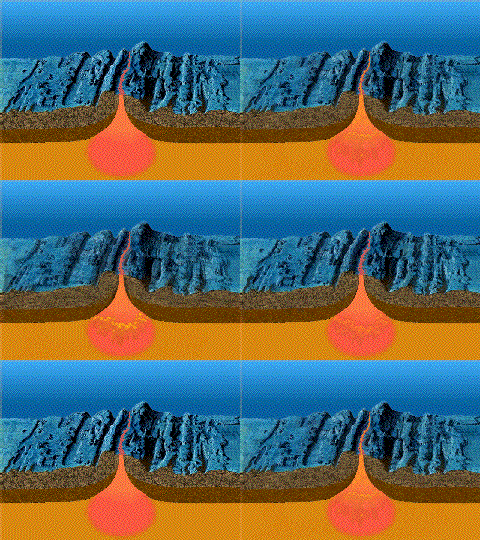
A mid-ocean ridge, with magma rising from a chamber below, forming new oceanic lithosphere that spreads away from the ridge

A mid-ocean ridge, with magma rising from a chamber below, forming new oceanic lithosphere that spreads away from the ridge

Rift zone in Þingvellir National Park, Iceland. The island is a sub-aerial part of the Mid-Atlantic RidgeImage by Rob Young from United Kingdom, licensed under Creative Commons Attribution 2.0

Rift zone in Þingvellir National Park, Iceland. The island is a sub-aerial part of the Mid-Atlantic Ridge

Age of oceanic crust. Red is most recent, and blue is the oldest.

Age of oceanic crust. Red is most recent, and blue is the oldest.

Oceanic crust is formed at an oceanic ridge, while the lithosphere is subducted back into the asthenosphere at trenches.Image by Surachit, licensed under Creative Commons Attribution-Share Alike 3.0

Oceanic crust is formed at an oceanic ridge, while the lithosphere is subducted back into the asthenosphere at trenches.

Magnesium/calcium ratio changes at mid-ocean ridges

Magnesium/calcium ratio changes at mid-ocean ridges

A theoretical model of the formation of magnetic striping. New oceanic crust forming continuously at the crest of the mid-ocean ridge cools and becomes increasingly older as it moves away from the ridge crest with seafloor spreading: a. the spreading ridge about 5 million years ago. b. about 2 to 3 million years ago. c. present-day.

A theoretical model of the formation of magnetic striping. New oceanic crust forming continuously at the crest of the mid-ocean ridge cools and becomes increasingly older as it moves away from the ridge crest with seafloor spreading: a. the spreading ridge about 5 million years ago. b. about 2 to 3 million years ago. c. present-day.

A makeshift demonstration of the polarity shifting.

A makeshift demonstration of the polarity shifting.

Mid-ocean ridge cross-section (cut-away view)Image by 37ophiuchi BrucePL, licensed under Creative Commons Attribution-Share Alike 4.0

Mid-ocean ridge cross-section (cut-away view)

Map of Marie Tharp and Bruce Heezen, painted by Heinrich C. Berann (1977), showing the relief of the ocean floors with the system of mid-ocean ridges

Map of Marie Tharp and Bruce Heezen, painted by Heinrich C. Berann (1977), showing the relief of the ocean floors with the system of mid-ocean ridges

A mid-ocean ridge, with magma rising from a chamber below, forming new oceanic lithosphere that spreads away from the ridge

A mid-ocean ridge, with magma rising from a chamber below, forming new oceanic lithosphere that spreads away from the ridge

Rift zone in Þingvellir National Park, Iceland. The island is a sub-aerial part of the Mid-Atlantic RidgeImage by Rob Young from United Kingdom, licensed under Creative Commons Attribution 2.0

Rift zone in Þingvellir National Park, Iceland. The island is a sub-aerial part of the Mid-Atlantic Ridge

Age of oceanic crust. Red is most recent, and blue is the oldest.

Age of oceanic crust. Red is most recent, and blue is the oldest.

Oceanic crust is formed at an oceanic ridge, while the lithosphere is subducted back into the asthenosphere at trenches.Image by Surachit, licensed under Creative Commons Attribution-Share Alike 3.0

Oceanic crust is formed at an oceanic ridge, while the lithosphere is subducted back into the asthenosphere at trenches.

Magnesium/calcium ratio changes at mid-ocean ridges

Magnesium/calcium ratio changes at mid-ocean ridges

A theoretical model of the formation of magnetic striping. New oceanic crust forming continuously at the crest of the mid-ocean ridge cools and becomes increasingly older as it moves away from the ridge crest with seafloor spreading: a. the spreading ridge about 5 million years ago. b. about 2 to 3 million years ago. c. present-day.

A theoretical model of the formation of magnetic striping. New oceanic crust forming continuously at the crest of the mid-ocean ridge cools and becomes increasingly older as it moves away from the ridge crest with seafloor spreading: a. the spreading ridge about 5 million years ago. b. about 2 to 3 million years ago. c. present-day.

A makeshift demonstration of the polarity shifting.

A makeshift demonstration of the polarity shifting.

Role In Plate Tectonics

Mid-ocean ridges play a major role in plate tectonics, which is how the Earth's crust moves! 🌍When tectonic plates pull apart, new ocean floor is formed! Mid-ocean ridges also help explain how continents move. 🌏As new floor forms, it pushes older pieces of crust away, causing continents to drift! This process helps create earthquakes and volcanic eruptions. 🌋The movement of plates is all part of a cycle that keeps our planet active and changing! Understanding plate tectonics helps scientists predict natural disasters and learn how Earth is always in motion! 🔄

Types Of Mid-ocean Ridges

There are many mid-ocean ridges across the globe, but they can be grouped into different types! 🌍The two main types are:
1. Fast-Spreading Ridges: These are the ones where plates pull apart quickly, like the East Pacific Rise. 🌊They can grow over a few centimeters every year!
2. Slow-Spreading Ridges: These separate more slowly, like the Mid-Atlantic Ridge. 🌊They grow just a few millimeters each year! Most mid-ocean ridges are either fast or slow-spreading. Each type has its own special features that scientists love to explore! 🔍

Seafloor Spreading Process

Seafloor spreading is a super cool process that creates mid-ocean ridges! 🌊First, tectonic plates pull apart at divergent boundaries. 🌍Then, magma from deep inside the Earth rises to fill the gap. When it reaches the surface, it cools and hardens, creating new ocean crust! This happens all the time! Imagine a conveyor belt moving endlessly, creating new land beneath the waves! ⛴️ Because of seafloor spreading, ocean floors can get wider over time. This is how Earth’s oceans grow bigger! 🌊The process also plays a big role in shaping our continents!

Formation Of Mid-ocean Ridges

Mid-ocean ridges are formed in a process called seafloor spreading. This happens when two tectonic plates pull apart, creating cracks in the ocean floor. 🌊As the plates move apart, magma from deep inside the Earth rises to fill the space. When the magma cools, it becomes solid rock, forming new land! This process is ongoing, which means mid-ocean ridges are always growing. 🌋Over millions of years, they can create large underwater mountains even taller than Mount Everest! 🏔️ Isn’t that amazing? The Mid-Atlantic Ridge mainly formed about 200 million years ago!

Notable Mid-ocean Ridge Locations

There are many incredible mid-ocean ridges around the world! 🌍One of the most famous is the Mid-Atlantic Ridge, which runs down the center of the Atlantic Ocean, from the Arctic Ocean to the Southern Ocean! 🌊Another notable ridge is the East Pacific Rise, which stretches along the Pacific Ocean, starting near Mexico and going toward New Zealand. 🗺️ Lastly, the Indian Ridge is in the Indian Ocean, separating Africa from Antarctica! These locations are super important for studying geology and ocean life. They remind us of the fascinating processes shaping our planet every day! 🌏

Impact On Ocean Currents And Climate

Mid-ocean ridges affect ocean currents and global climate in many ways! 🌊The ridges act like underwater obstacles that change the direction of ocean currents, which help transport warm and cold water around the planet. 🌍These currents play a big role in regulating the climate by distributing heat across the Earth. ⛄For example, the Gulf Stream starts in the Atlantic Ocean, near the Mid-Atlantic Ridge, and keeps Europe warm! 🥵Without mid-ocean ridges, ocean circulation would be different, making our world a very different place!

Mid-ocean Ridge Exploration Techniques

Exploring mid-ocean ridges is an exciting adventure! 🧭Scientists use special tools like submersibles and remotely operated vehicles (ROVs) to investigate the deep ocean. 🌊These machines can dive thousands of feet underwater and gather information about the ridges! They take pictures and collect samples of the rocks and creatures living there. 🦑Another technique is sonar mapping; it uses sound waves to create images of the seafloor, revealing ridge features. Researchers also study seismic waves to understand the structure of the ocean floor. 🛰️ With these tools, scientists can learn about Earth's hidden treasures!

Geological Features And Characteristics

Mid-ocean ridges are not just ordinary mountains; they have unique features! 🌊For example, they have steep cliffs, known as rift valleys, where the plates are pulling apart. 🏔️ Along these ridges, you can also find hydrothermal vents – openings where hot water and minerals burst from the Earth's crust! These vents create a special environment home to weird and wonderful creatures, like tube worms and giant clams. 🦪Additionally, mid-ocean ridges have volcanic activity, which means they can sometimes erupt! 🌋Scientists study these features to learn more about our planet and its processes.

Biological Ecosystems At Mid-ocean Ridges

Mid-ocean ridges are home to incredible ecosystems! 🌊Hydrothermal vents provide a warm, nutrient-rich environment where special creatures thrive. These vents release hot, mineral-filled water and support unique organisms, like giant tube worms, which can grow over 8 feet long! 🧪These worms don't need sunlight; instead, they rely on bacteria that turn chemicals from the vents into energy! 🦠This habitat is unlike any we find on land. Other creatures like shrimp, clams, and even strange fish can be found here, making them unique ecosystems in the deep ocean! 🌌

Mineral Resources Associated With Mid-ocean Ridges

Did you know that mid-ocean ridges are full of valuable minerals? 🌊The hydrothermal vents found there create mineral deposits, such as copper, gold, and silver! 🥇These minerals come from the hot water and can be harvested, making mid-ocean ridges important for mining. Scientists are studying these resources and how to collect them without harming the environment. 🌍Mining these minerals can help us in our everyday lives, from electronics to construction, but we must do it responsibly! 🌱Learning how to protect these ecosystems while using their resources is super important!

Mid-ocean Ridge Quiz

Q1
Question 1 of 10

Learn more about Mid-ocean Ridge

Ready to create?

Make

To create a safe space for kid creators worldwide!

Create

Vibe Coding

Kids GPT

All Tools

Kibu

Learn

Worksheets

Courses

Skills

Resources

SafeTube

Blog

FAQ

Pricing

Account

Log-in

Sign-up

Data Deletion

Company

About

Community Guidelines

Privacy Policy

Terms of Service

2025, URSOR LIMITED. All rights reserved. DIY is in no way affiliated with Minecraft™, Mojang, Microsoft, Roblox™ or YouTube. LEGO® is a trademark of the LEGO® Group which does not sponsor, endorse or authorize this website or event. Made with love in San Francisco.