Metric Space Facts For Kids
In mathematics, a metric space is a set together with a notion of distance between its elements, usually called points.
Select reading age
Metric Space Facts For Kids
Videos & Quizzesincluded
About this topic
Welcome to the world of metric spaces! 🌍Imagine a special playground where everything is measured by distance. A metric space is a collection of points where we can find out how far apart they are, just like measuring distances between swings and slides! 🛝A distance between any two points is called a "metric." It helps us understand and compare locations. For example, when you measure from your house to the park, you’re using a metric, just like in math! 📏Let’s explore the fun world of metric spaces together!
Explore with ChatDinoKey Points
Metrics have some awesome properties!
The Baire Category Theorem is a fancy way to say: “Every big space is special!”
There are many fun examples of metric spaces!
A metric space is like a magic box called a set, filled with points!
Continuity is like a smooth road without bumps!
Compactness is like a magical blanket that covers all points!
Convergence is a cool math word that tells us how points come together!
Metric spaces are extremely helpful in many areas!
In metric spaces, we can have open and closed sets!
Metric spaces connect with tons of other math ideas!
Photos of Metric Space

A diagram illustrating the great-circle distance (in cyan) and the straight-line distance (in red) between two points P and Q on a sphere.

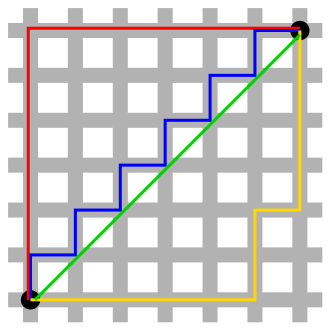
Comparison of Chebyshev, Euclidean and taxicab distances for the hypotenuse of a 3-4-5 triangle on a chessboard

Diameter of a set.

Euler diagram of types of functions between metric spaces.

One possible approximation for the arc length of a curve. The approximation is never longer than the arc length, justifying the definition of arc length as a supremum.
🎉 Properties Of Metrics
Metrics have some awesome properties! 🎉First, the distance between two points (like A and B) is the same in both directions. If A is 3 steps away from B, then B is also 3 steps away from A! (This is called symmetry.) ⚖️ The second property is the triangle inequality—imagine you’re going from point A to point B and then to point C. It’s always shorter or the same distance to go straight from A to C! ⏳These cool rules help us understand how distances work in a metric space!
Go deeper🎉 Baire Category Theorem
The Baire Category Theorem is a fancy way to say: “Every big space is special!” 🎉 It tells us that in a metric space, the intersection of open sets is still open, and sometimes, large spaces contain lots of “big” sets. 🌌Think of it as having a giant treasure chest! ⚓When you dig into it, you’ll find gold coins, even though many small treasures are hidden. This theorem is useful for showing that some spaces are too big for chaos—they have a structure we can use!
Go deeper🎈 Examples Of Metric Spaces
There are many fun examples of metric spaces! 🎈First up is the familiar number line! 📏The distance between numbers tells us how far apart they are. Another example is the 2D plane, like your flat drawing paper! We can measure distances between points using the Pythagorean theorem (a special way of finding distances). 📐Even cities can be a metric space! If you want to measure how far it is from your house to a friend’s house, that’s also a metric space! 🚗
Go deeper🌟 Definition Of Metric Space
A metric space is like a magic box called a set, filled with points! 🌟This set has a rule that tells us how to find the distance between these points. It’s like drawing a line between two stars in the sky and counting how many steps it takes to get from one to the other! 🌌To be a proper metric space, it must follow three important rules: you can measure the distance between points, the distance from a point to itself is zero, and the distance can’t be negative! Isn’t that cool? 🤩
Go deeper🛤️ Continuity In Metric Spaces
Continuity is like a smooth road without bumps! 🛤️ In metric spaces, a function is continuous if small changes in input lead to small changes in output. Imagine drawing a curve on paper. ✏️ If you can draw it without lifting your pencil, it’s continuous! This helps us understand how different points relate and move, creating a seamless journey in the metric space! 🌈That’s why mathematicians love continuity—it keeps things organized and flowing!
Go deeper🧚♀️ Compactness In Metric Spaces
Compactness is like a magical blanket that covers all points! 🧚♀️ In metric spaces, a set is compact if every sequence of points inside can have a limit point that’s also in the space! Think about a cozy gathering around a campfire 🔥—it’s nice and contained! Compact spaces are special because they’re complete and closed, ensuring nothing important is left out. They help mathematicians make good predictions about behavior and make it easier to handle different points in a space! 🌌
Go deeper🤝 Convergence And Completeness
Convergence is a cool math word that tells us how points come together! 🤝Imagine you’re running towards a friend; as you get closer, you’re converging! In metric spaces, a sequence of points converges if they get super close to a single point. 🌟Completeness means everything you need is there—it’s like having all your puzzle pieces! 🧩A metric space is complete if every converging sequence has a point already in the space, making it whole and complete!
Go deeper🚀 Applications Of Metric Spaces
Metric spaces are extremely helpful in many areas! 🚀For example, they can help in computer science, where collections of data need precise distances to measure similarity. 📊They’re also used in geography to find distances between landmarks! 📍In physics, metric spaces help scientists understand forces and movement. 🌍Overall, metric spaces help us make sense of the world around us by organizing points and distances in awesome ways!
Go deeper☀️ Open And Closed Sets In Metric Spaces
In metric spaces, we can have open and closed sets! ☀️ Imagine an open picnic blanket where you and your friends can sit, but no one can sit on the edges! This is an open set—everything inside is included, but not the borders. 🎈A closed set, on the other hand, is like a toy box with a lid. It includes everything inside AND its edges! 🧸The differences help mathematicians understand how points can stay together or be apart inside a space.
Go deeper🔗 Relation To Other Mathematical Concepts
Metric spaces connect with tons of other math ideas! 🔗For instance, topology, which studies the shape of spaces, is closely linked! It analyzes properties that remain under continuous transformations without details like distances. 🌀Linear spaces, which involve vectors and lines, also relate because they can have distances defined! 🎈By learning about metric spaces, you’ll open a door to exploring shapes, functions, and tons of cool math puzzles! 🧩Let’s keep discovering together!
Go deeper