Ionosphere Facts For Kids
The ionosphere is an ionized part of the upper atmosphere of Earth, important for communication and navigation, located from about 48 km to 965 km above sea level.
Select reading age
Ionosphere Facts For Kids
Videos & Quizzesincluded
About this topic
The ionosphere is a super cool region in Earth's upper atmosphere! 🌌It sits between 48 kilometers (29 miles) and 965 kilometers (600 miles) above sea level. The ionosphere is filled with tiny particles called ions, which are created by the Sun's energy. ☀️ It helps with communication, affects GPS signals, and even creates beautiful lights known as auroras. The ionosphere is also important for studying how our Earth interacts with space. So, next time you look at the stars, remember the ionosphere is working hard up there! 🌟
Explore with ChatDinoKey Points
The ionosphere is always changing!
The ionosphere has three main layers, called D, E, and F, and each one is special!
The Sun is a powerful star that affects the ionosphere!
The ionosphere is like a magical mirror for radio waves!
Did you know the ionosphere is connected to climate change?
The ionosphere is a special part of our atmosphere found high above the Earth!
Ever wondered how your phone knows where you are?
Scientists love to explore the ionosphere!
Auroras, or the "Northern and Southern Lights," are stunning light displays in the sky!
Photos of Ionosphere

Relationship of the atmosphere and ionosphere

Ionospheric layers.

Ionospheric sub-layers from night to day indicating their approximate altitudes

Lightning sprites.

Main gases of the ionosphere (about 50 km; 31 miand above on this chart) vary considerably by altitude

Overview of ionosphere phenomena
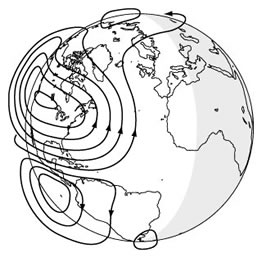
Electric currents created in sunward ionosphere.

Properties of Earth's Upper Atmosphere
🌪️ Formation And Dynamics
The ionosphere is always changing! 🌪️ It forms when sunlight interacts with gases like nitrogen and oxygen in the atmosphere. ☁️ During the day, the Sun's rays ionize the particles, creating more ions. At night, when the Sun goes down, fewer ions are made, and some ions even recombine back into neutral particles. The altitude and density of these layers can change, depending on the time of year and how much sunlight the Earth receives. This dynamic nature plays a major role in how the ionosphere affects our everyday technology, too! 💻
Go deeper🌈 Layers Of The Ionosphere
The ionosphere has three main layers, called D, E, and F, and each one is special! 🌈The D layer is the lowest, found around 48 to 90 kilometers (30 to 55 miles) above the Earth. It absorbs radio waves during the day! 📻The E layer, higher up at 90 to 150 kilometers (55 to 93 miles), is where more ions form but is weaker than the F layer. The F layer is the highest and is super important for long-distance radio communication! 🎶It can be split into F1 and F2 layers, depending on the time of day and how much sunlight is shining.
Go deeper☀️ Effects Of Solar Activity
The Sun is a powerful star that affects the ionosphere! ☀️ When there are solar flares or sunspots, the Sun emits strong bursts of energy that can change the ionosphere. 🌅These changes can cause radio signals to be disrupted, making them hard to understand or pick up. 📻Sometimes, they can even cause beautiful auroras! Scientists pay close attention to solar activity and study how it affects the ionosphere. Understanding this helps improve technology we use every day, like our phones and GPS systems. 🛰️
Go deeper📡 Role In Radio Communication
The ionosphere is like a magical mirror for radio waves! 📡When we send signals from radios and cellphones, they can bounce off the ionosphere and travel long distances! 🎶This helps people talk to each other from places far away. The ionosphere is especially helpful for AM radio stations, allowing them to be heard over many miles at night when the ionosphere is more active. 📻So, next time you listen to a radio show, thank the ionosphere for making it happen from so far away!
Go deeper🌍 The Ionosphere And Climate Change
Did you know the ionosphere is connected to climate change? 🌍It sounds surprising, but as our planet gets warmer, it can affect the ionosphere! The ionosphere reacts to changes in weather and temperature, like a living organism. 🌡️ Scientists study this connection to understand how global shifts might change our communications and technologies. 🔍By learning more about this, they can help protect satellite signals and keep our technology running smoothly. So, taking care of our Earth is crucial for the health of the ionosphere, too! 🌳
Go deeper🌍 Definition And Structure Of The Ionosphere
The ionosphere is a special part of our atmosphere found high above the Earth! 🌍It's made up of gases that get energized by sunlight, creating ions, which are tiny charged particles. This ionization can happen several times a day due to the Sun shining brightly at different times. The ionosphere is not solid like the ground; it's more like a dance of particles moving around! 💃There are four main layers in the upper atmosphere: the D, E, F1, and F2 layers. Each layer has different properties and functions, making the ionosphere a very interesting place!
Go deeper📱 Impact On Global Positioning Systems (gps)
Ever wondered how your phone knows where you are? 📱That's thanks to GPS, which uses signals sent from satellites! 🌐But guess what? The ionosphere helps these signals travel, too! 🛰️ Sometimes, the ionosphere can slow down or bend these signals, which can make GPS a little less accurate. Scientists study the ionosphere to help improve GPS systems! They want to make sure you can get to your favorite park or friend’s house without getting lost. 🗺️ So, the ionosphere is super important for helping us find our way!
Go deeper🧑🔬 Research And Exploration Of The Ionosphere
Scientists love to explore the ionosphere! 🧑🔬 They use special tools like satellites and rockets to study it. These missions help us understand how the ionosphere changes with the Sun's energy. NASA and other researchers look for patterns and collect data to learn more about this fascinating layer of the atmosphere. 🌌By studying the ionosphere, scientists can better predict communication issues and even weather patterns in space. 📊So, all the exciting research helps keep us connected and informed!
Go deeper🌌 Auroras And Their Connection To The Ionosphere
Auroras, or the "Northern and Southern Lights," are stunning light displays in the sky! 🌌They happen near the poles and are connected to the ionosphere. When solar wind, which is a stream of charged particles from the Sun, collides with Earth's magnetic field, they create these amazing lights. 🌈This happens in the ionosphere because that's where the charged particles gather. During strong solar activity, more auroras can be seen. Have you ever seen an aurora? They can be green, red, or even purple! 🌟It’s like nature's own light show!
Go deeper