All Articles

Galleon

Galleon Facts For Kids

Galleons were large, multi-decked sailing ships developed in Spain and Portugal during the 16th to 18th centuries, used primarily for armed cargo transport and later as warships.
🎨 Reading age for 6-8
Background blob
Galleon
Galleon
Facts for Kids!

Do more with AI

Introduction

Galleons were big ships built mainly by Spain and Portugal from the 16th to 18th centuries! 🚢These stunning multi-decked vessels were used for travel across oceans. They were strong enough to carry loads of goods and even had cannons for protection. Galleons helped explorers brave the seas and opened new trade routes connecting different parts of the world. 🌎Imagine sailing on a ship that could carry treasures like gold and spices! They were famous for their beauty and functionality, making them one of the most important ships of their time.

Images of Galleon

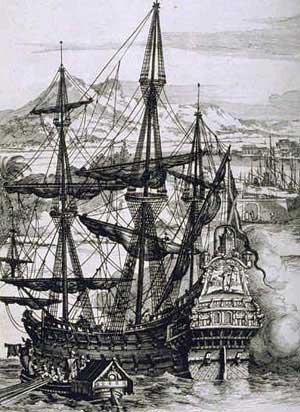
A Spanish galleon (left) firing its cannons at a Dutch warship (right). Cornelis Verbeeck, c. 1618–1620

A Spanish galleon (left) firing its cannons at a Dutch warship (right). Cornelis Verbeeck, c. 1618–1620

Carracks, galleon (center/right), square rigged caravel (below), galley and fusta (galliot) depicted by D. João de Castro on the "Suez Expedition" (part of the Portuguese Armada of 72 ships sent against the Ottoman fleet at anchor in Suez, Egypt, in response to its entry in the Indian Ocean and the siege of Diu in 1538) — Tábuas da India in the João de Castro's Roteiro do Mar Roxo (Routemap of the Red Sea) of 1540–1541.[2]

Carracks, galleon (center/right), square rigged caravel (below), galley and fusta (galliot) depicted by D. João de Castro on the "Suez Expedition" (part of the Portuguese Armada of 72 ships sent against the Ottoman fleet at anchor in Suez, Egypt, in response to its entry in the Indian Ocean and the siege of Diu in 1538) — Tábuas da India in the João de Castro's Roteiro do Mar Roxo (Routemap of the Red Sea) of 1540–1541.[2]

Technical drawing of a late 16th century or early 17th century Portuguese galleon, featured in the Livro de Traças de Carpintaria

Technical drawing of a late 16th century or early 17th century Portuguese galleon, featured in the Livro de Traças de Carpintaria

The galleon's pintle and gudgeon rudderImage by Eric Gaba ( Sting ), licensed under Creative Commons Attribution-Share Alike 4.0

The galleon's pintle and gudgeon rudder

Model of an English galleon sporting four mast types: (left to right) • Bonaventure mizzenmast, typically lateen-rigged and shorter than the main mizzen. • Mizzenmast, typically shorter than the foremast and lateen-rigged. • Mainmast, the tallest mast and, on vessels with more than three masts, the most centrally located. • Foremast, the second-tallest mast.

Model of an English galleon sporting four mast types: (left to right) • Bonaventure mizzenmast, typically lateen-rigged and shorter than the main mizzen. • Mizzenmast, typically shorter than the foremast and lateen-rigged. • Mainmast, the tallest mast and, on vessels with more than three masts, the most centrally located. • Foremast, the second-tallest mast.

A three-masted vessel, square-rigged on the foremast and mainmast and lateen-rigged on the mizzenmast.Image by Refundpolitics, licensed under Creative Commons Attribution-Share Alike 3.0

A three-masted vessel, square-rigged on the foremast and mainmast and lateen-rigged on the mizzenmast.

Wager's Action off Cartagena by Samuel Scott shows the 1708 sinking of the Spanish galleon San José

Wager's Action off Cartagena by Samuel Scott shows the 1708 sinking of the Spanish galleon San José

El Galeón, a 17th-century Spanish galleon replica in Quebec City in 2016.Image by Cephas, licensed under Creative Commons Attribution-Share Alike 4.0

El Galeón, a 17th-century Spanish galleon replica in Quebec City in 2016.

A Spanish galleon (left) firing its cannons at a Dutch warship (right). Cornelis Verbeeck, c. 1618–1620

A Spanish galleon (left) firing its cannons at a Dutch warship (right). Cornelis Verbeeck, c. 1618–1620

Carracks, galleon (center/right), square rigged caravel (below), galley and fusta (galliot) depicted by D. João de Castro on the "Suez Expedition" (part of the Portuguese Armada of 72 ships sent against the Ottoman fleet at anchor in Suez, Egypt, in response to its entry in the Indian Ocean and the siege of Diu in 1538) — Tábuas da India in the João de Castro's Roteiro do Mar Roxo (Routemap of the Red Sea) of 1540–1541.[2]

Carracks, galleon (center/right), square rigged caravel (below), galley and fusta (galliot) depicted by D. João de Castro on the "Suez Expedition" (part of the Portuguese Armada of 72 ships sent against the Ottoman fleet at anchor in Suez, Egypt, in response to its entry in the Indian Ocean and the siege of Diu in 1538) — Tábuas da India in the João de Castro's Roteiro do Mar Roxo (Routemap of the Red Sea) of 1540–1541.[2]

Technical drawing of a late 16th century or early 17th century Portuguese galleon, featured in the Livro de Traças de Carpintaria

Technical drawing of a late 16th century or early 17th century Portuguese galleon, featured in the Livro de Traças de Carpintaria

The galleon's pintle and gudgeon rudderImage by Eric Gaba ( Sting ), licensed under Creative Commons Attribution-Share Alike 4.0

The galleon's pintle and gudgeon rudder

Model of an English galleon sporting four mast types: (left to right) • Bonaventure mizzenmast, typically lateen-rigged and shorter than the main mizzen. • Mizzenmast, typically shorter than the foremast and lateen-rigged. • Mainmast, the tallest mast and, on vessels with more than three masts, the most centrally located. • Foremast, the second-tallest mast.

Model of an English galleon sporting four mast types: (left to right) • Bonaventure mizzenmast, typically lateen-rigged and shorter than the main mizzen. • Mizzenmast, typically shorter than the foremast and lateen-rigged. • Mainmast, the tallest mast and, on vessels with more than three masts, the most centrally located. • Foremast, the second-tallest mast.

A three-masted vessel, square-rigged on the foremast and mainmast and lateen-rigged on the mizzenmast.Image by Refundpolitics, licensed under Creative Commons Attribution-Share Alike 3.0

A three-masted vessel, square-rigged on the foremast and mainmast and lateen-rigged on the mizzenmast.

Wager's Action off Cartagena by Samuel Scott shows the 1708 sinking of the Spanish galleon San José

Wager's Action off Cartagena by Samuel Scott shows the 1708 sinking of the Spanish galleon San José

El Galeón, a 17th-century Spanish galleon replica in Quebec City in 2016.Image by Cephas, licensed under Creative Commons Attribution-Share Alike 4.0

El Galeón, a 17th-century Spanish galleon replica in Quebec City in 2016.

Cultural Impact

Galleons have had a huge impact on our culture! 🎭These majestic ships appear in stories, movies, and even cartoons! They are famous for being symbols of adventure and exploration. Think about pirates like Captain Jack Sparrow from "Pirates of the Caribbean"! 🏴‍☠️ Galleons also helped spread traditions and ideas between cultures. Spanish galleons brought food, music, and even dances to other countries! People still create art, write songs, and even host festivals inspired by these incredible ships. They remind us of the brave sailors who traveled across oceans long ago.

Famous Galleons

Some galleons gained fame throughout history! One of them, the “Nuestra Señora de Atocha,” sank in 1622 off Florida's coast and was filled with treasures! 💰It took over 300 years for people to find it again! Another famous galleon was the “San Salvador,” the ship that brought explorer Juan Rodríguez Cabrillo to California in 1542. 🌊These ships and their stories make history exciting and show how important galleons were for exploration and trade. Today, many museums display models of famous galleons for everyone to enjoy! 🏛️

History Of Galleons

Galleons started becoming popular around the 1500s. During this time, Spain and Portugal wanted to find new trade routes. 🌍They used galleons to transport precious metals and goods from the Americas, like gold and silver. By the 1600s, galleons were all the rage! They became crucial for carrying cargo and sometimes even pirates tried to steal from them! ⚓The most famous galleon, the “Nuestra Señora de Atocha,” sank in 1622 but was later found with many treasures. Isn't it exciting how something built long ago still fascinates us today?

Sailing And Navigation

Sailing a galleon was a real adventure! ⛵These ships used sails to catch the wind and move across vast oceans. Sailors learned to read the stars and use compasses for navigation. 🌌A compass helped them find North, while the stars showed them where to go. They also used maps to avoid dangerous areas like rocks and storms. 🌊The job was hard and required teamwork! Sailors needed to be strong and smart to steer the ship and keep passengers safe. After all, they were crossing the great blue seas!

Design And Construction

Galleons were carefully designed for ocean travel. 🛠️ They were long and narrow, allowing them to sail quickly. Most galleons were made of sturdy wood like oak, making them strong against waves. They also had three or four sails to catch the wind! 💨Each ship had a very high stern, which made it look very majestic. The decoration was beautiful, with bright colors and ornate designs! 🎨Some galleons even had a special place on the deck for cannons, so they could protect themselves from pirates and enemy ships.

Galleons In Modern Times

Even today, galleons capture our imagination! 🌟Many people love to build model galleons or create art about them. Some festivals celebrate galleons by recreating historical sailing events! ⛵In countries like Spain and Mexico, commemorations honor the long-gone galleon trade. There are also cruises that let people experience sailing on replicas of these famous ships. While galleons aren't used for trade anymore, their legacy continues to inspire books, movies, and even classroom projects! 🏫Just think about how these magnificent ships help us learn about history and adventure!

Military Use Of Galleons

Galleons weren't just for trading; they were also important in battles! ⚔️ Many galleons were equipped with cannons, making them powerful warships. Countries like Spain would send their galleons to protect their trade routes from pirates and enemy ships. 🚢💥 The ships’ size and strength made them hard to defeat. During battles, sailors fired cannons, trying to outsmart and overpower the enemy. The Spanish Armada in 1588 had many galleons in its fleet! These ships played a big part in history by fighting for their countries and protecting precious cargo.

Role In Trade And Exploration

Galleons played a vital role in trade during the Age of Sail. 💰They carried precious goods like spices from Asia, sugar from the Caribbean, and silk from China back to Europe. These ships made trade easier and helped people from different cultures meet one another. 🌏Galleons traveled on famous routes like the Manila Galleon Trade, where goods were exchanged between Mexico and the Philippines. They helped spread ideas, inventions, and even delicious foods! Imagine how exciting it was to receive treasures from far-off lands!

The Evolution Of Naval Technology

Galleons were super important for the development of modern ships. ⚓They introduced many new designs, like multiple decks and powerful sails. Over time, shipbuilding improved, leading to faster and stronger vessels. After galleons, ships transitioned to steam power in the 19th century! 🚢These changes made sea travel easier and faster. Today, we have giant container ships that can carry hundreds of containers all over the world. 🌍Galleons remind us how far we've come and how important ships have been throughout history! They were not just ships; they were floating treasures of knowledge!

Galleon Quiz

Q1
Question 1 of 10

Learn more about Galleon

Ready to create?

Make

To create a safe space for kid creators worldwide!

Create

Vibe Coding

Kids GPT

All Tools

Kibu

Resources

Worksheets

SafeTube

Blog

FAQ

Account

Pricing

Log-in

Sign-up

Data Deletion

Company

About

Community Guidelines

Privacy Policy

Terms of Service

2025, URSOR LIMITED. All rights reserved. DIY is in no way affiliated with Minecraft™, Mojang, Microsoft, Roblox™ or YouTube. LEGO® is a trademark of the LEGO® Group which does not sponsor, endorse or authorize this website or event. Made with love in San Francisco.