All Articles

Elagabalus

Elagabalus Facts For Kids

Elagabalus was a controversial Roman Emperor known for his eccentricities and the introduction of Eastern religious practices to Rome during his short reign from 218 to 222 AD.

🎨 Reading age for 6-8
Background blob
Elagabalus
Elagabalus
Facts for Kids!
Image by Carole Raddato from FRANKFURT, Germany, licensed under Creative Commons Attribution-Share Alike 2.0

Do more with AI

Introduction

Elagabalus was a fascinating Roman emperor who ruled from 218 to 222 AD. 🎉He was born in Syria, a region in the Middle East, and was originally named Varius Avitus Bassianus. Elagabalus became emperor when he was just 14 years old! He is known for his unique personality, unusual customs, and colorful reign. 🌈His rule was often filled with surprising events and extravagant parties, making him a memorable figure in history. Elagabalus was passionate about the sun god, Elagabal, who was worshipped in Syria, which influenced many of his decisions as emperor! ☀️

Images of Elagabalus

Photos of ElagabalusImage by CNG, licensed under Creative Commons Attribution-Share Alike 2.5
Photos of ElagabalusImage by Wolfgang Sauber, licensed under Creative Commons Attribution-Share Alike 3.0
Reverse of an aureus of Elagabalus, marked: salus antonini aug· ("the Health of Antoninus Augustus")

Reverse of an aureus of Elagabalus, marked: salus antonini aug· ("the Health of Antoninus Augustus")

Denarius of Elagabalus, inscribed: imp· antoninus pius aug· on the obverse and fortunae aug· on the reverse, showing Fortuna with a cornucopia and a rudder on a globeImage by Elagabalus, licensed under Creative Commons Attribution-Share Alike 3.0

Denarius of Elagabalus, inscribed: imp· antoninus pius aug· on the obverse and fortunae aug· on the reverse, showing Fortuna with a cornucopia and a rudder on a globe

Amphitheatrum Castrense in the Horti Spei Veteris on the Esquiline Hill in RomeImage by Lalupa, licensed under Creative Commons Attribution-Share Alike 3.0

Amphitheatrum Castrense in the Horti Spei Veteris on the Esquiline Hill in Rome

The apse of the Sessorium basilica in the Horti Spei VeterisImage by Lalupa, licensed under Creative Commons Attribution-Share Alike 3.0

The apse of the Sessorium basilica in the Horti Spei Veteris
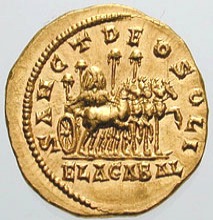
Reverse of an aureus of Elagabalus, with the baetyl transported in a quadriga. Inscription: sanct· deo soli elagabal· ("to the Holy Sun God El-Gabal")
Reverse of an aureus of Elagabalus, with the baetyl transported in a quadriga. Inscription: sanct· deo soli elagabal· ("to the Holy Sun God El-Gabal")

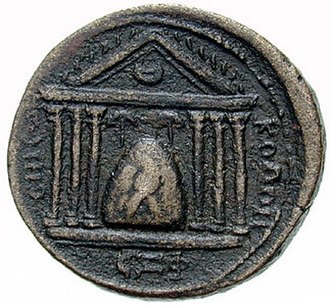
The baetyl of Elgabal back in its home temple at Emesa, on a coin of UraniusImage by Saperaud (Original image), licensed under Creative Commons Attribution-Share Alike 3.0

The baetyl of Elgabal back in its home temple at Emesa, on a coin of Uranius

Denarius depicting Aquilia Severa, the second wife of Elagabalus. The marriage caused a public outrage because Aquilia was a Vestal Virgin, sworn by Roman law to celibacy for 30 years. Inscription: iulia aquilia severa aug·Image by Elagabalus, licensed under Creative Commons Attribution-Share Alike 3.0

Denarius depicting Aquilia Severa, the second wife of Elagabalus. The marriage caused a public outrage because Aquilia was a Vestal Virgin, sworn by Roman law to celibacy for 30 years. Inscription: iulia aquilia severa aug·

Photos of ElagabalusImage by CNG, licensed under Creative Commons Attribution-Share Alike 2.5
Photos of ElagabalusImage by Wolfgang Sauber, licensed under Creative Commons Attribution-Share Alike 3.0
Reverse of an aureus of Elagabalus, marked: salus antonini aug· ("the Health of Antoninus Augustus")Image by ANO "International Numismatic Club", licensed under Creative Commons Attribution-Share Alike 4.0

Reverse of an aureus of Elagabalus, marked: salus antonini aug· ("the Health of Antoninus Augustus")

Denarius of Elagabalus, inscribed: imp· antoninus pius aug· on the obverse and fortunae aug· on the reverse, showing Fortuna with a cornucopia and a rudder on a globeImage by Elagabalus, licensed under Creative Commons Attribution-Share Alike 3.0

Denarius of Elagabalus, inscribed: imp· antoninus pius aug· on the obverse and fortunae aug· on the reverse, showing Fortuna with a cornucopia and a rudder on a globe

Amphitheatrum Castrense in the Horti Spei Veteris on the Esquiline Hill in RomeImage by Lalupa, licensed under Creative Commons Attribution-Share Alike 3.0

Amphitheatrum Castrense in the Horti Spei Veteris on the Esquiline Hill in Rome

The apse of the Sessorium basilica in the Horti Spei VeterisImage by Lalupa, licensed under Creative Commons Attribution-Share Alike 3.0

The apse of the Sessorium basilica in the Horti Spei Veteris

Reverse of an aureus of Elagabalus, with the baetyl transported in a quadriga. Inscription: sanct· deo soli elagabal· ("to the Holy Sun God El-Gabal")Image by Steerpike (Original image), licensed under Creative Commons Attribution-Share Alike 3.0

Reverse of an aureus of Elagabalus, with the baetyl transported in a quadriga. Inscription: sanct· deo soli elagabal· ("to the Holy Sun God El-Gabal")

The baetyl of Elgabal back in its home temple at Emesa, on a coin of UraniusImage by Saperaud (Original image), licensed under Creative Commons Attribution-Share Alike 3.0

The baetyl of Elgabal back in its home temple at Emesa, on a coin of Uranius

Denarius depicting Aquilia Severa, the second wife of Elagabalus. The marriage caused a public outrage because Aquilia was a Vestal Virgin, sworn by Roman law to celibacy for 30 years. Inscription: iulia aquilia severa aug·Image by Elagabalus, licensed under Creative Commons Attribution-Share Alike 3.0

Denarius depicting Aquilia Severa, the second wife of Elagabalus. The marriage caused a public outrage because Aquilia was a Vestal Virgin, sworn by Roman law to celibacy for 30 years. Inscription: iulia aquilia severa aug·

Rise To Power

Elagabalus' rise to power began when his mother made a clever plan to help him become emperor. 🌟After the assassination of Emperor Caracalla, Elagabalus was declared the new emperor by his grandmother, Julia Maesa. He marched into Rome with a strong army, and the people were curious about him! 🤔Elagabalus was only 14, making him one of the youngest emperors ever. He immediately started celebrating his new title with grand festivals that surprised many Romans. However, some people were unhappy with his rule and his focus on the sun god instead of traditional Roman gods. 🔆

Cultural Impact

Even though Elagabalus' rule was short, he left a unique impact on Roman culture. 😍His flamboyant style, love for festivals, and energy influenced how people celebrated life in Rome. He introduced new music and dances to the city, which made parties more exciting! 🎶Many stories about his wild lifestyle circulated, both in his time and still today. Although some viewed him as a reckless leader, others admired his courage to be different. Elagabalus pushed the boundaries of Roman culture, showcasing how one person can change traditions and inspire conversations in history! 🌍

Life And Background

Elagabalus was born around 204 AD in the city of Emesa, located in present-day Syria. 🏛️ His mother was a priestess of the sun god Elagabal, which greatly influenced his beliefs. When Elagabalus became emperor, he brought his religious practices to Rome, much to the surprise of its people. He came from a wealthy family and was related to both the previous emperor and the famous Roman general Septimius Severus. This royal connection helped him claim the throne. Elagabalus loved extravagant clothing and bright jewelry, standing out among the other leaders of Rome! 💎

Portrayals In Media

Elagabalus has been portrayed in various forms of media, including books and movies! 📚In literature, writers have used his character to explore themes of identity and rebellion. Films sometimes depict him as an extravagant and wild leader who breaks traditions for fun. 🎬Television series and documentaries about ancient Rome often include Elagabalus, showing his rise and fall. These portrayals help bring history to life and spark interest in learning about the Roman Empire and its rulers. Elagabalus teaches us that stories from the past can inspire creativity and art in the present! 🎨

Religious Practices

Elagabalus was very devoted to his god, Elagabal, who represented the sun. ☀️ In Rome, he worked hard to promote the worship of this god and even built a special temple, called the Elagabalium. This temple had fantastic decorations and large festivals in honor of Elagabal. Elagabalus insisted that everyone had to join in these ceremonies, which caused some anger among Romans who preferred their traditional gods like Jupiter and Mars. ⚡He introduced exotic rituals, dancing, and celebrations that puzzled many but showed his desire to bring a new religion to Rome.

Controversies And Scandals

Elagabalus’ reign was filled with controversies! 😲Some Romans thought he was too wild and extravagant. He often dressed in women's clothes and was rumored to have offered outrageous gifts, like a golden statue of himself. Some people also said that he appointed close friends to high positions, even if they were not skilled for the jobs, which made others mad! He even tried to marry a Vestal Virgin, a priestess sworn to remain unmarried. This led to protests because it broke important rules! 🚫Elagabalus’ life was colorful, but it also created tension in Rome during his time.

Comparison With Other Roman Emperors

When comparing Elagabalus to other Roman emperors, we see a mix of differences and similarities. 🌟For example, Augustus was the first emperor and focused on stability, while Elagabalus chased extravagance. Another emperor, Nero, was known for his artistic talents, and like Elagabalus, he faced controversies for his wild behaviors. Both emperors showed that leadership in Rome could be unique and sometimes chaotic. However, Elagabalus’ reign was much shorter—only four years! 🤷‍♂️ Each emperor shaped Rome in their own way, but Elagabalus stands out for being one of the most colorful and eccentric!

Legacy And Historical Interpretations

Elagabalus' legacy is a mix of admiration and controversy. 📖Some historians see him as a daring figure who brought new ideas, but others believe he weakened the Roman Empire's traditions. His unusual behaviors and religious changes sparked discussions among writers and philosophers for centuries. Today, he is often portrayed as a puzzling emperor, someone full of surprises! His reign reminds us of how different people's beliefs and traditions can be. Elagabalus remains an important figure in the story of Rome, showing the complexity of leadership in an ancient world. 🏺

Elagabalus Quiz

Q1
Question 1 of 10

Learn more about Elagabalus

Ready to create?

Make

To create a safe space for kid creators worldwide!

Create

Vibe Coding

Kids GPT

All Tools

Kibu

Resources

Worksheets

SafeTube

Blog

FAQ

Account

Pricing

Log-in

Sign-up

Data Deletion

Company

About

Community Guidelines

Privacy Policy

Terms of Service

2025, URSOR LIMITED. All rights reserved. DIY is in no way affiliated with Minecraft™, Mojang, Microsoft, Roblox™ or YouTube. LEGO® is a trademark of the LEGO® Group which does not sponsor, endorse or authorize this website or event. Made with love in San Francisco.