Deimos Facts For Kids
Deimos is the smaller and outer moon of Mars, often considered more of an asteroid due to its tiny size and irregular shape.
Select reading age

Deimos Facts For Kids
Videos & Quizzesincluded
About this topic
Deimos is one of the two moons of Mars, the fourth planet from the Sun! 🌌It was discovered by an American astronomer named Asaph Hall on August 12, 1877. Deimos is the smaller moon, measuring about 12.4 kilometers (7.7 miles) across. 🌑It orbits Mars at a distance of about 23,460 kilometers (14,570 miles). This tiny moon is shaped like a potato and is very fascinating because it moves slowly across the Martian sky.
Explore with ChatDinoKey Points
So far, Deimos hasn’t had a lander visit yet, but it has been seen by many spacecraft!
The surface of Deimos is filled with craters!
Scientists believe Deimos formed from space debris!
Deimos orbits Mars at an average speed of 1.35 kilometers per second (about 3,000 miles per hour)!
Deimos gets its name from Greek mythology!
Studying Deimos helps scientists understand more about moons, planets, and our Solar System.
Deimos and its better-known brother, Phobos, are quite different!
Deimos is not just small; it has a bumpy, cratered surface!
Exploring Deimos may teach us about the history of Mars and our Solar System!
Photos of Deimos

Size comparison between Phobos, Deimos and the Moon (right)
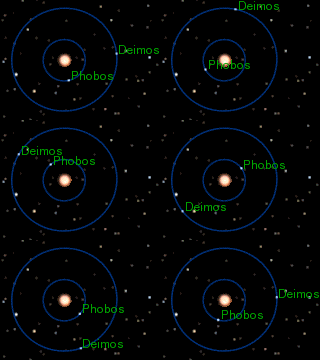
Orbits of Phobos and Deimos (to scale)

Asaph Hall III, discoverer of Deimos

Curiosity's view of the Mars moons: Phobos passing in front of Deimos in real-time (video-gif, 1 August 2013)

Deimos transits the Sun – as viewed by the Mars rover Opportunity (4 March 2004)
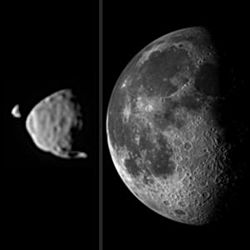
Deimos and Phobos as seen from Mars, compared in apparent size to the Moon as seen from Earth. If they would be as far away from Mars as the Moon from Earth, they would appear as faint star-like features in the Martian sky.
🚀 Exploration
So far, Deimos hasn’t had a lander visit yet, but it has been seen by many spacecraft! 🚀NASA's Mariner 9 and Viking missions sent back stunning pictures. In 2003, the Mars Express helped scientists learn more about Deimos's surface. Future missions might land on Deimos and explore it even further. Imagine hopping around on this distant moon one day!
Go deeper🌕 Surface Features
The surface of Deimos is filled with craters! 🌕The biggest one is called Stickney, which is about 9 kilometers (5.6 miles) wide. Deimos is also very dusty because it hasn't been smoothed out by geological activity like other planets. Some craters are shallow, while others are deep, and there's soft soil all around. Exploring its surface might tell us about the history of our Solar System!
Go deeper🌌 Formation Theories
Scientists believe Deimos formed from space debris! 🌌After Mars collided with a large object long ago, leftovers may have come together to create this tiny moon. Some think Deimos might have been captured by Mars’s gravity when it was wandering through space. Isn’t it fun to think about how a moon could come from an accident in space?
Go deeper🚀 Orbit And Rotation
Deimos orbits Mars at an average speed of 1.35 kilometers per second (about 3,000 miles per hour)! 🚀It takes Deimos about 30.3 hours to complete one orbit around Mars. Surprisingly, it rotates on its axis very slowly, taking about 30.3 hours to make one rotation too. This means that it always shows the same side to Mars, just like our Moon does for Earth!
Go deeper🏛️ Cultural References
Deimos gets its name from Greek mythology! 🏛️ Deimos means "terror" and is the son of Ares, the god of war. That’s fitting because Mars is named after the Roman god of war! Deimos also appears in stories and cartoons, often as a scary and mysterious place. Many people enjoy imagining what life would be like on such a small moon!
Go deeper🌌 Scientific Importance
Studying Deimos helps scientists understand more about moons, planets, and our Solar System. 🌌By looking at its surface and composition, we can learn about the history of space! This moon may hold secrets about how planets and moons are formed. Learning about Deimos can help prepare for future trips to Mars and beyond! 🚀
Go deeper🤔 Comparison With Phobos
Deimos and its better-known brother, Phobos, are quite different! 🤔Deimos is smaller, and its craters are not as deep. Phobos orbits Mars much closer and moves faster. 🌌While Deimos takes about 30.3 hours to orbit, Phobos only takes 7.6 hours. Both moons have potato-like shapes, but Deimos is more round than Phobos. They make an interesting pair in the Martian sky!
Go deeper🎢 Physical Characteristics
Deimos is not just small; it has a bumpy, cratered surface! 🎢It's mostly made of ice and rock, which gives it a dark appearance. Its surface is covered with dust, making it look fuzzy. Because Deimos is so small, it has very little gravity—about one-sixth of Earth's gravity! 🌍If you weigh 60 pounds on Earth, you'd weigh only 10 pounds on Deimos. Isn't that cool?
Go deeper🌍 Potential For Future Exploration
Exploring Deimos may teach us about the history of Mars and our Solar System! 🌍Future missions could send robots or astronauts to learn more. This could help us understand more about moons and how they form. Some scientists even think it could be a launching point for missions to Mars in the future! Imagine visiting a moon before going to a planet!
Go deeper