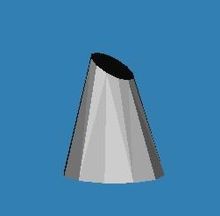
A cone is a three-dimensional geometric shape with a circular base and a single vertex known as the apex.
Set reading age
View for Kids
Easy to read and understand
View for Students
Clear, detailed explanations
View for Scholars
Deep dives and big ideas
A cone is a fun shape that looks like a party hat! 🎉It has a pointy top called the apex and a flat, round bottom known as the base. Cones can be found in many places. For example, ice cream cones 🍦 and traffic cones 🚦 are both shaped like cones. The cone is three-dimensional, which means it has depth, width, and height, unlike flat shapes like squares. You can find cones in nature too, like pine cones! 🌲Next time you see a cone, remember it's not just a fun hat but a shape that's everywhere!
Here are some fun facts about cones! 🤓Did you know a cone can roll? If placed on its side, it can move just like a circle! 🎡Cone shapes are often associated with fun occasions, like parties and birthdays, because of their hat look. 🎂Pine cones can hold seeds for new trees, helping nature! 🌳And here’s a head-scratcher: if you spin a cone, it looks like a circle, just like the shape of a pizza! 🍕Using cones in games like "Dodgeball" adds excitement. So many facts about these fantastic shapes!
To help us understand cones better, we need some math formulas! 🧮The volume of a cone (the space inside) is calculated with the formula V = (1/3)πr²h. This means we take the area of the base (πr²) and multiply it by the height (h), then divide by three! 🌐The surface area (the area all around) can be found using A = πr(r + l), where “l” is the slant height. These formulas help students learn about shape sizes in fun and helpful ways!
There are different types of cones based on their shapes and sizes! The most common are right cones and oblique cones. 🤔A right cone has a straight apex directly above the center of the base, while an oblique cone leans to one side. 🙃We also have circular cones, where the base is a perfect circle, and elliptical cones, where the base is an oval! 🥚You can find these cones in artist sculptures, playground equipment, and even in certain types of toys!
Did you know that cones have a long history? Ancient Egyptians used cone shapes in the design of pyramids! ⏳Cones were also used in Greek architecture to create beautiful structures. Famous mathematician Archimedes studied cones over 2,000 years ago! 📚He discovered that a cone's volume relates to a cylinder with the same base and height. Cones have been a vital part of math and design, helping us build cities and understand shapes!
Cones have some interesting properties! 🌟One of them is volume, which tells us how much space is inside. The volume of a cone can be found using the formula V = (1/3)πr²h, where "r" is the radius and "h" is the height. 📐Another property is the surface area, which is the area of the outside. You can find it using A = πr(r + l), where "l" is the slant height. 🌈Learning about these properties helps us understand how to measure our favorite cone-shaped things!
Cones appear in many cultures around the world! 🎭In Mexico, colorful cone-shaped piñatas are used during celebrations! 🎉In art, cone shapes are often found in sculptures and paintings. 🎨In the culinary world, ice cream cones 🍦 can be found in almost every country, enjoyed as a treat. Even traffic cones play a part in keeping us safe. ⚠️ This fun shape connects us all, showing how cultures use math daily in their unique ways!
In math, a cone is defined as a solid shape with a circular base and a vertex point at the top. The distance from the center of the base to its edge is called the radius. 🌍If you were to slice a cone across, you’d see a triangle! Cones belong to the family of shapes called “3D shapes,” which are different from 2D shapes that are flat. The cone's height is measured straight from the apex down to the center of the base. 📏This cool shape is great for learning about geometry!
Cones are used in many everyday items, which makes them super important! 🏗️ For safety, construction workers use orange traffic cones 🚧 to warn drivers. In sports, goal cones mark boundaries in games like soccer and football. ⚽⛹️ Cones are also used in art, like in building sculptures and decorations! Think of ice cream cones 🍨 too — they hold yummy ice cream. Understanding cones helps us see how math is everywhere, even in our favorite things!


DIY is a creative community where kids draw, build, explore ideas, and share.
No credit card required