Comecon Facts For Kids
COMECON (Council for Mutual Economic Assistance) was an economic organization from 1949 to 1991, led by the Soviet Union to foster economic cooperation among socialist countries in Eastern Europe and beyond.
Select reading age

Comecon Facts For Kids
Videos & Quizzesincluded
About this topic
COMECON, short for the Council for Mutual Economic Assistance, was an organization created in 1949 🏗️. It helped countries that were friendly to the Soviet Union improve their economies. The members believed that working together would make everyone stronger. Imagine a group of friends teaming up for a school project! 🌏COMECON helped countries in Eastern Europe, like Poland and Hungary, and some from around the world, like Cuba and Vietnam, trade goods and share ideas. It lasted until 1991, when it became less important as countries changed and formed different partnerships.
Explore with ChatDinoKey Points
Originally, there were six member countries in COMECON: the Soviet Union, Poland, Hungary, Czechoslovakia, Romania, and Bulgaria 🇷🇺.
COMECON aimed to help its members grow their economies together 🌟.
Even though COMECON no longer exists, its history is essential to understanding the past of Eastern Europe 🌏.
COMECON started on January 25, 1949, in Moscow, Russia 🏛️.
Today, lessons from COMECON can still be seen in organizations like the European Union and others 🌐.
By the late 1980s, many member countries faced problems and wanted change 🌪️.
COMECON helped boost the economies of its member states 📈.
COMECON made many agreements to improve trade and cooperation amongst member countries 🤝.
COMECON had a specific structure to help its goals.
While COMECON focused on friendly countries in the Eastern Bloc, it had complicated relationships with organizations like the European Community 🌍.
Photos of Comecon

English (en): The members and observers of the former Comecon . Member states Member states who left the Warsaw Pact earlier (Albania) Associate members Observers
![Former USSR Comecon headquarters in Moscow.[4]](https://upload.wikimedia.org/wikipedia/commons/thumb/e/eb/Ex-Comecon_building%2C_2009-06-22.jpg/960px-Ex-Comecon_building%2C_2009-06-22.jpg)
Former USSR Comecon headquarters in Moscow.[4]

The executive committee of the COMECON in session.

1974 Medallion 10th Anniversary of Intermetall, that was founded in 1964 in Budapest
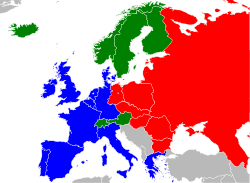 Image by Original: Kpalion Vector: MTRB, licensed under Creative Commons Attribution-Share Alike 3.0
European trade blocs as of the late 1980s. EEC member states are marked in blue, EFTA – green, and Comecon – red.
🌱 Member States
Originally, there were six member countries in COMECON: the Soviet Union, Poland, Hungary, Czechoslovakia, Romania, and Bulgaria 🇷🇺. Later, Cuba, East Germany, Mongolia, and even Vietnam joined! In total, there were about ten member countries during its peak. Each country brought unique resources and skills to the group. For example, Poland was known for its coal mining, while Cuba had sugar and tobacco 🌱. They all learned from each other, much like friends sharing their talents on a group project!
Go deeper🌟 Economic Objectives
COMECON aimed to help its members grow their economies together 🌟. This meant they wanted to increase production of goods like food, machines, and technology. By working as a team, they could sell their products not just to each other, but also to other countries around the world! 🎉This created jobs and improved living standards. The members also wanted to lessen their dependence on Western countries, making sure they supported each other as friends.
Go deeper🌏 Legacy And Influence
Even though COMECON no longer exists, its history is essential to understanding the past of Eastern Europe 🌏. It reminded the world how countries could work together for a common goal. Some of the friendships and partnerships formed during that time still matter today! The sharing of knowledge and cooperation had lasting effects on economies and friendships. It's fascinating how these lessons continue to influence countries working together in various ways. 🤝
Go deeper🏛️ History And Formation
COMECON started on January 25, 1949, in Moscow, Russia 🏛️. After World War II, many countries in Eastern Europe had similar governments and could work together. The leaders wanted to boost their economies, so they created COMECON to help. The first countries to join were the Soviet Union, Poland, Czechoslovakia, Hungary, Romania, and Bulgaria. Over time, Cuba and other socialist countries joined in to share resources and knowledge 🌱. This was like forming a club with rules on how to help each other out!
Go deeper🌐 Contemporary Relevance
Today, lessons from COMECON can still be seen in organizations like the European Union and others 🌐. Countries now aim to cooperate more freely and share ideas without strict rules. The world has changed, and nations continue to learn from the past. Young students today can remember the importance of teamwork and how working together can lead to new possibilities – just like COMECON tried to do! 💡
Go deeper🌪️ Decline And Dissolution
By the late 1980s, many member countries faced problems and wanted change 🌪️. People started to want more freedom and different ways to manage their economies. In 1991, COMECON officially ended due to these changes, and many countries began forming new partnerships. This was like a club that dissolved because members wanted to explore new adventures! 🧭Each country ventured out to find its way in a new world, full of opportunities.
Go deeper📈 Impact On Member Economies
COMECON helped boost the economies of its member states 📈. By sharing resources and knowledge, countries improved their industries. For example, Czechoslovakia became known for making cars! 🚗This teamwork allowed countries to trade more easily and develop faster than they could alone. However, when economies stayed too focused on each other, they sometimes forgot to innovate new ideas. This lack of creativity made it hard for some countries when there were changes around the world!
Go deeper🤝 Major Policies And Agreements
COMECON made many agreements to improve trade and cooperation amongst member countries 🤝. For example, they focused on sharing resources like steel and machinery. They even created common plans for industries! By having friendly rules, countries could more easily trade materials they needed. COMECON helped ensure everyone had what they needed, similar to sharing snacks at lunch 🍎🍪! These policies reunited member countries around mutual dependability and shared success.
Go deeper🏛️ Key Institutions And Structure
COMECON had a specific structure to help its goals. The main meeting place was in Moscow, where leaders gathered to discuss plans 🏛️. The organization had different committees to focus on various subjects like agriculture, transportation, and science. Leaders and experts from member countries worked together to create recommendations. It was like a council of superheroes, each with a special power to help their country become stronger and better! ⚡️
Go deeper🌍 Relations With Other Organizations
While COMECON focused on friendly countries in the Eastern Bloc, it had complicated relationships with organizations like the European Community 🌍. These organizations sometimes had different ideas, with COMECON focusing on social ownership, while the European Community emphasized free market principles. COMECON wanted to create a strong bond with fellow socialist countries, but the differences in ideas caused challenges and misunderstandings between them.
Go deeper