All Articles

Boron

Boron Facts For Kids

Boron is a versatile non-metallic element that plays a crucial role in various industrial applications and is essential for plant growth.
🎨 Reading age for 6-8
Background blob
Boron
Boron
Facts for Kids!
Image by James L Marshall, licensed under Creative Commons Attribution-Share Alike 3.0

Do more with AI

Introduction

Boron is a special chemical element with the symbol B and atomic number 5! 🧪It’s a unique member of the group known as metalloids. Unlike metals, it doesn’t conduct electricity as well but is a bit harder! You can find boron in many places, like the Earth’s crust, in some foods, and even in the Sun! ☀️ Boron plays a big role in making glass and ceramics. Did you know that it was discovered back in 1808 by a scientist named Sir Humphry Davy? How cool is that? 🌍

Images of Boron

Rhombohedral crystal structure.Image by Vectorization: Stannered, licensed under Creative Commons Attribution-Share Alike 3.0

Rhombohedral crystal structure.

Amorphous boron powderImage by Unknown author Unknown author, licensed under Creative Commons Attribution 3.0

Amorphous boron powder

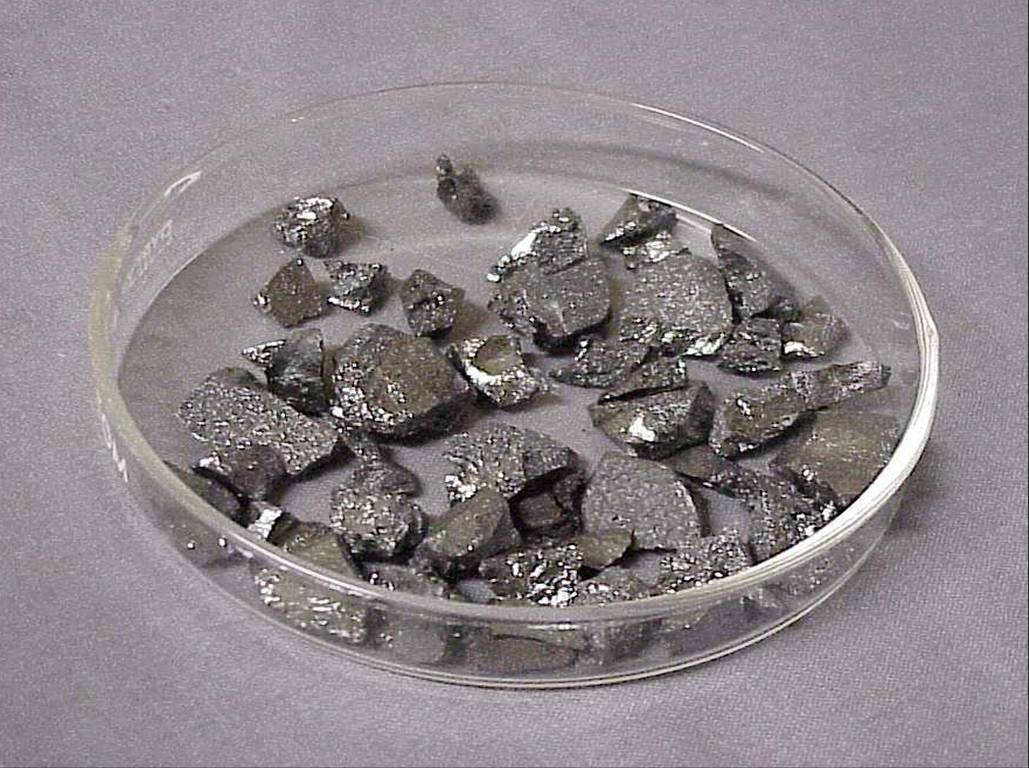
Boron chunks

Boron chunks

Ball-and-stick model of tetraborate anion, [B4O5(OH)4]2−, as it occurs in crystalline borax, Na2[B4O5(OH)4]·8H2O. Boron atoms are pink, with bridging oxygens in red, and four hydroxyl hydrogens in white. Note two borons are trigonally bonded sp2 with no formal charge, while the other two borons are tetrahedrally bonded sp3, each carrying a formal charge of −1. The oxidation state of all borons is III. This mixture of boron coordination numbers and formal charges is characteristic of natural boron minerals.

Ball-and-stick model of tetraborate anion, [B4O5(OH)4]2−, as it occurs in crystalline borax, Na2[B4O5(OH)4]·8H2O. Boron atoms are pink, with bridging oxygens in red, and four hydroxyl hydrogens in white. Note two borons are trigonally bonded sp2 with no formal charge, while the other two borons are tetrahedrally bonded sp3, each carrying a formal charge of −1. The oxidation state of all borons is III. This mixture of boron coordination numbers and formal charges is characteristic of natural boron minerals.

Ball-and-stick models showing the structures of the boron skeletons of borane clusters. The structures can be rationalised by polyhedral skeletal electron pair theory.[61]

Ball-and-stick models showing the structures of the boron skeletons of borane clusters. The structures can be rationalised by polyhedral skeletal electron pair theory.[61]

Structure of diborane

Structure of diborane

Unit cell of B4C. The green sphere and icosahedra consist of boron atoms, and black spheres are carbon atoms.[71]Image by Materialscientist, licensed under Creative Commons Attribution-Share Alike 3.0

Unit cell of B4C. The green sphere and icosahedra consist of boron atoms, and black spheres are carbon atoms.[71]

Rhombohedral crystal structure.

Rhombohedral crystal structure.

Amorphous boron powder

Amorphous boron powder

Boron chunks

Boron chunks

Ball-and-stick model of tetraborate anion, [B4O5(OH)4]2−, as it occurs in crystalline borax, Na2[B4O5(OH)4]·8H2O. Boron atoms are pink, with bridging oxygens in red, and four hydroxyl hydrogens in white. Note two borons are trigonally bonded sp2 with no formal charge, while the other two borons are tetrahedrally bonded sp3, each carrying a formal charge of −1. The oxidation state of all borons is III. This mixture of boron coordination numbers and formal charges is characteristic of natural boron minerals.

Ball-and-stick model of tetraborate anion, [B4O5(OH)4]2−, as it occurs in crystalline borax, Na2[B4O5(OH)4]·8H2O. Boron atoms are pink, with bridging oxygens in red, and four hydroxyl hydrogens in white. Note two borons are trigonally bonded sp2 with no formal charge, while the other two borons are tetrahedrally bonded sp3, each carrying a formal charge of −1. The oxidation state of all borons is III. This mixture of boron coordination numbers and formal charges is characteristic of natural boron minerals.

Ball-and-stick models showing the structures of the boron skeletons of borane clusters. The structures can be rationalised by polyhedral skeletal electron pair theory.[61]

Ball-and-stick models showing the structures of the boron skeletons of borane clusters. The structures can be rationalised by polyhedral skeletal electron pair theory.[61]

Structure of diborane

Structure of diborane

Unit cell of B4C. The green sphere and icosahedra consist of boron atoms, and black spheres are carbon atoms.[71]

Unit cell of B4C. The green sphere and icosahedra consist of boron atoms, and black spheres are carbon atoms.[71]

Boron In Agriculture

Boron is essential for plants to grow! 🌱It helps them create cell walls and absorb nutrients better. Farmers use boron in fertilizers to make sure their crops get enough. 🥕Did you know that broccoli and carrots are high in boron? 🌽It’s like a magical mineral that keeps plants healthy and tasty! Without boron, many plants wouldn’t grow well, so it’s super important for food production! Yum! 🍏

Uses Of Boron In Industry

Did you know that boron is super useful in industries? 🏭It helps make strong glass and ceramics, which are used for things like windows and dishes! Boron is also important in making rocket fuels and nuclear reactors. 🚀It helps improve the strength of materials used in sports equipment! ⚽Even in cosmetics, boron compounds help keep products safe and effective! So, boron is everywhere, helping us in many ways!

Chemical Properties Of Boron

Boron is special because it can form different types of bonds with other elements! 🤝It is mostly found in nature as a compound with oxygen, called borates, like borax! Boron likes to combine with other elements, forming strong bonds, and that’s why it’s used in glass-making! It has a high melting point of about 2,550 °C (4,582 °F), which means it can withstand very high temperatures. 🔥Boron also reacts with oxygen and nitrogen, but not with water. Isn’t science exciting? 🌈

Physical Properties Of Boron

Boron is a pretty interesting element! It often appears as a shiny, black metal-like solid, but sometimes it can look like a brown, powdery substance. 🖤Its density is about 2.46 grams per cubic centimeter. This means it’s heavier than water but lighter than iron! When you heat boron, it can change to a liquid, and if it gets really hot, it will turn into a gas! 🌬️ Boron is also very hard and is used to make materials tougher. So, it’s strong like a superhero! 💪

Environmental Impact Of Boron

Boron is generally safe for the environment, but too much of it can be harmful! 🌏If boron enters water systems, it can affect plants and animals. 🌊Some fish may be sensitive to high boron levels. That’s why it’s crucial to use boron wisely in agriculture and industry! 🌿With proper care, we can enjoy all the benefits of boron while protecting our planet! Let’s be responsible learners and help keep our Earth healthy! 🌍✨

Biological Importance Of Boron

Boron helps keep our bodies healthy too! 🌟Though we only need a tiny amount, it plays a big role in bone health and keeping our brain functioning well. 🧠Some studies say boron may even help with better memory and thinking! However, we usually get boron through our food, like nuts, fruits, and vegetables! 🍆It’s amazing how something small can make a big difference in how we feel!

Occurrence And Sources Of Boron

Boron is found naturally in many places on Earth! 🌍It mostly comes from mineral deposits called borates, which are found in places like Turkey, the USA, and Argentina. In Turkey, the largest boron mines are located in a region called Bigadiç. Turkey supplies about 70% of the world’s boron! Countries like the USA have boron sources too, in places like California. This makes boron a valuable resource! 🌱

Boron Compounds And Their Applications

Boron forms many compounds, such as borax and boric acid. 🧪Borax is a popular cleaning agent while boric acid is often used as an insect repellent! 🐜It can also help make special glasses for telescopes and lenses. 🔭Boron compounds are used in soaps, detergents, and even in high-tech materials like bulletproof vests! 🦺It’s incredible how these compounds improve our daily lives!

Boron Quiz

Q1
Question 1 of 10

Learn more about Boron

Ready to create?

Make

To create a safe space for kid creators worldwide!

Create

Vibe Coding

Kids GPT

All Tools

Kibu

Resources

Worksheets

SafeTube

Blog

FAQ

Account

Pricing

Log-in

Sign-up

Data Deletion

Company

About

Community Guidelines

Privacy Policy

Terms of Service

2025, URSOR LIMITED. All rights reserved. DIY is in no way affiliated with Minecraft™, Mojang, Microsoft, Roblox™ or YouTube. LEGO® is a trademark of the LEGO® Group which does not sponsor, endorse or authorize this website or event. Made with love in San Francisco.