All Articles

Abdomen

Abdomen Facts For Kids

The abdomen is the front part of the torso, located between the thorax and pelvis, containing vital organs and playing key roles in digestion and movement.

🎨 Reading age for 6-8
Background blob
Abdomen
Abdomen
Facts for Kids!
Image by 7mike5000, licensed under Creative Commons Attribution-Share Alike 3.0

Do more with AI

Introduction

The abdomen, or tummy, is a special part of our body! 🏃‍♂️ It is located between the chest (thorax) and the hips (pelvis). This area is important because it holds many vital organs, like the stomach, intestines, and kidneys. The abdomen plays a key role in digestion, helping our bodies break down food and give us energy. It can be found in many animals too, not just humans! 🐶The abdomen can stretch when we eat or sit down. Isn’t that cool? Let’s explore more about this amazing part of our body! 🌟

Images of Abdomen

Front of abdomen, showing markings for duodenum, pancreas, and kidneys

Front of abdomen, showing markings for duodenum, pancreas, and kidneys

Photos of Abdomen
Photos of Abdomen
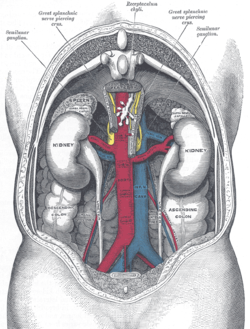
The relations of the viscera and large vessels of the abdomen. (Seen from behind, the last thoracic vertebra being well raised.)

The relations of the viscera and large vessels of the abdomen. (Seen from behind, the last thoracic vertebra being well raised.)

Photos of Abdomen
Photos of AbdomenImage by Locketudor, licensed under Creative Commons Attribution-Share Alike 3.0
Abdominal organs anatomy in an adult human maleImage by BruceBlaus, licensed under Creative Commons Attribution-Share Alike 4.0

Abdominal organs anatomy in an adult human male

The Superman exercise, involving balancing solely with the abdomen (on a folded towel) while raising the upper torso and pelvis off the floor with the limbs bent. There are numerous variations.[6]Image by RickyBennison, licensed under Creative Commons Attribution 4.0

The Superman exercise, involving balancing solely with the abdomen (on a folded towel) while raising the upper torso and pelvis off the floor with the limbs bent. There are numerous variations.[6]

Surface projections of the organs of the trunk, from which organ locations are derived mainly from vertebra levels, ribs and the ilium

Surface projections of the organs of the trunk, from which organ locations are derived mainly from vertebra levels, ribs and the ilium

Photos of Abdomen
Photos of Abdomen
The relations of the viscera and large vessels of the abdomen. (Seen from behind, the last thoracic vertebra being well raised.)

The relations of the viscera and large vessels of the abdomen. (Seen from behind, the last thoracic vertebra being well raised.)

Photos of Abdomen
Photos of AbdomenImage by Locketudor, licensed under Creative Commons Attribution-Share Alike 3.0
Abdominal organs anatomy in an adult human maleImage by BruceBlaus, licensed under Creative Commons Attribution-Share Alike 4.0

Abdominal organs anatomy in an adult human male

The Superman exercise, involving balancing solely with the abdomen (on a folded towel) while raising the upper torso and pelvis off the floor with the limbs bent. There are numerous variations.[6]Image by RickyBennison, licensed under Creative Commons Attribution 4.0

The Superman exercise, involving balancing solely with the abdomen (on a folded towel) while raising the upper torso and pelvis off the floor with the limbs bent. There are numerous variations.[6]

Surface projections of the organs of the trunk, from which organ locations are derived mainly from vertebra levels, ribs and the ilium

Surface projections of the organs of the trunk, from which organ locations are derived mainly from vertebra levels, ribs and the ilium

Front of abdomen, showing markings for duodenum, pancreas, and kidneys

Front of abdomen, showing markings for duodenum, pancreas, and kidneys

Functions Of The Abdomen

The abdomen has lots of important jobs! 🎉One of its biggest roles is to help us digest food. When we eat, our food travels from the mouth to the stomach, and then to the intestines, where our body absorbs nutrients and energy. The abdomen also helps protect vital organs like the kidneys and bladder. 💪It supports our posture and keeps our body stable when we run or play. It even helps us breathe! When we inhale, our abdomen expands, and when we exhale, it goes back to its normal shape. Isn't that fascinating? 🌬️

Fun Facts About The Abdomen

Here are some awesome and funny facts about the abdomen! 🎉Did you know that our abdomen can expand when we eat? It's true! It can stretch to hold a lot of food. Also, your tummy can produce over 7 liters of gastric juice every day to help digest food. Isn’t that wild? 🤯Some animals have more than one stomach! 🐄Cows have four! Lastly, have you ever noticed that when you laugh really hard, it feels like your tummy is doing a workout? That's your abdominal muscles at work! 😂

Anatomy Of The Human Abdomen

The human abdomen has four main parts! 📏These are called quadrants: right upper, right lower, left upper, and left lower. In these quadrants, you can find important organs! The liver and gallbladder are in the right upper quadrant, while the left upper quadrant has the stomach and spleen. The small and large intestines are in the lower quadrants. The abdomen is covered by skin and filled with muscles, called abdominal muscles, which help us move. 🏋️ So when we jump, bend, or laugh, we’re working our abdomen!

Abdominal Muscles And Movements

Our abdominal muscles are super important for movement! 💪They help us sit, stand, and bend. There are three main types of abdominal muscles: the rectus abdominis (which makes up the "six-pack"), the external obliques, and the internal obliques. Together, they work to support our spine and keep our body balanced. When we exercise, these muscles get stronger! 🏆They also play a role in important daily activities, like laughing, coughing, and sneezing. So next time you play, thank your abdominal muscles for helping you move! 🚲

Abdominal Disorders And Diseases

Sometimes, the abdomen can get sick, just like any part of our body. 😷Some common problems include stomachaches, which can happen due to eating too much or too quickly. A more serious issue is appendicitis, where the appendix (a small organ) becomes inflamed and may need surgery! 🚑Other abdominal problems include ulcers and irritable bowel syndrome (IBS). It's important to listen to our bodies. If our tummy hurts, we should tell an adult! This way, we can get the help we need to feel better. ❤️

Digestive System And The Abdomen

The abdomen is a vital part of the digestive system! 🍕When we eat a meal, it travels down our throat into the stomach, where it mixes with special juices. These juices help break down the food. Then, the food goes to the small intestine, where nutrients are absorbed. 🌽After that, the leftover waste moves to the large intestine and finally leaves our body. The abdomen also helps us feel hunger and fullness. Our brain communicates with our tummy to let us know when it’s time to eat or stop eating. Wow, our bodies are amazing! 🥗

Cultural Perspectives On The Abdomen

Different cultures view the abdomen in unique ways! 🌍In many places, being healthy and having a strong abdomen is celebrated through exercises like yoga and martial arts. In some cultures, food plays a big role in nurturing the abdomen. For example, there are yummy dishes from around the world, like sushi from Japan or tacos from Mexico, which help feed our tummies! 🍱Also, some cultures have special dances that use abdominal movements, making it a fun way to stay active! 💃Isn’t it neat how our abdomens connect us to food and culture?

Diagnostic Techniques For Abdominal Issues

Doctors use special tools to check if our abdomen is feeling okay. 🔍One common method is called an ultrasound, where sound waves create pictures of the inside of our tummy. Another is an X-ray, which helps doctors see any problems with our organs. Sometimes, doctors may ask us to do a CT scan, which shows detailed images of our abdomen. 🚶‍♂️ If our tummy hurts, the doctor will gently press around the area to see what could be wrong. It’s important to visit a doctor when we have tummy troubles! 📅

Comparative Anatomy: Human Vs. Insect Abdomen

Did you know that insects have abdomens too? 🐞While our abdomen is soft and flexible, an insect's abdomen is hard and divided into segments. Insects, like ants and beetles, use their abdomens to help with digestion, just like humans do! However, an insect's abdomen also plays roles in reproduction and sometimes even in breathing. 🦋Additionally, they tend to have a smaller abdomen compared to their body size, while ours is larger in proportion. Isn’t it interesting how our bodies are different yet similar in some ways? 🌍

Abdomen Quiz

Q1
Question 1 of 10

Learn more about Abdomen

Ready to create?

Make

To create a safe space for kid creators worldwide!

Create

Vibe Coding

Kids GPT

All Tools

Kibu

Resources

Worksheets

SafeTube

Blog

FAQ

Account

Pricing

Log-in

Sign-up

Data Deletion

Company

About

Community Guidelines

Privacy Policy

Terms of Service

2025, URSOR LIMITED. All rights reserved. DIY is in no way affiliated with Minecraft™, Mojang, Microsoft, Roblox™ or YouTube. LEGO® is a trademark of the LEGO® Group which does not sponsor, endorse or authorize this website or event. Made with love in San Francisco.