Use Fills While Beatboxing
Learn to add simple vocal drum fills to your beatboxing routines using lips, tongue, and breath. Practice timing, rhythm, and creative expression.


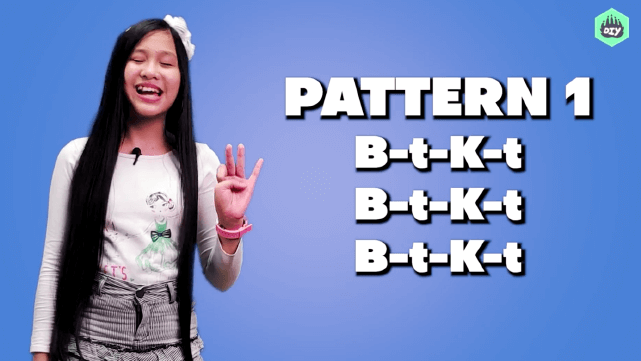
Step-by-step guide to add fills while beatboxing
Step 1
Sit up straight in a comfy chair so you can breathe easily.
Step 2
Place the mirror where you can see your mouth and lips clearly.
Step 3
Open your metronome app and set it to a slow steady tempo like 60 BPM.
Step 4
Take three slow deep breaths to relax your mouth and tongue.
Step 5
Make the kick drum sound by pressing your lips together and pushing a short burst of air to say a strong "B" five times.
Step 6
Make the hi-hat sound by touching the tip of your tongue behind your top teeth and pushing air to make a crisp "tss" sound five times.
Step 7
Make the snare sound by pressing your lips together and blowing a short "pf" puff to create a snappy "pf" sound five times.
Step 8
Practice a basic 4-beat pattern with the metronome by doing B on beat 1 then Tss on beat 2 then B on beat 3 then Tss on beat 4 for eight bars.
Step 9
Practice adding the snare by doing B on beat 1 then Tss on beat 2 then Pf on beat 3 then Tss on beat 4 for eight bars.
Step 10
Practice a short vocal drum fill by quickly doing Tss then Pf then a soft B between two metronome clicks and repeat this fill four times.
Step 11
Share your finished beatboxing routine on DIY.org.
Help!?
What can we use if we don't have a mirror, metronome app, or access to DIY.org?
Use your phone's front camera or a small handheld mirror for mouth checks, replace the metronome app with a free online metronome or a parent tapping a steady 60 BPM, and save or share the routine on a parent's tablet or video-sharing app if you can't access DIY.org.
I'm not getting a clear 'pf' snare or steady B on the beat—what should I try?
Check your lip and tongue placement in the mirror (lips together for the B kick and tongue tip behind top teeth for the 'tss'), slow the tempo to 60 BPM or less, and repeat the three deep breaths step before re-practicing the snare and basic 4-beat pattern.
How can we adapt the steps for younger children or make it harder for older kids?
For younger kids, reduce the eight-bar practice sections to four bars, keep the metronome at 60 BPM or slower and let them clap the pattern instead of doing mouth sounds, while older kids can raise the tempo, extend practice beyond eight bars, and add more complex fills than the four-repeat fill.
What are simple ways to personalize or extend the beatboxing routine after mastering the fill?
After mastering the short vocal drum fill (Tss–Pf–soft B between clicks), create additional fills, experiment with a low vocal bass or vocal effects on your phone recordings, mix multiple takes, or add a signature ending before uploading your final routine to DIY.org.
Watch videos on how to add fills while beatboxing
How To Beatbox For Beginners: Learn The Basics (Part 1)
4 Videos
How To Beatbox For Beginners: Learn The Basics (Part 1)
How To Beatbox The Basics (10 Beginner Sounds)
How To Beatbox For Beginners: Learn The Basics (Part 2)

Hi-Hat - How to Beatbox (EASY TUTORIAL) by a beatbox teacher
Facts about beatboxing and vocal percussion
🥁 Beatboxing can mimic an entire drum kit—bass (B), snare (K/Pf), and hi-hat (ts)—using only lips, tongue, and breath.
🎧 The modern beatboxing scene exploded in 1980s hip-hop; artists like Doug E. Fresh helped popularize vocal percussion on records and live shows.
🔁 A "fill" is a short rhythmic phrase that links song sections—beatbox fills spice up transitions and solos with creative sounds.
⏱️ Practice timing: at 120 BPM one bar has 16 sixteenth-notes, so fills often squeeze 8–16 quick sounds into a short space.
🌍 Beatbox battles and communities exist worldwide, with annual championships that bring together creative vocal percussionists.
How do you practice adding fills while beatboxing?
What materials do I need to learn beatboxing fills?
What ages is learning beatboxing fills suitable for?
What are the benefits and safe practice tips for beatboxing fills?
