Sketch out your 8 page comic using simple stick figures
Create an eight-page comic using simple stick figures, plan panels and story, draw scenes, add speech and captions, and assemble into a booklet.


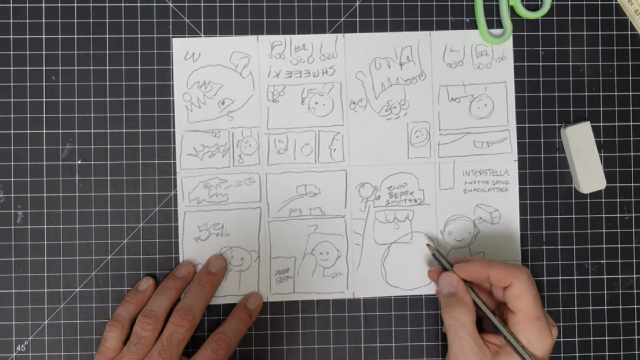

Step-by-step guide to create an eight-page stick-figure comic
Step 1
Gather all your materials and clear a flat workspace so you have room to draw.
Step 2
Stack the eight sheets and fold them in half together to make an eight-page booklet.
Step 3
Use your ruler and pencil to lightly draw comic panels on each page to plan where each scene will go.
Step 4
On a scrap sheet write one short sentence for each page to plan the story from start to finish.
Step 5
Sketch stick-figure scenes in the panels on each page following your one-sentence plan.
Step 6
Draw speech bubbles and short captions for each panel to show what the characters say and think.
Step 7
Erase any extra sketch lines that you do not want in your final comic.
Step 8
Trace over your final pencil lines to make them darker and clearer.
Step 9
Add color and small details to your characters and backgrounds with your colouring materials.
Step 10
Write a title and your name on the front cover and staple or tape the folded spine to bind the booklet with an adult’s help.
Step 11
Share your finished eight-page comic on DIY.org.
Help!?
If we don't have a ruler, colouring markers, or a stapler, what can we use instead?
Use the straight edge of a book or a cereal box as a ruler to draw panels with your pencil, substitute crayons or coloured pencils for markers when you add color, and bind the folded spine with two strong paperclips or a hole-punched ribbon tied by an adult if you don't have a stapler or tape.
My panels look crooked and my penciled drawings keep smudging—how can we fix that?
Lightly sketch panels and stick figures with your pencil using a book edge for straight lines, erase extra sketch lines carefully before you trace over your final pencil lines to make them darker, and let any marker ink dry completely before closing the booklet.
How can we adapt this 8-page comic activity for a 4-year-old versus a 10-year-old?
For a 4-year-old pre-fold the eight sheets, draw large single panels and help them dictate one short sentence per page and color with crayons, while a 10-year-old can create multiple smaller panels, write their own page sentences, add detailed backgrounds with coloured pencils, and trace final lines for inking.
What are easy ways to personalize or extend the finished comic beyond the basic stick-figure booklet?
Number the pages, design a decorated front cover with the title and your name, add consistent character color schemes and small background details when you add color, and photograph or scan the booklet to edit or add speech-bubble fonts before sharing on DIY.org.
Watch videos on how to create an eight-page stick-figure comic
Kids Make Comics#1: Simple Shapes make Super Characters!
4 Videos

Kids Make Comics#1: Simple Shapes make Super Characters!
How I Make Mini Comics? (step by step) PART I
Kids Make Comics #6: Inking Your Comics
Kids Make Comics #7: Making Comic Panels
Facts about comic-making for kids
📰 The Yellow Kid, appearing in the 1890s, is often credited as one of the first popular newspaper comic strips.
✏️ Stick figures are one of the oldest ways people draw humans—simple human forms appear in ancient rock and cave art worldwide.
📚 Comics expert Scott McCloud describes six types of panel-to-panel transitions—small choices that greatly affect a story's pacing.
🗣️ Early comics often used captions under panels; speech balloons became a standard later to show dialogue directly in the scene.
📄 You can make an 8-page mini-comic by nesting two sheets of paper, folding them together, and stapling the spine to create a booklet.
How do you sketch out an eight-page comic using simple stick figures?
What materials do I need to make an eight-page stick-figure comic booklet?
What ages is this stick-figure comic activity suitable for?
What are the benefits of making an eight-page stick-figure comic?
