Share how you want to improve your song
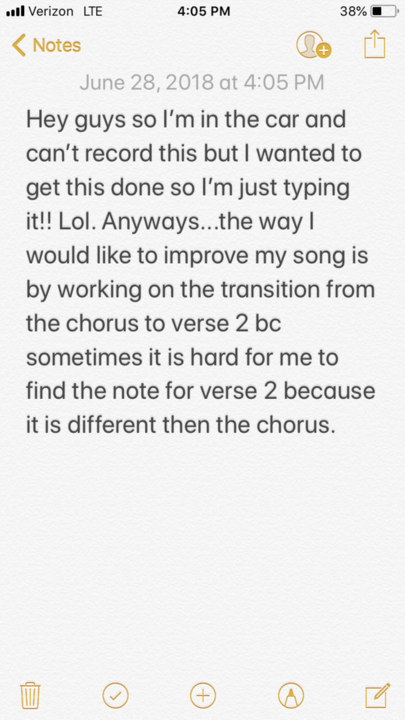
Make a short recorded or written plan listing three changes to improve your song, then try one revision and listen for the difference.
About this activity
Make a short recorded or written plan listing three changes to improve your song, then try one revision and listen for the difference.
What you need
Step by step
- 1
Step 1
Find a quiet spot where you can hear yourself sing or play.
- 2
Step 2
Gather your paper and pencil and sit down to work.
- 3
Step 3
Sing or play your original song from start to finish one time.
- 4
Step 4
Listen carefully to the whole performance and notice what stands out to you.
- 5
Step 5
Write three short ideas on your paper for how the song could be better (one idea per line).
- 6
Step 6
Circle the one change you most want to try first.
- 7
Step 7
Write one clear sentence that explains exactly how you will change that part.
- 8
Step 8
Try the change by singing or playing the song with your chosen revision.
- 9
Step 9
Listen to your revised version right after you play it.
- 10
Step 10
Write one sentence about what sounds different or improved after the change.
- 11
Step 11
Share your finished plan and your revised version on DIY.org.
Fun facts
How do I help my child improve a song using a short plan and one revision?
Start by recording the original version or writing the song down to capture a baseline. Ask your child to list three specific changes—like adjusting melody, simplifying lyrics, changing tempo, adding harmony, or altering instrumentation. Pick one change to try, set a short time for the revision, then record the new version. Listen together and talk about differences: what improved, what they liked, and what to try next. Celebrate effort.
What materials do I need to do this song revision activity at home?
You'll need a simple recording device (smartphone, tablet, or voice recorder), paper or a notebook, and a pen or pencil to list three changes. Optional helpful items include a small instrument, headphones, a metronome or rhythm app, and a basic audio app for trimming or replaying takes. No fancy gear is needed—clear audio and a way to note ideas are enough to compare versions and learn.
What ages is this song revision activity suitable for?
This activity suits children roughly ages 5–14, with adjustments. Ages 5–7 benefit from very simple choices (louder/softer, change a word) and adult help with recording. Ages 8–11 can list three creative changes and try revisions independently. Ages 12–14 can use basic editing apps, explore harmony or structure, and reflect critically. Always tailor language and expectations to the child’s attention span and musical experience.
What are the benefits of making a short recorded or written plan and revising a song?
Making a short plan and revising songs builds listening skills, musical judgment, and creative confidence. Kids learn to identify specific problems, try focused experiments, and reflect on outcomes—valuable critical-thinking skills that transfer to school and teamwork. The activity also practices language (lyrics), fine motor skills (playing instruments), and persistence. Keep feedback positive and framed as experiments to support growth and avoid discouraging sensitive children.
Watch & Learn
Need help?
If I don't have paper and pencil, what can I use instead to follow the 'Gather your paper and pencil and sit down to work' step?
If you don't have paper and pencil, use a phone or tablet notes app or a voice memo to record your three ideas and the one-sentence plan instead of writing on paper.
What should I do if I can't hear myself well when I 'Sing or play your original song' and need to 'Listen carefully to the whole performance'?
If you can't hear yourself clearly, record the performance on your phone in a quiet spot and play it back so you can complete step 4 and notice what stands out.
How can I adapt 'Write three short ideas' and 'Circle the one change' for different ages?
For preschoolers, have them draw one picture per idea and let an adult circle the chosen change, while older kids can write three concise notes, use a metronome, and compare multiple takes before circling.
How can I extend or personalize the activity beyond the 'Try the change' and 'Share your finished plan' steps?
To enhance the activity, experiment with adding harmony, changing tempo or instrumentation when you try the change, note the difference in your written sentence, and upload both original and revised clips with a brief caption to DIY.org.