Purify water
Build a simple water purifier using gravel, sand, charcoal, and a plastic bottle; test it with dirty water (do not drink) and learn about filtration.



Step-by-step guide to build a simple water purifier
PURIFICATION OF WATER || PURIFICATION METHODS || SCIENCE EDUCATIONAL VIDEO FOR CHILDREN
Step 1
Gather all the materials on a table and read the safety rule that the water is for testing only and never to be drunk.
Step 2
Ask an adult to cut off the bottom of the plastic bottle so the top becomes an inverted funnel.
Step 3
Push a coffee filter or a square of clean cloth into the bottle neck and secure it tightly with a rubber band.
Step 4
Place a small thin pad of cotton balls or another piece of cloth on top of the filter inside the neck to hold the layers above.
Step 5
With an adult's help crush the charcoal into small pieces in a bowl.
Step 6
Pour a 2 to 3 centimeter layer of the crushed charcoal into the bottle on top of the cotton pad.
Step 7
Add a 3 to 5 centimeter layer of fine sand on top of the charcoal.
Step 8
Add a 3 to 5 centimeter layer of pebbles or gravel on top of the sand.
Step 9
Set the bottle upside down with the neck pointing into the clear cup or jar so the cut end faces up.
Step 10
Slowly pour the dirty water into the top of the bottle and let it drip into the cup below without disturbing the layers.
Step 11
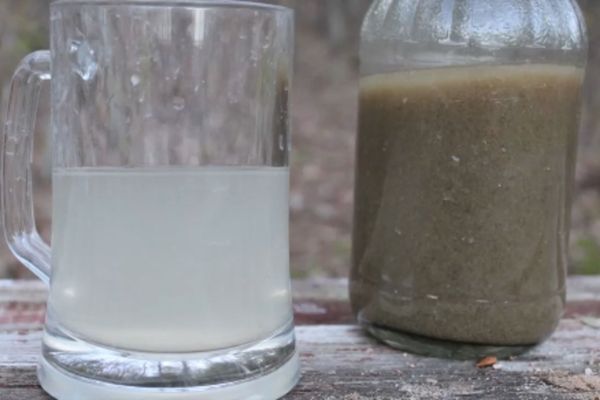
Look at the filtered water and compare it with the dirty water to see how much cleaner it looks and remember not to drink either sample.
Step 12
Take a photo or write a short note about your purifier and share your finished creation on DIY.org
Help!?
What can we use instead of charcoal or a coffee filter if those are hard to find?
Use activated charcoal from an aquarium supply or crushed plain BBQ charcoal instead of the crushed charcoal, and substitute a paper towel, unbleached coffee filter, or a clean cotton sock for the coffee filter or square of cloth, securing it with the rubber band as in the instructions.
If the filtered water still looks dirty or the layers keep mixing, what should we try?
Check that the cotton pad is sitting on top of the filter and held by the rubber band, pour the dirty water much more slowly, and add a finer sand layer or an extra layer of crushed charcoal so particles are trapped instead of disturbing the sand and pebbles.
How can we change the activity for younger children or older kids?
For younger children have an adult cut the bottle and pre-crush and layer the charcoal, sand, and pebbles and use larger pebbles for safety while older kids can measure the 2–5 cm layers precisely, test turbidity or pH, and record before-and-after photos for DIY.org.
How can we extend, improve, or personalize the purifier for a project or display?
Add a second inverted bottle as a second-stage filter, experiment with an extra charcoal layer or different sand grain sizes, decorate and label the bottle and clear cup, and document clarity changes with photos or notes to share on DIY.org.
Watch videos on how to build a simple water purifier
Water Storage and Purification | Easy Learning for Kids | Fefdy Prime
4 Videos
Water Storage and Purification | Easy Learning for Kids | Fefdy Prime
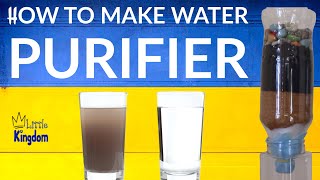
Water Filter - Science Experiments for Kids | Water Purifier | Little Kingdom
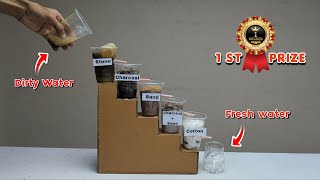
DIY Water Purification Model | Easy 5 Steps 💧 Science Project 🧪

Water Sanitation and Purification: Three Ways to Purify Drinking Water at Home
Facts about water filtration and safety
🧪 Slow sand filters have been used since the 1800s to make river water safer for towns and cities.
🌊 About 71% of Earth's surface is water, but only about 1% is readily available freshwater for people to use.
🔥 Charcoal (and its stronger form, activated carbon) can trap odors and many chemicals—people have used charcoal to clean water for thousands of years.
🪨 Gravel and sand are great at catching visible dirt because bigger particles get trapped between the grains as water flows through.
⚠️ A homemade bottle filter can clear cloudy water but usually won't remove all bacteria or viruses, so filtered water in experiments should still not be drunk.
How do I build a simple water purifier with a plastic bottle?
What materials do I need to make a DIY water filter for a school project?
What ages is this water purification activity suitable for?
What are the safety tips and learning benefits of making a simple water purifier?
