Practice the First Five Calligraphy Strokes
Practice the first five basic calligraphy strokes using a brush pen or marker and paper, repeating drills to build steady pressure, control, and neat letterforms.
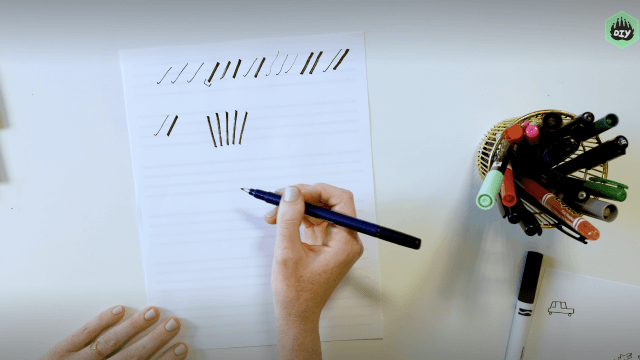
About this activity
Practice the first five basic calligraphy strokes using a brush pen or marker and paper, repeating drills to build steady pressure, control, and neat letterforms.
What you need
Step by step
- 1
Step 1
Place your paper on a flat table and set your brush pen marker pencil ruler and scrap paper within reach.
- 2
Step 2
Use the pencil and ruler to draw three light horizontal guide lines across your paper about a finger width apart.
- 3
Step 3
On the scrap paper make twenty quick wrist circles or scribbles to warm up your hand.
- 4
Step 4
Hold your brush pen at a 45-degree angle and rest your hand lightly on the table for steady control.
- 5
Step 5
On the top guide line draw ten thin upstrokes using very light pressure from bottom to top.
- 6
Step 6
On the next guide line draw ten thick downstrokes using heavier pressure from top to bottom.
- 7
Step 7
On the next line practice ten underturn strokes starting with light pressure then increasing slightly as you curve under.
- 8
Step 8
Draw ten overturn strokes starting with heavier pressure then easing to light pressure as you move upward.
- 9
Step 9
Practice ten compound curve or oval strokes that go thin up thick through the middle and thin again at the end.
- 10
Step 10
Use the strokes you practiced to write three simple letters like l o and u three times each on fresh paper focusing on smooth connections.
- 11
Step 11
Take a photo of your best practice sheet and share your finished calligraphy drills on DIY.org
Fun facts
How do you practice the first five calligraphy strokes?
Start by setting up a guideline sheet with horizontal lines and an x-height. Hold the brush pen at a comfortable angle (about 45°). Warm up with loose circles and straight lines. Drill each stroke slowly: light upstrokes (thin), heavier downstrokes (thick), underturns/overturns to change pressure, compound curves (down then up), and ovals. Repeat each stroke 10–20 times, focusing on consistent pressure and smooth motion. Rest and review for evenness.
What materials do I need for practicing basic calligraphy strokes?
You need a soft brush pen or flexible marker, smooth practice paper or a calligraphy pad, and printed guideline sheets. Add a pencil and ruler for drawing guides, an eraser, and a paper towel to blot excess ink. Optional extras: a lightbox for tracing, multiple nib sizes to explore, and non-toxic washable pens for children. Keep a stable workspace and good lighting for best control.
What ages is practicing the first five calligraphy strokes suitable for?
This activity suits children about 7 years and older who have basic pencil control. Younger kids (4–6) can try simplified drills with chunky markers and close supervision to build strength. Teens and adults benefit equally. Adjust session length—short bursts work best for young learners—and offer help with grip, posture, and guided tracing until fine motor control improves.
What are the benefits of practicing these calligraphy strokes?
Repeating the first five strokes builds fine motor control, steady hand pressure, and better handwriting. It improves focus, patience, and visual motor coordination while teaching muscle memory for neat letterforms. Regular practice also boosts confidence and creativity. To vary practice, try different pen sizes, contrast colors for drills, or combine strokes into simple letters once the basic shapes feel consistent.
Watch & Learn
Need help?
What can we use instead of a brush pen, marker, or ruler if we don't have them?
If you don't have a brush pen, use a soft paintbrush with water-based ink or a chisel-tip marker for similar thick/thin effects, and substitute a straight book edge or the long side of a cereal box for the ruler while keeping the pencil guide lines light.
My strokes look uneven or shaky—what step might be causing this and how can we fix it?
If upstrokes are too thick or downstrokes shaky, do extra wrist-circle warm-ups on scrap paper, make sure you're holding the brush pen at a 45-degree angle and resting your hand lightly on the table, and test pressure on the scrap before drawing on the top guide line and the next lines.
How can we change the activity for younger or older kids?
For younger children, draw wider guide lines with the pencil and ruler, use a washable felt-tip marker instead of a brush pen, and reduce repetitions to five per stroke, while older kids can tighten the guide spacing, increase repetitions to ten or twenty, and practice connecting strokes into words on fresh paper.
How can we extend or personalize the calligraphy practice once we've finished the drills and letters?
To enhance the activity, experiment with multiple colored brush pens when practicing the five strokes, add decorative compound-curve flourishes to your l, o, and u on fresh paper, and mount your best practice sheet as a handmade card before photographing it to share on DIY.org.