Practice letters with V shape - m, n, u, v, w, x and y
Practice writing V-shaped letters m, n, u, v, w, x, and y using tracing, stencils, and fun drawing exercises to improve handwriting skills.


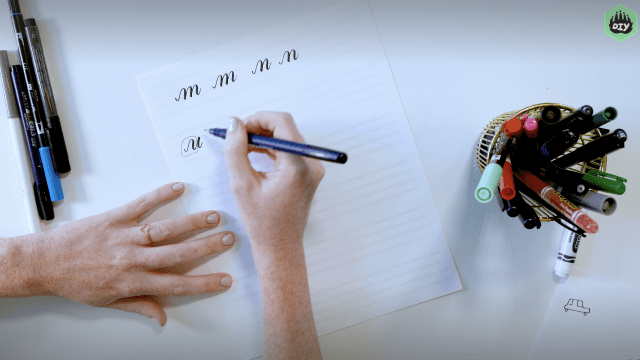

Step-by-step guide to practice letters with V shape - m, n, u, v, w, x and y
Step 1
Gather all your materials and sit at a clean flat table where you can draw.
Step 2
Use the pencil to draw a large V shape on the cardboard to make a stencil.
Step 3
With an adult's help cut out the V shape from the cardboard to create your V stencil.
Step 4
Place the paper flat and use the stencil to trace seven rows of Vs down the page so you have one row for each letter.
Step 5
Turn each V in the first row into an m by drawing two small rounded humps connected to the right side of each V.
Step 6
Turn each V in the second row into an n by drawing one small rounded hump connected to the right side of each V.
Step 7
Turn each V in the third row into a u by softening the bottom point into a smooth curve and finishing the right stroke slightly upward.
Step 8
Turn each traced V in the fourth row into a v by tracing over the lines to make neat even v shapes.
Step 9
Turn each V in the fifth row into a w by drawing a second V right after the first so the pair makes a w shape.
Step 10
Turn each V in the sixth row into an x by drawing a diagonal line from the top left to the bottom right across the V.
Step 11
Turn each V in the seventh row into a y by drawing a short straight tail down from the bottom point of the V.
Step 12
Decorate and color your rows of letters using crayons or markers to make your practice sheet bright and fun.
Step 13
Share your finished creation on DIY.org
Help!?
What can we use if we don't have cardboard or markers?
Use a cereal-box panel or stiff cardstock instead of the cardboard to make the V stencil, and swap markers for crayons or colored pencils when decorating the rows.
My stencil rips or the traced Vs are uneven — how can I fix that?
Reinforce the pencil-drawn V on the cardboard with clear tape or glue two cereal-box layers together before cutting, and keep the stencil flat and pressed down while tracing the seven rows to keep the Vs even.
How can I change the activity for younger or older kids?
For toddlers make a much larger V stencil and use chunky crayons with only two rows (for example m and n) to simplify turning Vs into humps, while older children can use a finer pencil, add more rows, and practise neatness by tracing over the lines to make v shapes.
How can we extend or personalize the finished practice sheet?
Color-code each row with different crayons or markers, add a small drawing or a related word beside each letter row (like 'moon' next to m), and laminate or photograph the page to share on DIY.org.
Watch videos on how to practice letters with V shape - m, n, u, v, w, x and y
How to Write Letters for Children - Teaching Writing ABC for Preschool - Alphabet for Kids
4 Videos
How to Write Letters for Children - Teaching Writing ABC for Preschool - Alphabet for Kids
Teaching Kids How to Write The Alphabet Letters A-Z | Learning the Uppercase Letters Handwriting
Alphabuddies Letters U-V-W-X | Episodes 21-24 | Abc Phonics Show for Kids
Abc Phonics For Kids | Letters U-V-W | Alphabuddies Ep.23
Facts about handwriting for kids
📝 Kids often begin practicing letter shapes around ages 3–5 when fine motor skills are growing fast.
✍️ Letters like m, n, v, w, and y all use V-shaped strokes — thinking of tiny mountains helps kids remember them!
🔤 The modern Latin alphabet has 26 letters; mastering a handful of similar shapes can speed up learning the rest.
🧠 Writing by hand activates different parts of the brain than typing, which can boost memory and reading skills.
🎨 Artists and makers have used stencils and tracing tools for centuries to copy shapes, learn forms, and make learning fun.
How do I teach my child to practice V-shaped letters (m, n, u, v, w, x, y)?
What materials do I need to practice V-shaped letters with my child?
What ages are V-shaped letter practice activities suitable for?
What are the benefits of practicing V-shaped letters, and how can I vary the activity?
