How to Draw a Thermometer
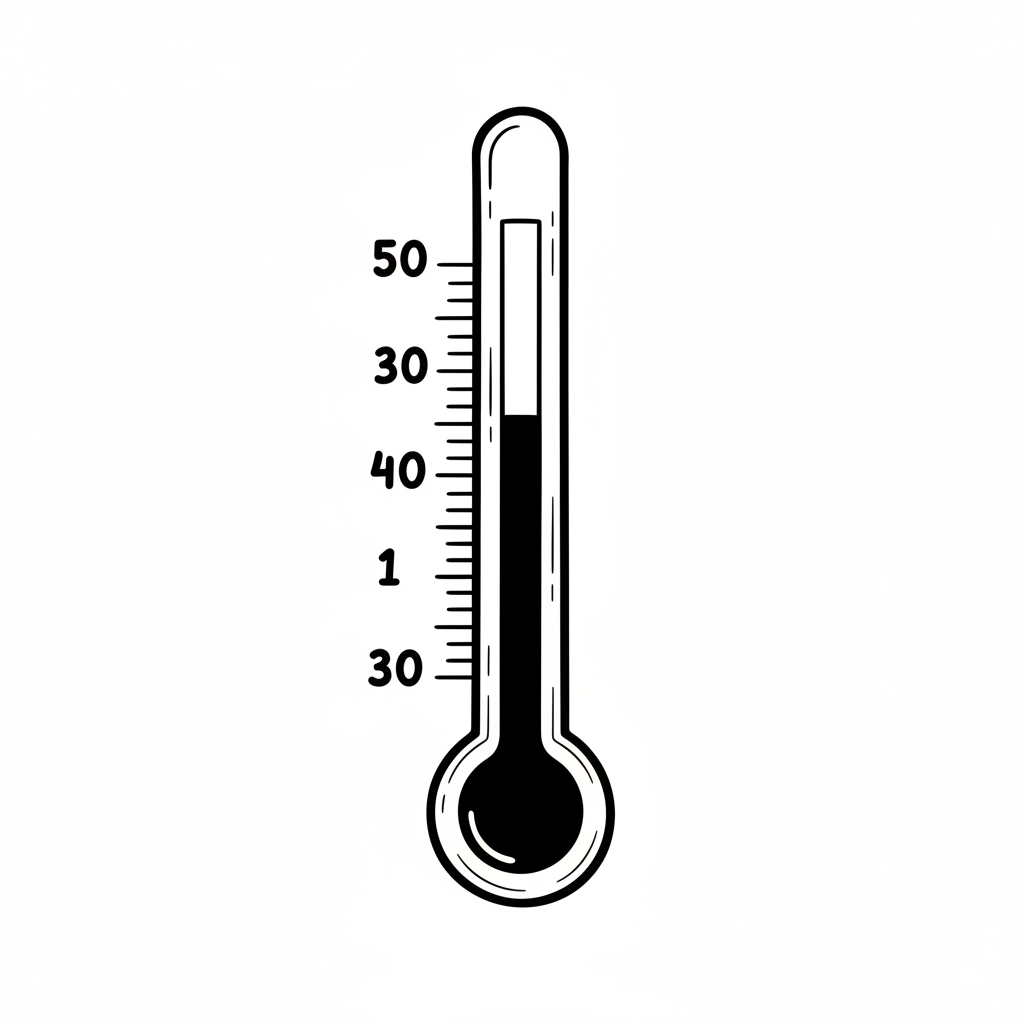
Draw a detailed thermometer using paper, pencil, ruler, and color. Create scale markings, label temperatures, and practice careful measuring and shading.
About this tutorial
Draw a detailed thermometer using paper, pencil, ruler, and color. Create scale markings, label temperatures, and practice careful measuring and shading.
What you need
Instructions
- 1
Step 1
Place your paper in portrait (vertical) position on a flat table.
- 2
Step 2
Lightly draw a circle about 4 cm across near the bottom center of the paper for the thermometer bulb.
- 3
Step 3
From the top center of the bulb lightly draw a centerline upward to about 12 cm above the bulb top to mark the tube height.
- 4
Step 4
Use your ruler to draw two straight parallel vertical lines 1.5 cm apart along the centerline to form the glass tube.
- 5
Step 5
Connect the two tube lines at the top with a small semicircle to make the rounded top cap.
- 6
Step 6
Mark the bottom major tick (0°C) just above the bulb and the top major tick (100°C) at the top cap.
- 7
Step 7
Use your ruler to make small pencil marks every 1.2 cm up the tube to mark each 10°C interval.
- 8
Step 8
Add a shorter pencil mark halfway between each 10°C mark (0.6 cm from each major mark) for 5°C intervals.
- 9
Step 9
Draw long tick lines at each 10°C mark and shorter tick lines at each 5°C mark using your ruler.
- 10
Step 10
Write the temperature numbers 0 10 20 30 40 50 60 70 80 90 100 neatly next to the long ticks on the right side.
- 11
Step 11
Choose a temperature you want to show and make a small dot at that tick so you know where the mercury should stop.
- 12
Step 12
Color the bulb and fill the tube up to your chosen dot with red coloring material to show the mercury level.
- 13
Step 13
Add a thin pencil shadow along one side of the tube and leave a narrow uncolored strip for a glass highlight.
- 14
Step 14
Erase any extra construction lines and darken the final outline and ticks so your thermometer looks neat.
- 15
Step 15
Share your finished thermometer drawing on DIY.org
Get inspired
Fun facts
How do I teach my child to draw a detailed thermometer step-by-step?
Start by sketching a large bulb at the bottom and a narrow stem upward. Use a ruler to draw straight sides for the stem and mark equally spaced ticks along one edge for degrees. Label main temperatures (for example 0, 10, 20°C) and add smaller ticks for single degrees. Shade the mercury column with a solid color, add highlight and shadow for realism, and erase construction lines when finished.
What materials are needed to draw a thermometer with accurate scale markings?
You'll need plain drawing paper, a sharp pencil (HB or 2B), a ruler for straight edges and precise tick placement, an eraser, and a fine-tip pen for permanent labels. Add colored pencils or markers (red for the mercury, greys for shading), a sharpener, and optional compass for a perfect bulb. A small scrap paper for measuring fractions and a steady surface complete the kit.
What ages is drawing a detailed thermometer suitable for?
This project suits kids roughly 6–12 years. Younger children (about 4–6) can enjoy drawing a simple thermometer with adult help for measuring and labeling. Ages 7–9 can handle ruler work and basic scale markings with coaching. Ages 10–12 can create accurate scales, label temperatures in °C/°F, and practice realistic shading. Adjust complexity and supervision based on each child's fine-motor and numeracy skills.
What are the benefits and safety tips for this thermometer drawing activity?
Drawing a thermometer builds measuring, number sense, fine motor control, and observation skills while reinforcing science concepts like temperature. It encourages careful measuring and patience. For safety, supervise use of sharp pencils and a compass, keep small items away from toddlers, and ensure a stable workspace to avoid slips. Offer breaks to reduce strain and model gentle ruler handling. Variations include changing scale ranges or drawing digital thermometer displays.
Watch & Learn
Need help?
What can we use if we don't have a ruler, compass, or red pencil for this thermometer drawing?
Use the straight edge of a book or cereal box to draw the two 1.5 cm-apart tube lines and measure 1.2 cm tick spacing with a folded paper strip, and substitute a red marker, crayon, or piece of red paper to color the bulb and fill the tube.
My tube lines or tick marks look crooked or uneven—how can I fix that step-by-step?
Lightly erase the uneven lines, relight the centerline, place your ruler on that centerline to mark 1.5 cm for the tube edges and make all 1.2 cm major tick marks with the ruler before darkening the long and short ticks to ensure straight, evenly spaced marks.
How should I change the activity for younger kids or for older kids who want more challenge?
For younger children, simplify by drawing a larger bulb and only three big ticks and having them color up to their chosen dot, while older kids can use a compass to make an exact 4 cm bulb, measure precise 1.2 cm intervals for each 10°C and add a Fahrenheit scale alongside the °C numbers.
What are some creative ways to enhance or personalize the finished thermometer before sharing on DIY.org?
Add a thin pencil shadow and narrow highlight as instructed, decorate a seasonal background to show when the chosen temperature occurs, or glue a sliding red paper strip under a clear plastic overlay to make an interactive mercury effect before photographing for DIY.org.