How to Draw a Rectangular Prism
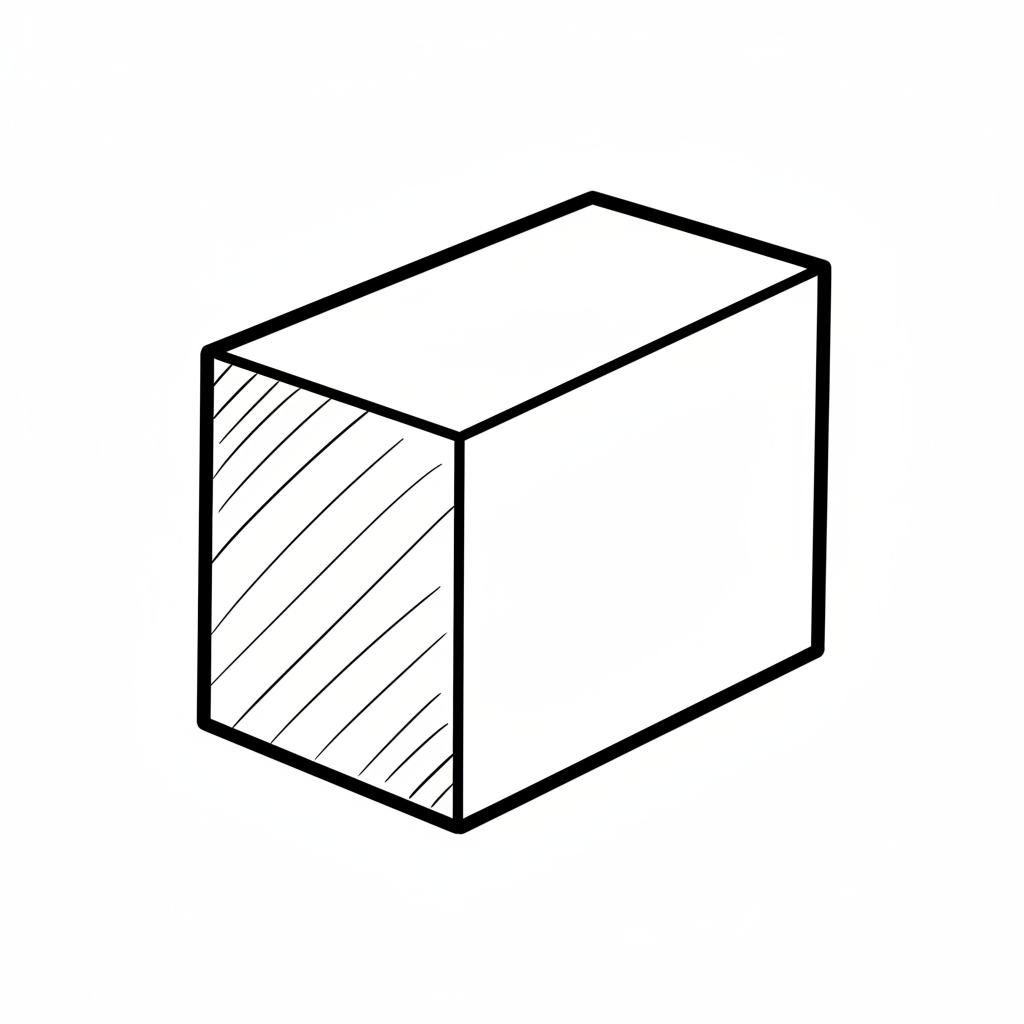
Draw a 3D rectangular prism using pencil, ruler, and vanishing point perspective techniques. Practice shading and labeling faces to understand depth and proportions.
About this tutorial
Draw a 3D rectangular prism using pencil, ruler, and vanishing point perspective techniques. Practice shading and labeling faces to understand depth and proportions.
What you need
Instructions
- 1
Step 1
Gather your materials so everything is ready to draw.
- 2
Step 2
Place the paper flat in front of you on a table or desk.
- 3
Step 3
Use the ruler to draw a straight horizontal line about one-third from the top of the paper.
- 4
Step 4
Put a small dot on the horizon line to mark your vanishing point.
- 5
Step 5
Draw a neat rectangle below the horizon line to be the front face of your rectangular prism.
- 6
Step 6
From each corner of the front rectangle draw light straight guideline rays that go toward the vanishing point.
- 7
Step 7
Decide how deep the prism will be and connect the appropriate guideline ends to form the back face rectangle.
- 8
Step 8
Darken the outer edges of the rectangular prism so the shape stands out.
- 9
Step 9
Erase any extra construction lines that are outside the prism so the drawing looks clean.
- 10
Step 10
Pick a spot for your light source and draw a tiny sun or arrow to show where the light is coming from.
- 11
Step 11
Shade each visible face with your pencil and blending tool so the face closest to the light is lightest and the farthest face is darkest.
- 12
Step 12
Label the faces by writing "front" "top" and "side" on the correct faces and add small arrows or short measurements for width height and depth.
- 13
Step 13
Take a photo or scan of your finished rectangular prism and share your creation on DIY.org.
Get inspired
Fun facts
How do I draw a 3D rectangular prism using vanishing point perspective?
Start by drawing a horizon line and choose a vanishing point (one-point) or two vanishing points (two-point). Lightly sketch the front rectangle with a pencil and ruler. From each front-corner draw construction lines toward the vanishing point(s) to set depth, then close the back face with vertical or horizontal lines. Darken the final edges, erase guidelines, practice shading from a single light source, and label faces (top, front, side) to study proportions.
What materials do I need to draw a rectangular prism in perspective?
You’ll need a pencil (HB or 2B), a good eraser, a ruler or straightedge, and drawing paper. Add a sharpener and optional tools like a blending stump or tissue for smooth shading. Colored pencils or markers help label faces. Mechanical pencils work for fine lines; for younger kids choose thicker pencils and a ruler with grip. Keep scrap paper underneath to protect the sheet while shading.
What ages are suitable for drawing a rectangular prism with perspective?
This activity suits children about 8 years and older. Ages 8–11 can learn one-point perspective and simple rectangular prisms with guidance. Ages 12+ can handle two-point perspective, more accurate proportions, and refined shading. For younger children (5–7) simplify the task by drawing isometric boxes or basic 3D shapes and offer close supervision. Adjust instructions and session length to match attention and fine-motor skills.
What are the benefits of practicing rectangular prism drawing and shading?
Drawing rectangular prisms builds spatial reasoning, observation, and fine motor control while teaching geometry and perspective basics. Shading practice strengthens understanding of light, form, and depth; labeling faces reinforces vocabulary and proportion awareness. The exercise encourages patience, planning, and visual problem-solving—skills useful in art, design, and STEM. It also boosts confidence as children track visible improvement in accuracy and shading.
Watch & Learn
Need help?
What can we use if we don't have a ruler or blending tool?
If you don't have a ruler use the straight edge of a book or credit card for the horizon and rectangle lines, and substitute a tissue, cotton swab, or your fingertip for the blending tool when shading the faces.
My back rectangle looks skewed — how do I fix the perspective?
If the back face looks skewed, redraw light guideline rays from each corner toward the vanishing point, mark equal depth points along those rays, then connect those marks to form the back rectangle before darkening the outer edges.
How can I adapt this drawing for younger or older kids?
For younger children trace or pre-print the front rectangle and have them color and label the faces, while older kids can try two-point perspective, use precise ruler measurements for width/height/depth, and add more detailed shading.
How can we make the finished prism more interesting or personal?
Add a cast shadow based on your chosen light source, texture each face with hatching or color them with colored pencils before blending, then photograph or scan the final drawing to share on DIY.org.