How to draw a pool - a free pool drawing guide
Learn to draw a backyard swimming pool with water, tiles, ladder, and shadows. Practice simple shapes, perspective, and coloring techniques step by step.


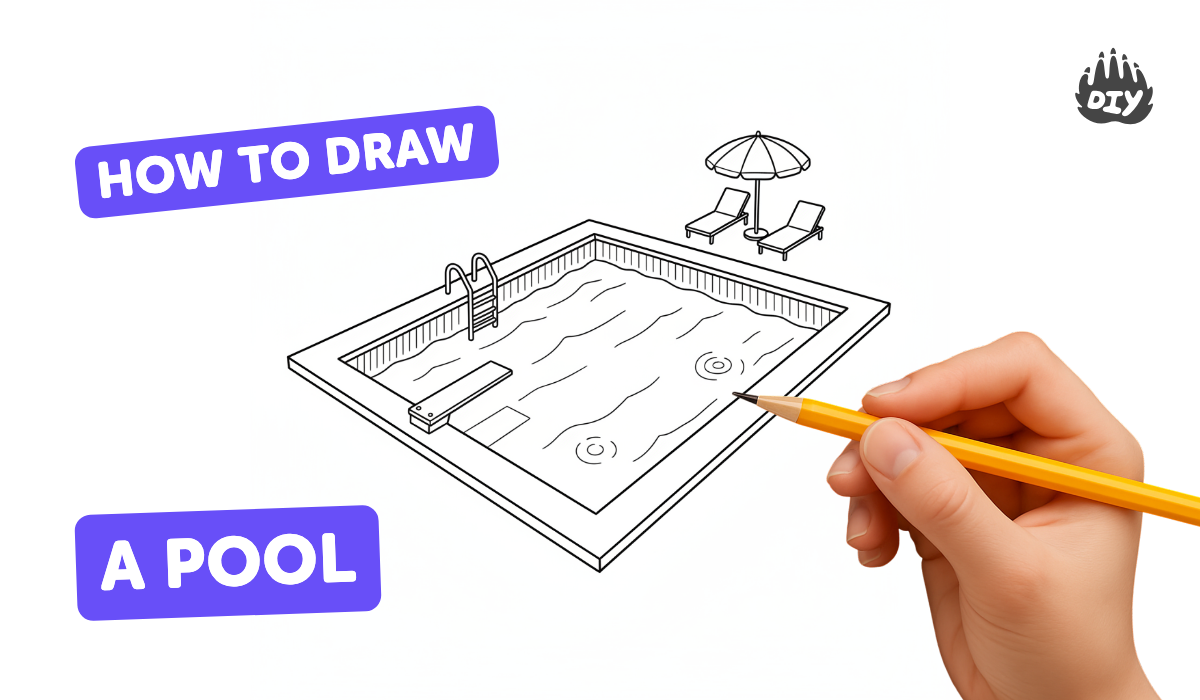
Step-by-step guide to draw a backyard swimming pool
How To Draw A Swimming Pool
Step 1
Draw a straight horizon line near the top of your paper and put a dot in the middle for a vanishing point to help with perspective.
Step 2
Use your ruler to draw the outer shape of the pool by making a near edge across the bottom and two lines that meet the vanishing point and then a back edge.
Step 3
Draw a smaller similar shape inside the outer shape to show the water surface and the pool rim.
Step 4
Draw small rectangle tiles along the inside rim to show the tile pattern around the pool.
Step 5
Sketch two curved vertical rails coming down over the front rim where the ladder will go.
Step 6
Add three or four horizontal rungs between the ladder rails to finish the ladder shape.
Step 7
Draw gentle wavy lines across the water surface to show ripples and movement.
Step 8
Draw a few curved lighter shapes on the water to show bright reflections of sunlight.
Step 9
Add thin lines across the water that follow the perspective to suggest depth and the pool floor tiles.
Step 10
Shade a soft shadow under the ladder and a longer shadow along one side of the pool to match your light source.
Step 11
Trace the important outlines with a black marker to make your drawing pop.
Step 12
Color the water using darker blue at the far end and lighter blue near the front then gently blend with your tissue if you like.
Step 13
Color the tiles and add thin darker lines between tiles for grout and texture.
Step 14
Add backyard details like grass or patio stones around the pool and erase any stray pencil lines to tidy your drawing.
Step 15
Share your finished backyard pool drawing on DIY.org
Help!?
What can we use instead of a tissue or a black marker if we don't have them?
If you don't have a tissue for blending the water colors, use a folded paper towel or cotton ball, and if you don't have a black marker to 'Trace the important outlines with a black marker,' use a dark colored pencil or fine-tip pen instead.
My perspective lines or inner water shape look off — how can I fix them?
If the outer shape, back edge, or the smaller inner water shape don't line up toward the vanishing point, redraw those lines lightly with your ruler from the near edge to the vanishing point (following 'Use your ruler to draw the outer shape...' and 'Draw a smaller similar shape inside...') and erase extra guidelines so the perspective matches.
How can I adapt this pool drawing for different ages or skill levels?
For younger kids skip the horizon and vanishing point and draw a simple oval pool with a ladder and big wavy ripples, while older kids should follow the full perspective steps, add the tile rectangles on the rim, and blend water colors with a tissue for more realism.
What are some ways to enhance or personalize the finished backyard pool drawing?
To extend the activity add a colorful pool float or diving board over the back edge, vary tile colors and grout lines when you 'Color the tiles,' include grass or patterned patio stones around the pool per 'Add backyard details,' and then share the finished drawing on DIY.org.
Watch videos on how to draw a backyard swimming pool
How To Draw A Pool
4 Videos
How To Draw A Pool

How to Draw a Cute Swimming Pool for Kids Step by Step
EASY DRAWING SWIMMING POOL FOR KIDS
How to Draw A Pool easy Step by Step
Facts about drawing and perspective for kids
🏊♀️ Backyard pools can hold thousands of gallons—drawing ripples and sparkly highlights makes water look alive!
🎯 Linear perspective uses a horizon line and vanishing point to make flat drawings appear 3D—perfect for pool edges and tiles.
🌊 Water reflections act like mirrors but wobble with waves—short curved lines and bright spots sell the effect.
🧱 Pool tiles are often tiny squares or mosaics—using a tiled grid helps show the pool's curve and depth in perspective.
🔦 Shadows get softer and longer the farther they are from the object—add shadows under the ladder and steps to ground them.
How do I teach my child to draw a backyard swimming pool with water, tiles, ladder, and shadows?
What materials do I need to draw a backyard swimming pool with tiles, a ladder, water, and shadows?
What ages is drawing a backyard pool suitable for?
What are the benefits of drawing a backyard swimming pool with water, tiles, ladder, and shadows?
