How to draw a police officer - a free police officer drawing guide
Draw a friendly police officer step by step, practicing shapes, proportions, uniform details, and adding color to learn drawing skills and respect for helpers.


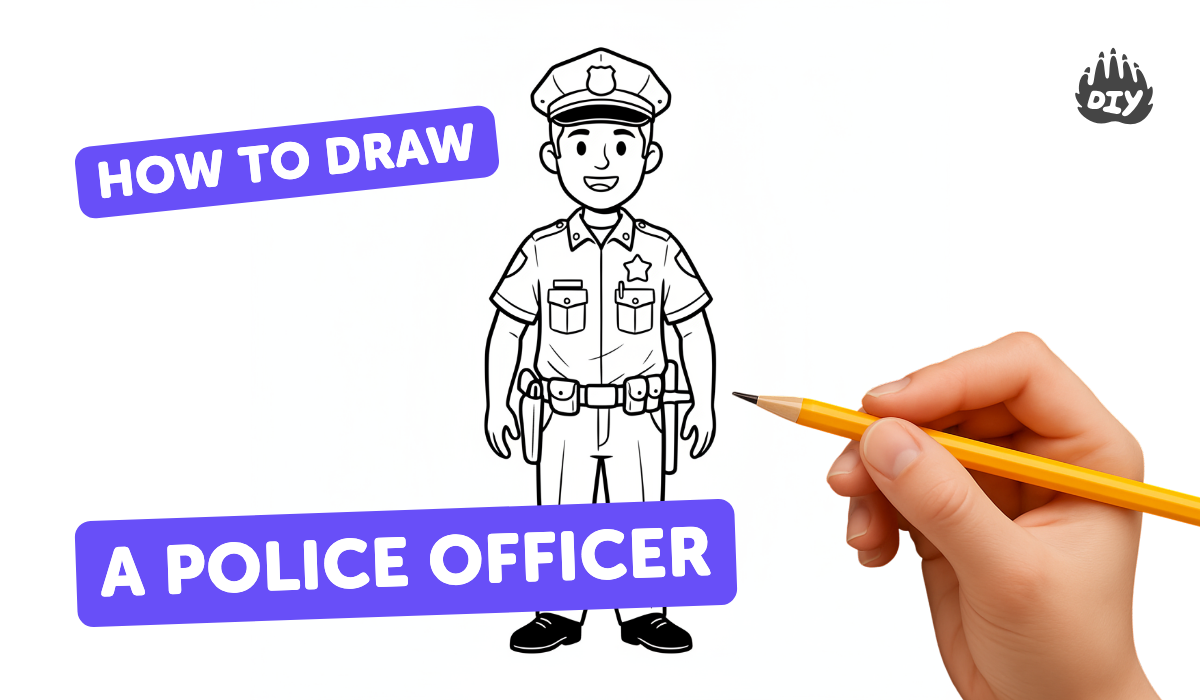
Step-by-step guide to draw a friendly police officer
How To Draw Police Officer for Kids | Step by Step Drawing Tutorial | Kids Art Made Easy! Cute Art
Step 1
Gather your Materials Needed and sit where you have lots of room to draw.
Step 2
Draw a large circle or oval near the top of the paper for the police officer's head.
Step 3
Lightly draw a vertical line down the middle of the face and a horizontal line across the middle to help place the features.
Step 4
Draw two eyes as small circles on the horizontal guideline.
Step 5
Draw a small oval or curved shape for the nose on the vertical guideline below the eyes.
Step 6
Draw a friendly smiling mouth below the nose.
Step 7
Draw two small ears on the sides of the head lined up with the eyes.
Step 8
Draw a police hat on top of the head with a flat brim and a rounded top and add a small badge shape on the front of the hat.
Step 9
Draw a short neck then draw a torso under the head and add two straight legs coming down from the torso.
Step 10
Draw two arms coming from the shoulders and simple rounded hands at the ends.
Step 11
Draw a badge shape on the chest to show the officer's badge.
Step 12
Add uniform details like a pocket and a row of buttons on the torso.
Step 13
Erase any light pencil guidelines and stray marks so your drawing looks neat.
Step 14
Color your police officer using blue for the uniform and other colors for skin hair and accessories.
Step 15
Share your finished police officer on DIY.org
Help!?
What can we use if we don't have blue crayons or colored pencils to color the uniform?
If you don't have blue crayons or colored pencils, use blue paint, a blue marker or pen, or color the uniform dark gray or black while still following the step to color your police officer using blue for the uniform.
My face features look uneven after drawing—how can I fix them without ruining the head circle?
Use the lightly drawn vertical and horizontal guideline across the face to reposition the eyes, nose, and mouth, erase the incorrect lines, and then erase any light pencil guidelines so the head circle stays neat.
How can I adapt this drawing activity for a 3-year-old or for an older 10-year-old?
For younger children simplify shapes into one big head circle, straight legs, and simple rounded hands, while older kids can add the badge shape on the chest, uniform details like a pocket and a row of buttons, and more realistic proportions.
What are fun ways to extend or personalize the police officer drawing once it's finished?
Add a background like a patrol car or police station, change skin and hair colors, personalize the hat badge and accessories, try different arm and leg poses, use shading when you color the uniform, and then share your finished police officer on DIY.org.
Watch videos on how to draw a friendly police officer
How To Draw A Police Officer | Police Drawing Easy
3 Videos
How To Draw A Police Officer | Police Drawing Easy
Easy Police Drawing - How to Draw a Policeman Face Step by Step
Drawing and Coloring a Police Officer with Accessories 👮📱⭐ Drawings for Kids
Facts about drawing people for kids
👮♂️ Police officers wear badges and patches that tell you their city or department—great little details to add to your drawing!
🎨 Artists start characters with simple shapes like circles, ovals, and rectangles before adding features and clothing.
🧍♀️ A handy rule: an adult human figure is usually about 7.5–8 heads tall to keep proportions believable.
🦺 Many helpers wear reflective vests or bright patches so they’re easy to spot—try drawing a shiny stripe for realism.
🌈 Blue is one of the most common police uniform colors worldwide, making it a classic choice when coloring your officer.
How do I draw a friendly police officer step by step?
What materials do I need to draw a police officer?
What ages is this drawing activity suitable for?
What are the benefits of drawing a police officer with my child?
