How to draw a nurse - a free nurse drawing guide
Learn to draw a friendly nurse step by step using simple shapes, pencil, eraser, and color to create a caring character illustration.


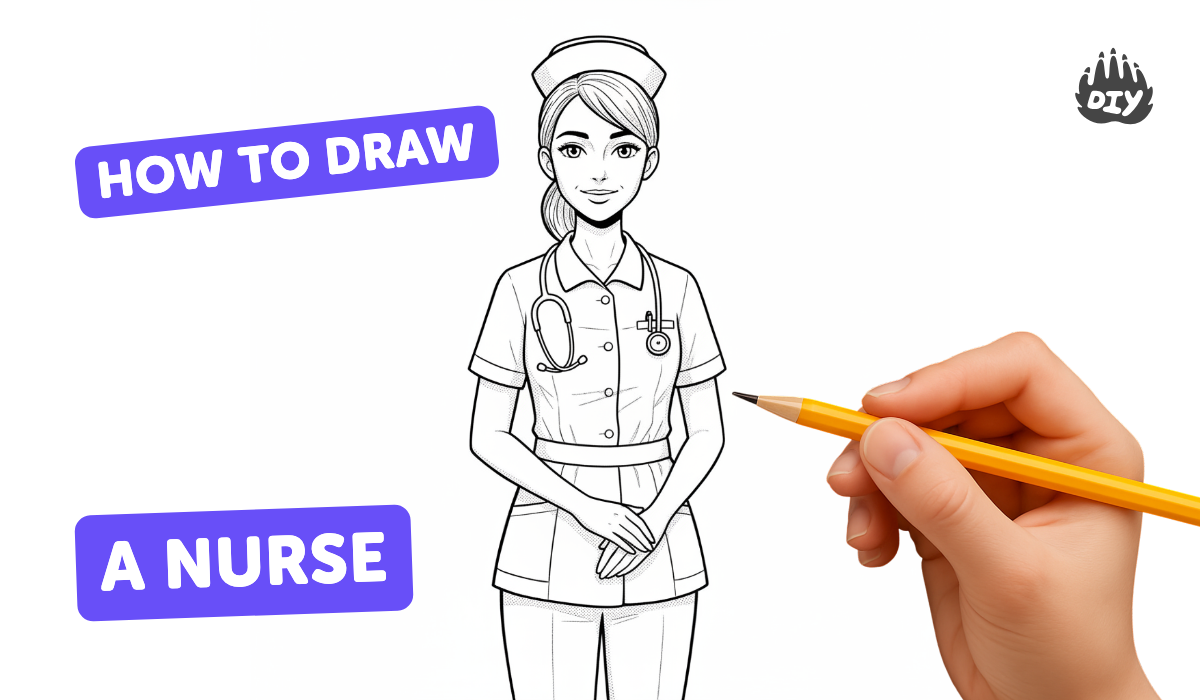
Step-by-step guide to draw a friendly nurse
Easy Nurse Drawing for Kids. How to Draw a Cute and Simple Nurse
Step 1
Gather your materials and sit at a flat table so you can draw easily.
Step 2
Lightly draw a round circle near the top center of the page for the nurse’s head.
Step 3
Draw a short vertical line under the head to make a simple neck.
Step 4
Draw a rounded rectangle under the neck to make the nurse’s body like a cozy coat.
Step 5
Draw two tube-shaped arms at the sides of the body and two short tube legs under the body.
Step 6
Draw a small nurse hat on top of the head and add a little cross in the middle of the hat.
Step 7
Draw two round eyes and a smiling mouth on the face to make the nurse look friendly.
Step 8
Draw simple hair lines around the head to give your nurse a hairstyle.
Step 9
Draw a stethoscope around the neck with a U-shaped tube and small earpieces.
Step 10
Draw a small pocket and a name badge on the uniform for caring details.
Step 11
Carefully erase any light guide lines so your drawing looks neat.
Step 12
Color your nurse with bright colors using your coloring materials.
Step 13
Take a photo of your finished nurse drawing and share it on DIY.org
Help!?
What can we use if we don't have a pencil, eraser, or coloring materials?
If you don't have a pencil or eraser, sketch the head, short neck, and rounded-rectangle coat lightly with a ballpoint pen and tidy stray marks with a soft cloth, and if you lack coloring supplies use markers, crayons, watercolor, or glued magazine scraps to fill in the uniform before photographing the finished nurse.
My nurse looks lopsided or the arms are uneven—how do we fix it?
If the head, tube arms, or short tube legs look uneven, redraw using faint guide lines for the circle head, neck, and rounded-rectangle body, measure sides with your finger to match lengths, then darken the correct lines and carefully erase guides so the stethoscope, pocket, and badge stay neat.
How can I make this activity easier or harder depending on my child's age?
For younger kids simplify by tracing big shapes (the circle head and rounded-rectangle body) and using stickers for eyes and the name badge, while older kids can add hair line details, a realistic U-shaped stethoscope, shading on the coat, and a clinic background before coloring.
How can we personalize or extend the drawing to make it more creative?
Personalize the nurse by designing a custom name badge and pocket items, trying bright uniform colors and patterned fabrics, adding a patient or background scene, or turning a sequence of light guide-line sketches into a flipbook to photograph and share on DIY.org.
Watch videos on how to draw a friendly nurse
How to draw a Nurse step by step (very easy) ||Nurse Drawing for Kids"
4 Videos

How to draw a Nurse step by step (very easy) ||Nurse Drawing for Kids"
How to Draw a Nurse Easy for Kids
How To Draw a Nurse Step by Step Easy!
How To Draw Cartoon Nurse
Facts about drawing and illustration for kids
👩⚕️ Nurses are the largest group of healthcare workers worldwide and care for millions of people every day.
🩺 The stethoscope, a tool often seen with nurses, was invented in 1816 by French physician René Laennec.
✏️ Cartoonists and illustrators often start with simple shapes—circles, ovals, and rectangles—to build friendly characters quickly.
🎨 You can mix basic paints (red, yellow, blue) plus white to create many skin tones and soft scrub colors for your nurse drawing.
🙂 Changing a tiny detail like the curve of a mouth or the angle of an eyebrow can completely change a character's expression.
How do I teach my child to draw a friendly nurse step by step?
What materials do I need to draw a nurse with my child?
What ages is drawing a nurse suitable for?
What are the benefits of drawing a nurse for kids?
