How to draw a jungle - a free jungle drawing guide
Draw a colorful jungle scene with trees, vines, animals, and a river using pencils and markers, practicing shapes, perspective, and texture.


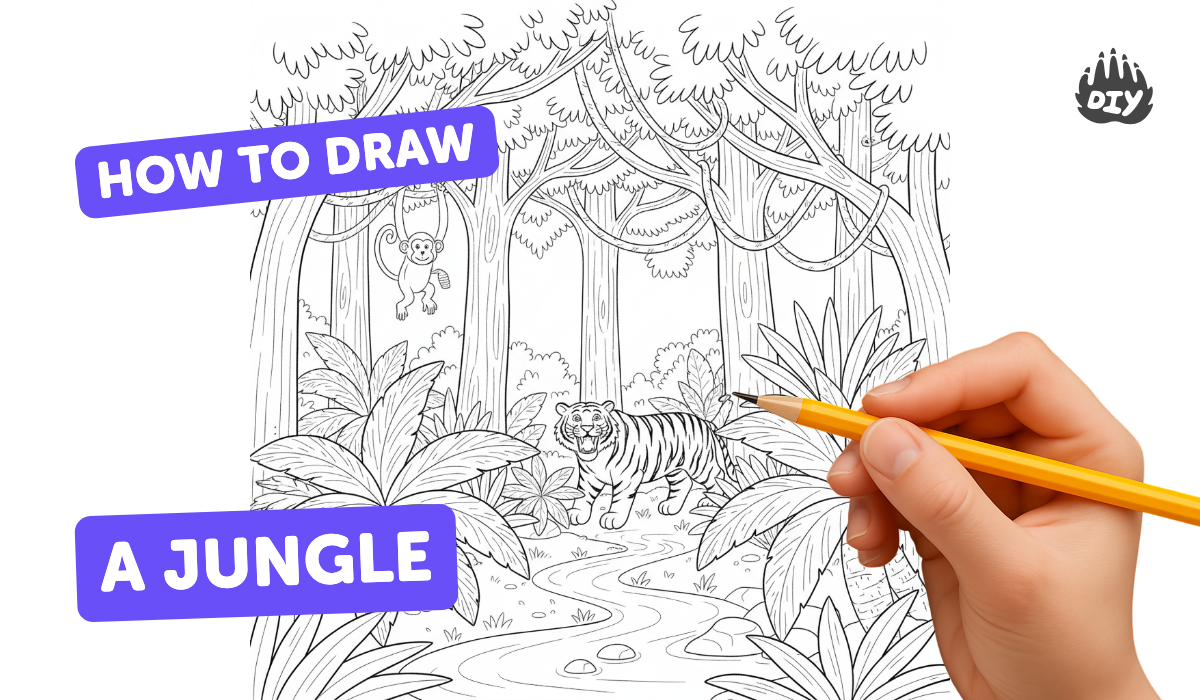
Step-by-step guide to draw a jungle scene
How To Draw A Jungle Treehouse And Friends
Step 1
Gather your drawing materials.
Step 2
Set up a flat workspace with good light.
Step 3
Lightly draw a winding river that flows from one edge of the page toward the middle.
Step 4
Lightly draw a horizon line near the top of your paper.
Step 5
Sketch large tree trunks in the foreground using simple vertical shapes.
Step 6
Draw big rounded canopies on top of those trunks for leaves.
Step 7
Add long curved vines hanging from branches across the page.
Step 8
Draw smaller trees and plant shapes near the horizon to show depth.
Step 9
Sketch simple animals using circles ovals and rectangles around the trees and river.
Step 10
Add texture details by drawing short bark lines on trunks and small strokes inside leaves.
Step 11
Trace the pencil outlines neatly with markers to make your drawing bold.
Step 12
Color your jungle with markers and colored pencils using darker tones in the front and lighter tones in the back to show distance.
Step 13
Share your finished creation on DIY.org.
Help!?
We don't have markers or colored pencils—what can we use instead?
If you don't have markers or colored pencils, use crayons or watercolor paints to color and substitute a fine-tip pen or washable highlighter to trace your pencil outlines neatly.
My winding river doesn't look natural and my marker lines smudge—how can I fix that?
Lightly sketch the winding river in pencil first and when you trace the pencil outlines neatly with a marker, let the ink dry fully and rest a scrap paper under your hand to avoid smudging.
How can I adapt this jungle drawing for younger or older kids?
For younger children simplify by drawing bigger tree trunks and rounded canopies and using crayons, while older kids can add short bark lines, more small trees near the horizon, and layered darker-front/lighter-back coloring with colored pencils.
How can we enhance or personalize the finished jungle drawing?
Make it unique by glueing painted paper or real leaves for canopies, using yarn for long curved vines, labeling the simple animal shapes you sketched, and emphasizing depth with darker tones in front and lighter tones near the horizon.
Watch videos on how to draw a jungle scene
Learn to draw an Easy Jungle Scene | How to Draw Wild Animals in a Forest | The Kid Next Door
4 Videos
Learn to draw an Easy Jungle Scene | How to Draw Wild Animals in a Forest | The Kid Next Door
How to Draw Rainforest (Jungle) Scenery for Kids Step by Step Easy
How to Draw | Jungle Animals | Twinkl Pictures
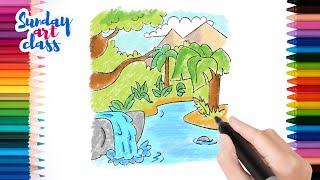
How to Draw a Jungle - Draw for Kids | Sunday Art Class
Facts about drawing and coloring for kids
🌳 Rainforests cover about 6% of Earth's land but are home to more than half of the world's plant and animal species.
🐒 Many jungle animals use bright colors, patterns, or shapes to hide (camouflage) or to attract mates.
🖼️ One-point perspective uses a single vanishing point on the horizon to make rivers, paths, and tree lines look like they recede into the distance.
✏️ You can create convincing textures—like rough bark or soft fur—using simple pencil techniques: cross-hatching, stippling, and short directional strokes.
🌈 Layering markers and colored pencils can make colors pop and blend smoothly, great for bright leaves, sparkling water, and colorful birds.
How do I guide my child to draw a colorful jungle scene step-by-step?
What materials do I need to draw a jungle scene with pencils and markers?
What ages is drawing a jungle scene suitable for?
What are the benefits of drawing a jungle scene for my child's development?
