How to Draw a Golf Ball
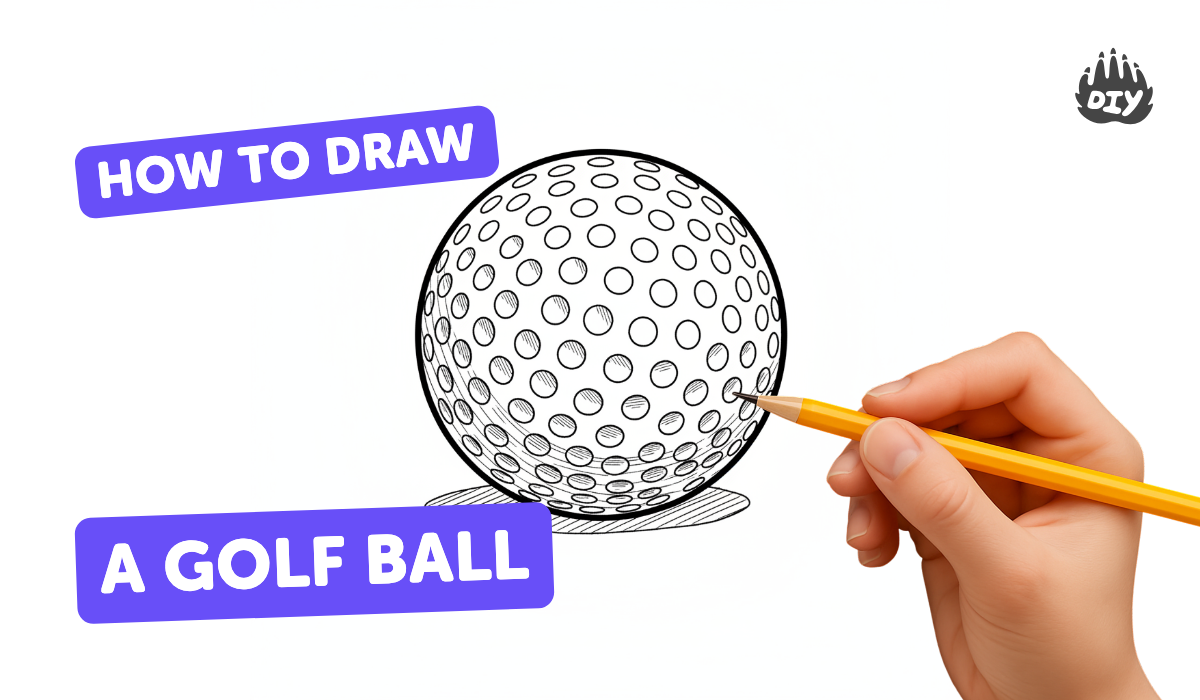
Draw a realistic golf ball by sketching a circle, adding dimples, shading for depth, and practicing light sources to improve drawing skills.
About this tutorial
Draw a realistic golf ball by sketching a circle, adding dimples, shading for depth, and practicing light sources to improve drawing skills.
What you need
Instructions
- 1
Step 1
Place the round object on the paper and trace around it to make a neat circle for your golf ball.
- 2
Step 2
Lightly draw a small dot outside the circle to mark where the light is coming from.
- 3
Step 3
Draw one faint curved guideline across the circle to help place dimples.
- 4
Step 4
Draw a second faint curved guideline perpendicular to the first to make a simple grid for dimple spacing.
- 5
Step 5
Start filling the circle with small evenly spaced round dimples following the curved guidelines in a staggered pattern.
- 6
Step 6
Darken the lower edge of each dimple a little on the side away from the light source to show depth in the dimples.
- 7
Step 7
Shade the side of the entire ball opposite the light source with light pencil strokes to create roundness.
- 8
Step 8
Use the blending stump or a tissue to gently smudge the shading and make the surface look smooth.
- 9
Step 9
Leave a small bright spot on the ball where the light hits by keeping it white or erasing a tiny area to form a highlight.
- 10
Step 10
Draw a soft shadow on the paper under the ball on the side opposite the light source to ground it.
- 11
Step 11
Erase the faint guide lines and any stray marks to clean up your drawing.
- 12
Step 12
Share your finished realistic golf ball drawing on DIY.org.
Fun facts
How do I teach my child to draw a realistic golf ball?
Start by tracing a circle or using a compass for a clean outline, then draw faint guide lines to place dimples. Sketch small, gently curved dimple shapes with varied spacing. Decide on a light source, darken areas opposite the light for shadow, and shade inside dimples to create depth. Blend softly with a stump or tissue, and add a subtle cast shadow under the ball. Encourage patience and repeated practice to improve realism.
What materials do we need to draw a realistic golf ball?
You’ll need drawing paper, an HB pencil for outlines, softer pencils (2B–4B) for shading, a kneaded eraser, a pencil sharpener, and a blending stump or tissue. Optional items: a compass or round object to trace, a white gel pen or white colored pencil for highlights, and a reference photo of a golf ball. These simple supplies help teach shading, texture, and light-source techniques.
What ages is drawing a realistic golf ball suitable for?
This activity suits children about 6 and up, with adult help for younger kids. Early elementary children (6–8) can practice tracing a circle and adding dots for dimples; older kids (9–14+) can work on precise dimples, directional shading, and blending. Adapt complexity: simplify for preschoolers by focusing on shape and dots, or add advanced shading and texture lessons for teens.
What are the benefits of drawing a realistic golf ball for kids?
Drawing a realistic golf ball builds observation, fine motor control, and shading technique. Kids learn about light sources, form, and cast shadows, which improves spatial reasoning and realistic rendering. The exercise fosters patience, concentration, and confidence as small improvements show quickly. It’s a short, focused project that links texture study (dimples) to broader drawing skills useful for portraits, still lifes, and 3D rendering.
Watch & Learn
Need help?
What can we use if we don't have a round object to trace or a blending stump?
Use a cup, jar lid, or tape roll to trace the circle and substitute the blending stump with a folded tissue, cotton swab, or soft fingertip to gently smudge the shading.
My dimples look uneven or too dark—how can I fix them?
If dimples are uneven, erase and redraw them following the faint curved guidelines, and if they're too dark, lift graphite with an eraser then darken only the lower edge of each dimple away from the light source before smudging with your blending stump or tissue.
How do I change this activity for kids of different ages?
For younger children use a larger round object, fewer bigger dimples and skip subtle shading, while older kids can draw tighter staggered dimples using both curved guidelines and refine shading and highlights with a blending stump for realism.
How can we make the golf ball drawing more interesting or personal?
Personalize the ball by drawing a tiny logo or number, adding scuff marks, arranging multiple balls with overlapping soft shadows for a more complex composition, or adding color before sharing your finished realistic golf ball drawing on DIY.org.