How to draw a farm - a free farm drawing guide
Draw a colorful farm scene with fields, animals, a barn, and sky using pencils, markers, and simple shapes while learning composition and scale.


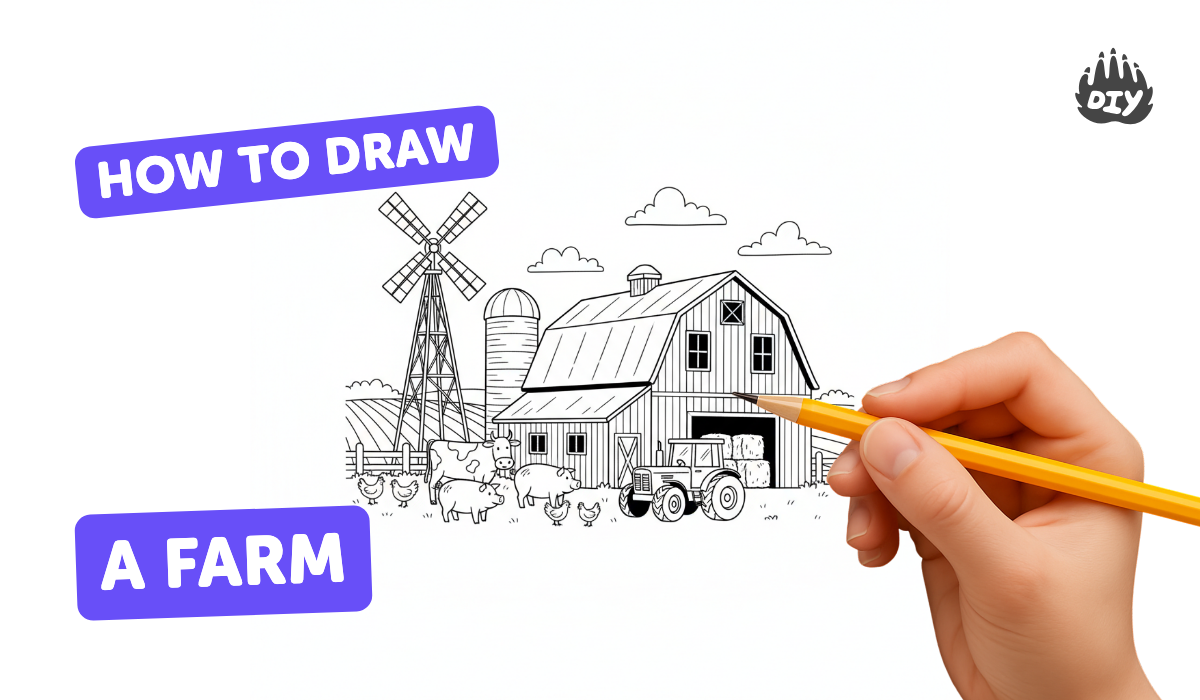
Step-by-step guide to draw a colorful farm scene
How To Draw A Farm Landscape
Step 1
Place your paper on a flat surface and put your pencil eraser ruler and markers within reach.
Step 2
Lightly draw a straight horizon line about one-third up from the bottom of the paper to separate land from sky.
Step 3
Use your ruler and pencil to add a few horizontal or diagonal lines below the horizon to make separate fields and crop rows.
Step 4
Draw a barn on one side of the fields using a rectangle for the barn body and a triangle for the roof.
Step 5
Sketch a path from the barn into the fields and draw simple fence lines with short vertical posts connected by straight lines.
Step 6
Lightly sketch animals in the fields using simple shapes like ovals circles and rectangles for different animals.
Step 7
Make closer objects larger and distant objects smaller so your animals barn and trees show clear scale.
Step 8
Draw a sun and a few fluffy clouds in the sky using circles and curved lines.
Step 9
Carefully trace your pencil lines with markers starting with the barn then the animals and fields.
Step 10
Color the sky fields barn and animals using markers or colored pencils choosing colors you love.
Step 11
Add small details like grass strokes fur spots and wood texture to make your farm look lively.
Step 12
Share your finished farm drawing on DIY.org
Help!?
I don't have markers or colored pencils—what can I use instead to color my farm?
Use crayons, washable paints, or felt-tip pens as substitutes for markers and colored pencils and finish coloring after you trace the barn, animals, and fields in pencil.
My lines smudge or markers bleed through the paper—how can I fix that while following the tracing step?
To prevent smudging or bleeding during the step where you carefully trace pencil lines, use heavier drawing paper, let marker ink dry before erasing pencil lines, and draw lightly with your pencil and ruler for the horizon and crop rows.
How can I adapt this drawing activity for different ages?
For younger kids, pre-draw the horizon and simple barn shape for them to color with crayons, while older kids can use the ruler to add precise crop rows, scale animals as directed, and add wood texture and fur detail from the last steps.
How can we extend or personalize the finished farm drawing?
Personalize the farm by gluing small bits of dried grass or fabric to the fields, adding colored-pencil shadows under animals and the barn for depth, writing a short farm story on the back, and then photograph the finished drawing to share on DIY.org.
Watch videos on how to draw a colorful farm scene
How To Draw A Farm Collection - Art For Kids Hub
4 Videos

How To Draw A Farm Collection - Art For Kids Hub
How To Draw A Barn (farm) 👩🌾
Drawing and Coloring a Farm with Animals 🐮🐷🐔🐑🐴🌈 Drawings for Kids
Barn with Farm Animals | Scene Drawing | Step By Step Tutorial | The Kid Next Door
Facts about drawing and composition for kids
🌾 Farms come in many types—crop farms, animal farms, and mixed farms—so there’s lots to draw!
🐄 Cow spot patterns are unique—no two cows have the exact same markings, like fingerprints.
📐 Scale helps artists: drawing distant fields smaller and nearby fences larger makes a scene look 3D.
🖍️ Combine pencils and markers: pencils add sketchy details and markers give bright, bold color.
🎨 Start with simple shapes—squares for barns, circles for suns, rectangles for fields—to build your farm.
How do you draw a colorful farm scene?
What materials do I need to draw a farm scene?
What ages is this farm drawing activity suitable for?
What are the benefits of drawing a farm scene?
