How to draw a coconut - a free coconut drawing guide
Draw a realistic coconut step-by-step using pencil, eraser, and shading techniques. Practice shapes, textures, and simple shading to create depth.


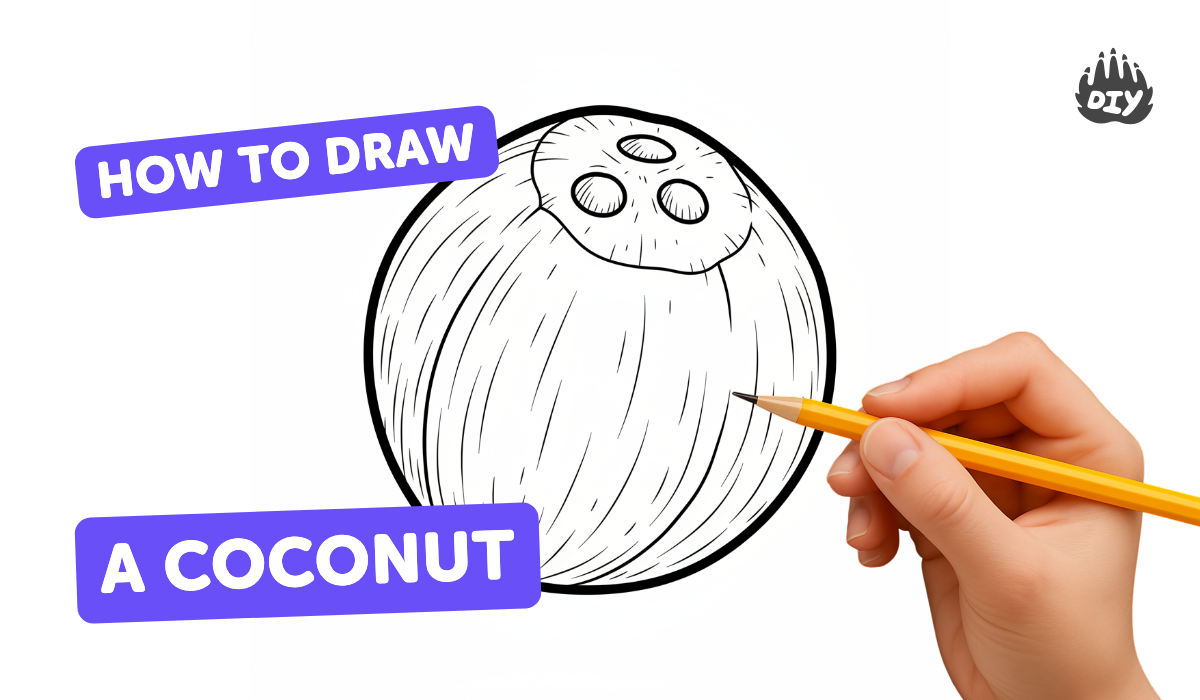
Step-by-step guide to draw a realistic coconut
How to draw Coconut step by step for kids | Coconut drawing for kids | Kids drawing | easy drawing
Step 1
Gather your materials and place them on a clean flat surface.
Step 2
Lightly draw a large oval in the middle of the paper to make the coconut’s main shape.
Step 3
Lightly draw a slightly flattened curve at the bottom of the oval to show where the coconut will sit.
Step 4
Draw three small circles close together near one end of the oval to make the coconut’s “eyes.”
Step 5
Softly sketch tiny uneven bumps along the outer edge of the oval to make the shell look natural.
Step 6
Decide where the light is coming from and mark a small arrow outside the drawing to remember it.
Step 7
Add short curved pencil strokes that follow the oval’s curve to create the coconut’s hairy texture.
Step 8
Shade the side opposite the light with light, even hatching strokes to start building form.
Step 9
Darken the areas near the eyes and the far edge with stronger pencil strokes to show depth.
Step 10
Use the blending stump or a tissue to gently smudge the shaded areas and soften transitions.
Step 11
Use the eraser to lift tiny highlights on the light-facing side to create shiny spots.
Step 12
Draw a soft shadow beneath the coconut on the side opposite the light to anchor it to the surface.
Step 13
Share your finished coconut drawing on DIY.org.
Help!?
What can I use if I don't have a blending stump or tissues?
Use a clean cotton swab or a folded tissue (or very gently a clean fingertip) to softly smudge the shaded areas as described in 'Use the blending stump or a tissue to gently smudge the shaded areas.'
My coconut looks flat—how can I make it look rounder and more three-dimensional?
Follow 'Decide where the light is coming from' and then shade the side opposite the light with light, even hatching strokes, darken the areas near the eyes and the far edge with stronger pencil strokes, blend them, and lift tiny highlights with the eraser to build form.
How can I adapt this activity for younger children or older kids?
For younger children, simplify to drawing the large oval, the three eyes, and soft bumps with crayons and skip shading, while older kids can refine the curved hairy pencil strokes, detailed hatching, blending with a stump, and eraser highlights as in the instructions.
How can we extend or personalize the coconut drawing once it's finished?
Add a cracked section to show the white interior with a darker rim, experiment with colored pencils or watercolor over your shading, use textured paper for a rough shell effect, and deepen the cast shadow beneath the coconut as in 'Draw a soft shadow beneath the coconut' to anchor it.
Watch videos on how to draw a realistic coconut
How to Draw a Coconut Easy Step by Step for Beginners | Simple Coconut Drawing Tutorial
4 Videos
How to Draw a Coconut Easy Step by Step for Beginners | Simple Coconut Drawing Tutorial
How to Draw a Coconut | Step-by-Step Drawing & Coloring for Kids
How To Draw A Cute Coconut/Step By Step Drawing For Kids
How to Draw and Color a Coconut 🥥 | Easy Drawing for Kids
Facts about pencil drawing and shading
🥥 Coconuts are technically drupes (a fruit with a hard inner shell), not true botanical nuts!
🌴 The coconut palm is often called the “tree of life” because nearly every part of it can be used by people.
✏️ Modern pencil leads (graphite/clay mixtures) were standardized by Nicolas-Jacques Conte in 1795.
🎨 Chiaroscuro is an art technique meaning “light–dark” used to create realistic volume and depth.
🔳 Hatching and cross-hatching build shading with lines—more lines = darker tone, fewer lines = lighter tone.
How do you draw a realistic coconut step-by-step?
What materials do I need to draw a realistic coconut?
What ages is this drawing activity suitable for?
What are the benefits of drawing a realistic coconut?
