Draw your comic hero showing different expressions!
Draw your own comic hero showing five different facial expressions in separate panels, practicing proportions, emotions, and coloring to tell a short visual story.
About this activity
Draw your own comic hero showing five different facial expressions in separate panels, practicing proportions, emotions, and coloring to tell a short visual story.
What you need
Step by step
- 1
Step 1
Gather your materials.
- 2
Step 2
Use the ruler to draw five comic panels across the page.
- 3
Step 3
Lightly sketch the same-sized simple head shape in the middle of each panel.
- 4
Step 4
Draw a vertical center line and a horizontal eye line inside each head to help with proportions.
- 5
Step 5
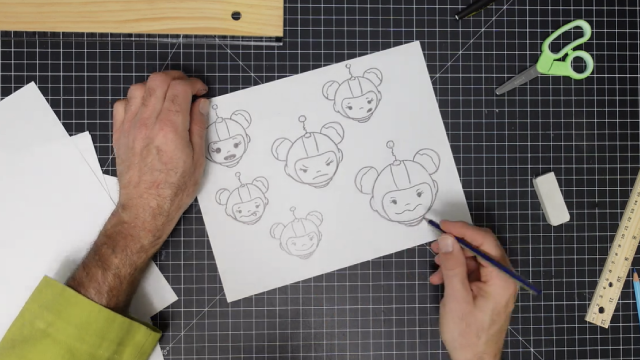
In each panel draw the facial features to show five different expressions: happy surprised angry sad and mischievous.
- 6
Step 6
Add simple shoulders and a small prop in each panel that matches the character’s feeling.
- 7
Step 7
Trace your final pencil lines with the black marker to create clean comic outlines.
- 8
Step 8
Let the ink dry completely.
- 9
Step 9
Erase the pencil guidelines and any stray marks.
- 10
Step 10
Color each panel using colors that match the mood of each expression.
- 11
Step 11
Add small speech or thought bubbles with a few short words in each panel to tell a short visual story.
- 12
Step 12
Give your comic a fun title at the top.
- 13
Step 13
Share your finished comic hero showing five expressions on DIY.org.
Fun facts
How do you draw your comic hero showing five different expressions?
Start by dividing your paper into five equal panels. Sketch a simple hero silhouette and draw consistent head and body proportions in each panel using light pencil guidelines (center line, eye line). Plan a short situation to link the panels, then change eyes, eyebrows, mouth, and head tilt to show each emotion. Ink the best lines, erase pencil marks, add color and small background details to finish the short visual story.
What materials do I need to draw a comic hero with five expressions?
You’ll need paper or a sketchbook, a pencil and eraser, a ruler to make five panels, and a fine-tip pen or marker for inking. Add colored pencils, markers, or watercolors for color and a white gel pen for highlights. Optional items: reference photos of faces, scrap paper for practice sketches, and a lightbox or tracing paper if you want to keep proportions consistent.
What ages is the five-panel comic hero activity suitable for?
This activity works for many ages: preschoolers (4–6) can try simple faces and color with adult help; elementary kids (7–9) can practice proportion and distinct expressions; tweens (10–13) can refine anatomy and storytelling; teens and older kids can add detailed shading, perspective, or dialogue. Adapt complexity, materials, and supervision to match each child’s motor skills and attention span.
What are the benefits and fun variations of drawing a comic hero with different expressions?
This exercise builds emotional literacy, facial observation, fine motor control, sequencing and visual storytelling. It boosts creativity and confidence by letting kids invent characters and short plots. Variations include using a flipbook to animate expressions, creating a wordless comic, experimenting with different art styles or media, or turning each panel into a speech bubble-driven mini-scene. Use non-toxic supplies and supervise younger children when using markers or watercolors.
Watch & Learn
Need help?
What can I substitute if I don't have a ruler, black marker, or markers for coloring?
Use the straight edge of a hardcover book or a cereal-box strip to draw the five comic panels, trace final lines with a fine-tip pen or dark colored pencil instead of the black marker, and color with crayons or colored pencils in place of markers.
My faces look uneven or the ink smudged—how do I fix that?
Redraw even panels using a straight edge, keep your head shapes light and use the vertical center and horizontal eye lines for proportion, and wait until the ink dries completely before you erase pencil guidelines to prevent smudging.
How can I adapt this activity for younger or older kids?
For younger children pre-draw the five panels and simple head shapes so they only add facial features, shoulders, and small props, while older kids can use the center/eye guidelines to refine proportions, add detailed shading when coloring, and write longer speech or thought bubbles to expand the short visual story.
What are some ways to enhance or personalize my five-expression comic hero?
Give your comic a fun title at the top, add matching backgrounds and unique props in each panel, experiment with different color moods, or turn the five inked and colored panels into a flipbook or share the finished comic hero on DIY.org.