Draw Mandala Art
Draw a colorful mandala using compass, ruler, pencil, and markers to create repeating patterns and learn about radial symmetry and concentration.
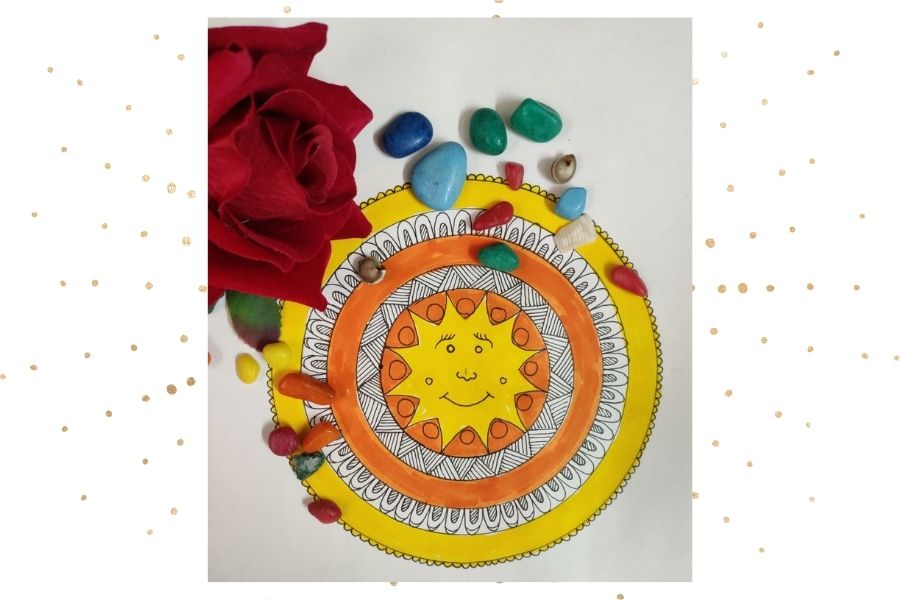
About this activity
Draw a colorful mandala using compass, ruler, pencil, and markers to create repeating patterns and learn about radial symmetry and concentration.
What you need
Step by step
- 1
Step 1
Clear a flat workspace and place your paper and all materials within reach.
- 2
Step 2
Lightly mark the center of your paper with a small pencil dot.
- 3
Step 3
Use the compass to draw several concentric circles around the center, increasing the radius each time.
- 4
Step 4
Place the ruler through the center and draw straight lines across the circles to divide them into equal slices (try 8 slices).
- 5
Step 5
Choose the innermost ring and draw a simple shape in pencil repeatedly around that ring.
- 6
Step 6
Choose another ring and draw a different repeating shape around that ring.
- 7
Step 7
Copy the same shapes into each slice so every slice matches and your design shows radial symmetry.
- 8
Step 8
Carefully trace over your pencil shapes and circle lines with the thin black marker to make them bold.
- 9
Step 9
Wait a moment for the ink to dry and then gently erase the pencil guide lines.
- 10
Step 10
Colour each repeating shape using your colouring materials and repeat colours in every slice to keep the symmetry.
- 11
Step 11
Share your finished mandala art on DIY.org.
Fun facts
How do you draw a colorful mandala using a compass, ruler, pencil, and markers?
Start by taping your paper to a flat surface and mark the center. Use a compass to draw several concentric circles as guides. With a ruler, lightly draw radial lines to divide the circle into equal sections. Sketch repeating shapes in pencil from the center outward, keeping motifs consistent across sections. Once happy, trace with markers and color between lines. Erase remaining pencil marks and encourage slow, steady strokes to keep symmetry and focus.
What materials do I need to draw mandala art with a compass and markers?
You’ll need good drawing paper, a drawing compass, a ruler or straightedge, a pencil and eraser, and a sharpener. Bring a set of fine and broad-tip markers for outlining and filling, plus colored pencils or gel pens for detail. Optional: a protractor for precise angles, masking tape to hold paper, and a blending stump for shaded effects. Keep a scrap sheet handy to test marker colors first.
What ages is mandala drawing suitable for and how can it be adapted?
Mandala drawing suits children roughly ages 6 and up; younger kids (4–6) can do simplified concentric patterns with supervision. Older children and teens can handle precise compass use and complex repeats. For beginners, pre-draw circles and larger sections and let them fill patterns. Supervise pointy tools for kids under 8, and offer thicker markers or sticker templates for children who need easier handling.
What are the benefits of drawing mandalas for kids?
Drawing mandalas supports fine motor skills, pattern recognition, and understanding of radial symmetry. The repetitive, focused work promotes concentration and can be calming, offering a simple mindfulness activity. It also strengthens planning and patience as children plan motifs and color schemes. For older kids, it connects to geometry (angles, circles) and artistic expression, building confidence as they complete visually satisfying, symmetrical designs.
Watch & Learn
Need help?
I don't have a compass — what can I use to draw the concentric circles?
Trace round objects like bottle caps, cups, or lids of different sizes around the pencil-dot center and use a string tied to a pencil anchored at the center for larger circles before dividing with the ruler into slices.
My slices look uneven — how can I fix that so the mandala keeps radial symmetry?
Fold the paper into 8 equal parts or use a protractor to mark equal angles and then draw straight lines through the pencil-dot center with your ruler so every slice matches before copying shapes into each slice.
How can I adapt this mandala activity for younger or older kids?
For younger children, pre-draw fewer concentric rings and 4 large slices and let them use stickers or crayons to repeat simple shapes, while older kids can add more rings, smaller slices, intricate repeating shapes, and trace with a thin black marker for finer detail.
What are simple ways to enhance or personalize the finished mandala?
Embellish coloured repeating shapes with metallic gel pens or glitter glue, write your name or date in the innermost ring, and photograph the finished piece to share on DIY.org.