Create a keyword cipher
Make a keyword cipher to encode and decode secret messages using an alphabet arranged by a chosen keyword, then swap messages with a friend.



Step-by-step guide to create a keyword cipher
How To Write Secret Codes Using Ciphers!
Step 1
Pick a short secret keyword you like (3 to 7 letters) and keep it as your code word.
Step 2
Write your keyword in big capital letters across the top of a blank sheet.
Step 3
Cross out any letters in the keyword that repeat so each letter appears only once.
Step 4
On a new line write the whole alphabet A B C D E ... Z in order.
Step 5
Cross out every letter on the alphabet line that appears in your keyword so those letters are removed.
Step 6
On the next line write your keyword letters first and then write the remaining unused alphabet letters to make one full 26-letter cipher alphabet.
Step 7
Draw two neat rows across the page and label the top row Plain and the bottom row Cipher.
Step 8
Copy A B C D E ... Z clearly into the Plain row.
Step 9
Copy your new keyword-based 26-letter alphabet into the Cipher row so each plain letter matches a cipher letter below it.
Step 10
Write a short secret message in simple words on a fresh line using only letters (no punctuation if you want).
Step 11
Encode your secret message by replacing each plain letter with the matching letter from your Cipher row.
Step 12
Fold the paper to hide the encoded message so it looks like a secret note to give to a friend.
Step 13
Give the folded secret note to a friend and then use your chart to decode any message they give you back.
Step 14
Share a photo or a clear description of your finished cipher chart and a decoded or encoded message on DIY.org
Help!?
What can we use if we don't have a blank sheet, ruler, or markers listed in the instructions?
Use notebook or scrap paper instead of a blank sheet, a straight book edge or an old credit card to draw the two neat rows, and pencil or pen if you don't have markers when writing your keyword and cipher alphabet.
Why does my encoded message look wrong when I check it with the chart?
Make sure you crossed out repeated letters in your keyword and removed those same letters from the alphabet line before writing the 26-letter cipher alphabet, align the Plain and Cipher rows carefully with a ruler or straight edge, and test by encoding a single letter to confirm each plain letter matches one cipher letter.
How can I change the activity for younger or older kids?
For younger children, pick a 3-letter keyword, pre-draw the Plain and Cipher rows and use sticker letters or alphabet cards to place the remaining letters, while older kids can use 5–7 letter keywords, include spaces or punctuation, or combine two keywords for a tougher cipher.
What are some ways to make the cipher chart more fun or secure for trading notes?
Decorate the chart with colored markers (for example color vowels in the Cipher row), fold the paper into a secret note and hide a tiny numbered key on the back, or turn the chart into a portable decoder card and share your finished chart and a decoded message on DIY.org.
Watch videos on how to create a keyword cipher
Substitution Cipher using a Keyword
4 Videos
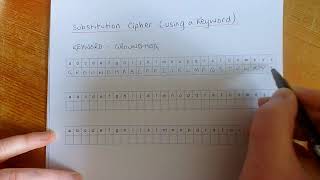
Substitution Cipher using a Keyword
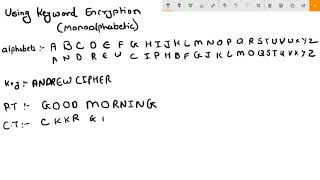
Using Keyword Cipher Technique | Mono-alphabetic
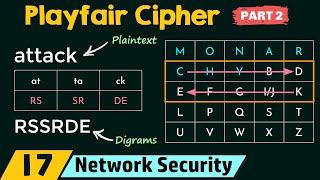
Playfair Cipher (Part 2)

Playfair Cipher (Part 1)
Facts about codes and ciphers
🔐 A keyword cipher is a type of monoalphabetic substitution where you build a new alphabet by writing a keyword and then the remaining letters.
✏️ When you remove repeated letters from your chosen keyword, you get a neat starter sequence for the cipher alphabet.
📬 Julius Caesar used a simple shift cipher (the Caesar cipher) to send secret military messages more than 2,000 years ago.
🔎 Simple substitution ciphers can often be cracked by frequency analysis because some letters (like E and T) appear more often.
🎲 There are 26! (about 4 × 10^26) possible ways to permute the alphabet — but using a keyword makes crafting codes fast and fun.
How do I make a keyword cipher to encode and decode secret messages?
What materials do I need to create a keyword cipher?
What ages is making a keyword cipher suitable for?
What are the benefits and safe variations of a keyword cipher activity?
