All Articles

Titan

Titan Facts For Kids

Titan is Saturn's largest moon and the second-largest in the Solar System, known for its thick atmosphere and unique lakes of methane and ethane.
🎨 Reading age for 6-8
Background blob
Titan
Titan
Facts for Kids!
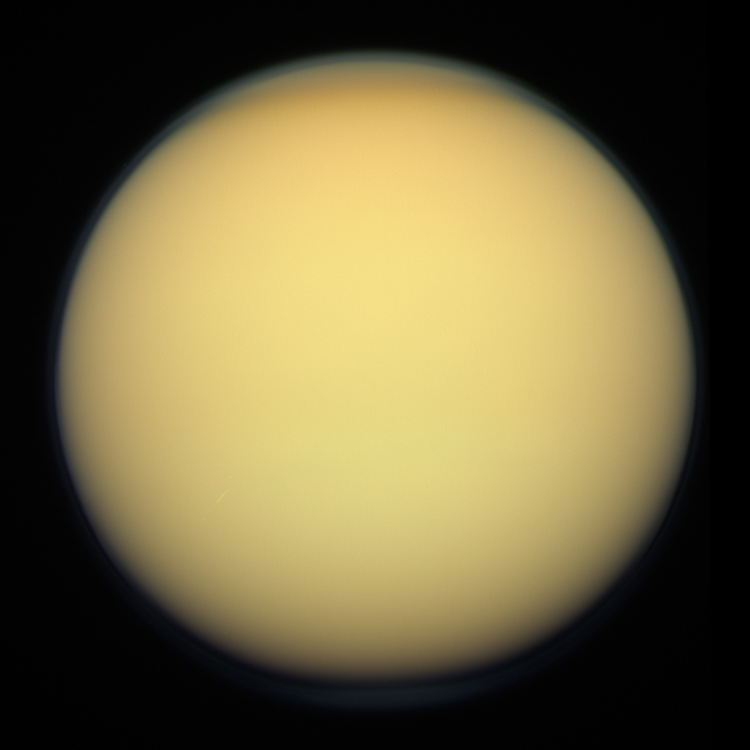
Image by NASA/JPL-Caltech/SSI/Kevin M. Gill, licensed under Creative Commons Attribution 2.0

Do more with AI

Introduction

Titan is a super fascinating moon that orbits the planet Saturn! 🌌It’s the largest moon of Saturn and the second largest moon in our entire Solar System! Titan has a diameter of about 5,150 kilometers (3,200 miles), making it even bigger than the planet Mercury! 🌍Even though it’s far away, researchers believe it holds secrets about how life could be beyond Earth. Titan is like an alien world, covered in thick clouds that hide its surface from view. Can you imagine exploring such a mysterious place?

Images of Titan

Christiaan Huygens discovered Titan in 1655.

Christiaan Huygens discovered Titan in 1655.

Titan's orbit (highlighted in red) among the other large inner moons of Saturn. The moons outside its orbit are (from the outside to the inside) Iapetus and Hyperion; those inside are Rhea, Dione, Tethys, Enceladus, and Mimas.Image by Original: Rubble pile Vector: Mysid ., licensed under Creative Commons Attribution-Share Alike 3.0

Titan's orbit (highlighted in red) among the other large inner moons of Saturn. The moons outside its orbit are (from the outside to the inside) Iapetus and Hyperion; those inside are Rhea, Dione, Tethys, Enceladus, and Mimas.

Photos of Titan
Vertical diagram of Titan's atmosphereImage by Kelvinsong, licensed under Creative Commons Attribution-Share Alike 3.0

Vertical diagram of Titan's atmosphere

NASA Identifies Ice Cloud Above Cruising Altitude on Titan - This cloud in the stratosphere over Titan’s north pole (left) is similar to Earth’s polar stratospheric clouds (right). NASA scientists found that Titan’s cloud contains methane ice, which was not previously thought to form in that part of the atmosphere. Cassini first spotted the cloud in 2006. Description: NASA scientists have identified an unexpected high-altitude methane ice cloud on Saturn's moon Titan that is similar to exotic clouds found far above Earth's poles. This lofty cloud, imaged by NASA's Cassini spacecraft, was part of the winter cap of condensation over Titan's north pole. Now, eight years after spotting this mysterious bit of atmospheric fluff, researchers have determined that it contains methane ice, which produces a much denser cloud than the ethane ice previously identified there. "The idea that methane clouds could form this high on Titan is completely new," said Carrie Anderson, a Cassini participating scientist at NASA's Goddard Space Flight Center in Greenbelt, Maryland, and lead author of the study. "Nobody considered that possible before." Methane clouds were already known to exist in Titan's troposphere, the lowest layer of the atmosphere. Like rain and snow clouds on Earth, those clouds form through a cycle of evaporation and condensation, with vapor rising from the surface, encountering cooler and cooler temperatures and falling back down as precipitation. On Titan, however, the vapor at work is methane instead of water. The newly identified cloud instead developed in the stratosphere, the layer above the troposphere. Earth has its own polar stratospheric clouds, which typically form above the North Pole and South Pole between 49,000 and 82,000 feet (15 to 25 kilometers) -- well above cruising altitude for airplanes. These rare clouds don't form until the temperature drops to minus 108 degrees Fahrenheit (minus 78 degrees Celsius). Other stratospheric clouds had been identified on Titan already, including a very thin, diffuse cloud of ethane, a chemical formed after methane breaks down. Delicate clouds made from cyanoacetylene and hydrogen cyanide, which form from reactions of methane byproducts with nitrogen molecules, also have been found there. But methane clouds were thought unlikely in Titan's stratosphere. Because the troposphere traps most of the moisture, stratospheric clouds require extreme cold. Even the stratosphere temperature of minus 333 degrees Fahrenheit (minus 203 degrees Celsius), observed by Cassini just south of the equator, was not frigid enough to allow the scant methane in this region of the atmosphere to condense into ice. What Anderson and her Goddard co-author, Robert Samuelson, noted is that temperatures in Titan's lower stratosphere are not the same at all latitudes. Data from Cassini's Composite Infrared Spectrometer and the spacecraft's radio science instrument showed that the high-altitude temperature near the north pole was much colder than that just south of the equator. It turns out that this temperature difference -- as much as 11 degrees Fahrenheit (6 degrees Celsius) -- is more than enough to yield methane ice. Other factors support the methane identification. Initial observations of the cloud system were consistent with small particles composed of ethane ice. Later observations revealed some regions to be clumpier and denser, suggesting that more than one ice could be present. The team confirmed that the larger particles are the right size for methane ice and that the expected amount of methane -- one-and-a-half percent, which is enough to form ice particles -- is present in the lower polar stratosphere. The mechanism for forming these high-altitude clouds appears to be different from what happens in the troposphere. Titan has a global circulation pattern in which warm air in the summer hemisphere wells up from the surface and enters the stratosphere, slowly making its way to the winter pole. There, the air mass sinks back down, cooling as it descends, which allows the stratospheric methane clouds to form. "Cassini has been steadily gathering evidence of this global circulation pattern, and the identification of this new methane cloud is another strong indicator that the process works the way we think it does," said Michael Flasar, Goddard scientist and principal investigator for Cassini's Composite Infrared Spectrometer (CIRS). Like Earth's stratospheric clouds, this methane cloud was located near the winter pole, above 65 degrees north latitude. Anderson and Samuelson estimate that this type of cloud system -- which they call subsidence-induced methane clouds, or SIMCs for short -- could develop between 98,000 to 164,000 feet (30 to 50 kilometers) in altitude above Titan's surface. "Titan continues to amaze with natural processes similar to those on the Earth, yet involving materials different from our familiar water," said Scott Edgington, Cassini deputy project scientist at NASA's Jet Propulsion Laboratory (JPL) in Pasadena, California. "As we approach southern winter solstice on Titan, we will further explore how these cloud formation processes might vary with season." The results of this study are available online in the journal Icarus.

NASA Identifies Ice Cloud Above Cruising Altitude on Titan - This cloud in the stratosphere over Titan’s north pole (left) is similar to Earth’s polar stratospheric clouds (right). NASA scientists found that Titan’s cloud contains methane ice, which was not previously thought to form in that part of the atmosphere. Cassini first spotted the cloud in 2006. Description: NASA scientists have identified an unexpected high-altitude methane ice cloud on Saturn's moon Titan that is similar to exotic clouds found far above Earth's poles. This lofty cloud, imaged by NASA's Cassini spacecraft, was part of the winter cap of condensation over Titan's north pole. Now, eight years after spotting this mysterious bit of atmospheric fluff, researchers have determined that it contains methane ice, which produces a much denser cloud than the ethane ice previously identified there. "The idea that methane clouds could form this high on Titan is completely new," said Carrie Anderson, a Cassini participating scientist at NASA's Goddard Space Flight Center in Greenbelt, Maryland, and lead author of the study. "Nobody considered that possible before." Methane clouds were already known to exist in Titan's troposphere, the lowest layer of the atmosphere. Like rain and snow clouds on Earth, those clouds form through a cycle of evaporation and condensation, with vapor rising from the surface, encountering cooler and cooler temperatures and falling back down as precipitation. On Titan, however, the vapor at work is methane instead of water. The newly identified cloud instead developed in the stratosphere, the layer above the troposphere. Earth has its own polar stratospheric clouds, which typically form above the North Pole and South Pole between 49,000 and 82,000 feet (15 to 25 kilometers) -- well above cruising altitude for airplanes. These rare clouds don't form until the temperature drops to minus 108 degrees Fahrenheit (minus 78 degrees Celsius). Other stratospheric clouds had been identified on Titan already, including a very thin, diffuse cloud of ethane, a chemical formed after methane breaks down. Delicate clouds made from cyanoacetylene and hydrogen cyanide, which form from reactions of methane byproducts with nitrogen molecules, also have been found there. But methane clouds were thought unlikely in Titan's stratosphere. Because the troposphere traps most of the moisture, stratospheric clouds require extreme cold. Even the stratosphere temperature of minus 333 degrees Fahrenheit (minus 203 degrees Celsius), observed by Cassini just south of the equator, was not frigid enough to allow the scant methane in this region of the atmosphere to condense into ice. What Anderson and her Goddard co-author, Robert Samuelson, noted is that temperatures in Titan's lower stratosphere are not the same at all latitudes. Data from Cassini's Composite Infrared Spectrometer and the spacecraft's radio science instrument showed that the high-altitude temperature near the north pole was much colder than that just south of the equator. It turns out that this temperature difference -- as much as 11 degrees Fahrenheit (6 degrees Celsius) -- is more than enough to yield methane ice. Other factors support the methane identification. Initial observations of the cloud system were consistent with small particles composed of ethane ice. Later observations revealed some regions to be clumpier and denser, suggesting that more than one ice could be present. The team confirmed that the larger particles are the right size for methane ice and that the expected amount of methane -- one-and-a-half percent, which is enough to form ice particles -- is present in the lower polar stratosphere. The mechanism for forming these high-altitude clouds appears to be different from what happens in the troposphere. Titan has a global circulation pattern in which warm air in the summer hemisphere wells up from the surface and enters the stratosphere, slowly making its way to the winter pole. There, the air mass sinks back down, cooling as it descends, which allows the stratospheric methane clouds to form. "Cassini has been steadily gathering evidence of this global circulation pattern, and the identification of this new methane cloud is another strong indicator that the process works the way we think it does," said Michael Flasar, Goddard scientist and principal investigator for Cassini's Composite Infrared Spectrometer (CIRS). Like Earth's stratospheric clouds, this methane cloud was located near the winter pole, above 65 degrees north latitude. Anderson and Samuelson estimate that this type of cloud system -- which they call subsidence-induced methane clouds, or SIMCs for short -- could develop between 98,000 to 164,000 feet (30 to 50 kilometers) in altitude above Titan's surface. "Titan continues to amaze with natural processes similar to those on the Earth, yet involving materials different from our familiar water," said Scott Edgington, Cassini deputy project scientist at NASA's Jet Propulsion Laboratory (JPL) in Pasadena, California. "As we approach southern winter solstice on Titan, we will further explore how these cloud formation processes might vary with season." The results of this study are available online in the journal Icarus.

Atmospheric polar vortex over Titan's south pole

Atmospheric polar vortex over Titan's south pole

An audio speaker emitting sound waves, in the Gnome style

An audio speaker emitting sound waves, in the Gnome style

Methane clouds (animated; July 2014).[76]

Methane clouds (animated; July 2014).[76]

PIA20713: Map of Titan with Labeled Features http://photojournal.jpl.nasa.gov/catalog/PIA20713 This map of Titan shows the names of many (but not all) features on the Saturnian moon that have been approved by the International Astronomical Union. The map shows Cassini imaging coverage of Titan as of June 2015 (previously published as PIA19658 and Wiki-version ). This map was produced by the USGS Astrogeology Science Center for the International Astronomical Union ( IAU ) Working Group for Planetary System Nomenclature. The Cassini mission is a cooperative project of NASA, ESA (the European Space Agency) and the Italian Space Agency. The Jet Propulsion Laboratory, a division of the California Institute of Technology in Pasadena, manages the mission for NASA's Science Mission Directorate, Washington. The Cassini orbiter and its two onboard cameras were designed, developed and assembled at JPL. The imaging operations center is based at the Space Science Institute in Boulder, Colorado. For more information about the Cassini-Huygens mission visit http://saturn.jpl.nasa.gov and http://www.nasa.gov/cassini . The Cassini imaging team homepage is at http://ciclops.org .

PIA20713: Map of Titan with Labeled Features http://photojournal.jpl.nasa.gov/catalog/PIA20713 This map of Titan shows the names of many (but not all) features on the Saturnian moon that have been approved by the International Astronomical Union. The map shows Cassini imaging coverage of Titan as of June 2015 (previously published as PIA19658 and Wiki-version ). This map was produced by the USGS Astrogeology Science Center for the International Astronomical Union ( IAU ) Working Group for Planetary System Nomenclature. The Cassini mission is a cooperative project of NASA, ESA (the European Space Agency) and the Italian Space Agency. The Jet Propulsion Laboratory, a division of the California Institute of Technology in Pasadena, manages the mission for NASA's Science Mission Directorate, Washington. The Cassini orbiter and its two onboard cameras were designed, developed and assembled at JPL. The imaging operations center is based at the Space Science Institute in Boulder, Colorado. For more information about the Cassini-Huygens mission visit http://saturn.jpl.nasa.gov and http://www.nasa.gov/cassini . The Cassini imaging team homepage is at http://ciclops.org .

Atmosphere

Titan's atmosphere is really different from Earth's! 🌫️ It's mostly filled with nitrogen, similar to how Earth's atmosphere is, but it also contains methane, a gas that can create clouds and rain on Titan. The pressure on Titan is 1.5 times that of Earth's, which means it feels a bit heavier! ⚖️ The clouds on Titan are made of methane, making it seem orange and hazy. However, even with its thick atmosphere, players on Titan would probably be able to see through its clouds sometimes! Don't forget about the mysterious fog that can dance around its surface! 🌁

Surface Features

Titan's surface is super cool and full of surprises! It has huge fields of ice and rivers and lakes made of liquid methane and ethane! 🏞️ One of the biggest lakes is called Kraken Mare, and it's bigger than any lake on Earth! 🌊Imagine floating in a lake made of thick, slippery gas – how unusual! Titan also has something called "dunes," which are big sand-like hills made of tiny ice particles! The surface has lots of craters too, which are like giant dents made by space rocks hitting Titan!

Potential For Life

Many scientists are curious about whether life could exist on Titan! 🦠Even though it’s freezing and mostly made of gas, some think that simple life forms might live in its liquid methane lakes! These creatures would be very different from anything we have on Earth. Researchers study Titan to find out more about how life could exist in extreme places. Knowing about life on Titan can help us understand whether there are other life forms beyond our planet! 🌌It's like a cosmic detective story!

Geological Activity

Even though Titan is very cold, it has geological activity just like Earth! 🌍Some scientists think that beneath its icy surface, there may be a liquid ocean of water! 🌊This ocean could cause the ice to move around, creating new landscapes. Just like how earthquakes shake our planet, Titan might have "cryovolcanoes," which are volcanoes that erupt ice instead of lava! ❄️ We don't fully understand how active Titan is, but it's a very exciting place to study and discover more about!

Exploration Missions

Titan has been explored by NASA’s Cassini spacecraft and the Huygens probe! 🚀Cassini studied Saturn and its moons from 2004 to 2017, sending back amazing pictures of Titan’s surface. The Huygens probe landed on Titan on January 14, 2005, and was the first human-made object to touch down on this distant moon. 🌙It sent back valuable data about the environment and weather. NASA is planning new missions to learn even more about Titan in the future, which is super exciting!

Comparison With Earth

Although Titan is very different from Earth, they share a few similarities too! 🌏Just like Earth, Titan has rivers, lakes, and clouds, but instead of water, they're made from methane! Its atmosphere is thicker than Earth's and has similar materials, but Life here isn't possible due to the brutal cold. ❄️ If you were on Titan, you would weigh less because it has less gravity than Earth. Titan is kind of like Earth’s dreamy cousin, with a strange and amazing world waiting to be explored! 🌌

Physical Characteristics

Titan is a very unique moon! It has a thick atmosphere made up of nitrogen, which makes it look orange from space! 🌑Its surface temperature is about -290 degrees Fahrenheit (-179 degrees Celsius), which is super cold. ❄️ Titan is also the only moon in our Solar System that has clouds and weather! Because of its thicker atmosphere, it can create rain and even rivers of liquid methane! 🌧️ Methane is a special kind of gas that can become a liquid when it's cold, just like how ice forms on water!

Hydrocarbon Lakes And Rivers

Titan is special because it has lakes and rivers made of methane and ethane instead of water! 🌊These lakes are incredibly cold and much different than what we see on our planet. The largest lake, Kraken Mare, is an amazing sight! 🦑Imagine sailing on a river made of a gas that you might use to power a lighter! The rivers on Titan can flow and change shape, like how water moves here on Earth. Scientists believe that Titan's lakes could hold clues about the building blocks of life! 🔍

Cultural Impact And Representation

Titan has captured the imaginations of many artists and scientists! It’s featured in books, movies, and even video games! 🎮For example, in science fiction stories, Titan sometimes becomes a place for alien adventures! 🌌Some creators imagine what it would be like to walk on its surface and explore its lakes. Titan helps inspire young scientists and dreamers to think about the possibilities of what lies in the universe and how we might one day visit and explore distant worlds! 🌠

Titan Quiz

Q1
Question 1 of 10

Learn more about Titan

Ready to create?

Drop Files here
Make

To create a safe space for kid creators worldwide!

Create

Vibe Coding

Kids GPT

All Tools

Kibu

Resources

Worksheets

SafeTube

Blog

FAQ

Account

Pricing

Log-in

Sign-up

Data Deletion

Company

About

Community Guidelines

Privacy Policy

Terms of Service

2025, URSOR LIMITED. All rights reserved. DIY is in no way affiliated with Minecraft™, Mojang, Microsoft, Roblox™ or YouTube. LEGO® is a trademark of the LEGO® Group which does not sponsor, endorse or authorize this website or event. Made with love in San Francisco.