All Articles

Schrödinger Equation

Schrödinger Equation Facts For Kids

The Schrödinger equation is a crucial mathematical formula in quantum mechanics that describes how particles behave and interact using a special function known as the wave function.

🎨 Reading age for 6-8
Background blob
Schrödinger Equation
Facts for Kids!
Image by Xcodexif, licensed under Creative Commons Attribution-Share Alike 4.0

Do more with AI

Introduction

The Schrödinger equation is like a magic recipe that helps scientists understand tiny particles, like atoms and electrons! 🌌These tiny things are the building blocks of everything around us. The equation was made by a clever scientist named Erwin Schrödinger in 1925, and it helps to show how these particles behave. Imagine trying to predict where a bouncing ball will land; the Schrödinger equation does something similar for the smallest particles in our universe! 🌟Instead of balls, it uses something called "wave functions," which tell us about the chances of finding these particles in different places.

Images of Schrödinger Equation

1-dimensional potential energy box (or infinite potential well)
1-dimensional potential energy box (or infinite potential well)

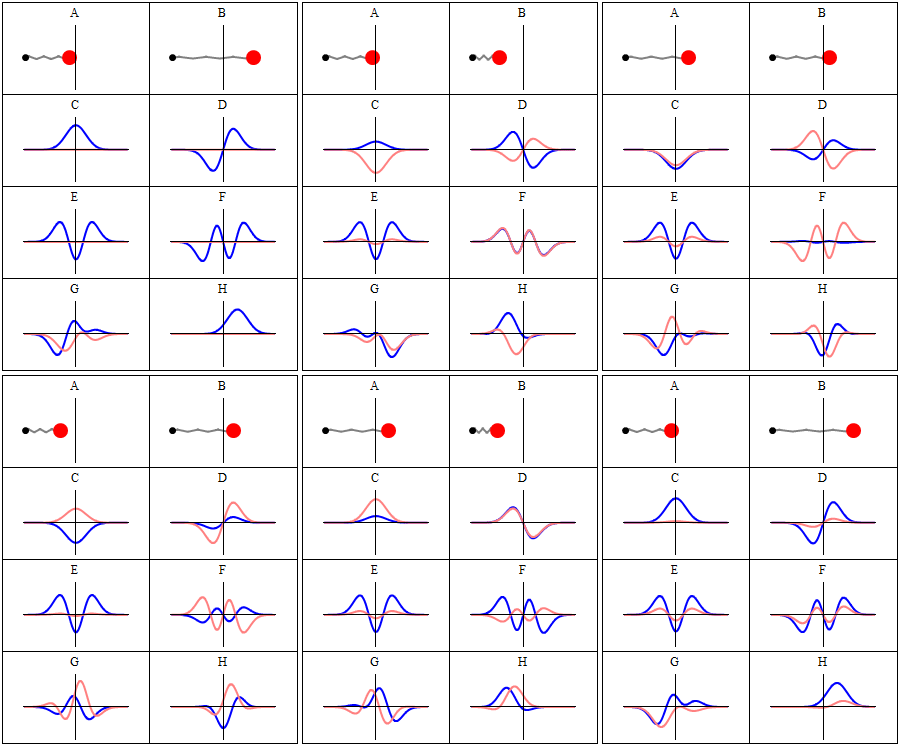
A harmonic oscillator in classical mechanics (A–B) and quantum mechanics (C–H). In (A–B), a ball, attached to a spring, oscillates back and forth. (C–H) are six solutions to the Schrödinger Equation for this situation. The horizontal axis is position, the vertical axis is the real part (blue) or imaginary part (red) of the wave function. Stationary states, or energy eigenstates, which are solutions to the time-independent Schrödinger equation, are shown in C, D, E, F, but not G or H.

A harmonic oscillator in classical mechanics (A–B) and quantum mechanics (C–H). In (A–B), a ball, attached to a spring, oscillates back and forth. (C–H) are six solutions to the Schrödinger Equation for this situation. The horizontal axis is position, the vertical axis is the real part (blue) or imaginary part (red) of the wave function. Stationary states, or energy eigenstates, which are solutions to the time-independent Schrödinger equation, are shown in C, D, E, F, but not G or H.

Wave functions of the electron in a hydrogen atom at different energy levels. They are plotted according to solutions of the Schrödinger equation.

Wave functions of the electron in a hydrogen atom at different energy levels. They are plotted according to solutions of the Schrödinger equation.

Erwin Schrödinger

Erwin Schrödinger

Schrödinger's equation inscribed on the gravestone of Annemarie and Erwin Schrödinger. (Newton's dot notation for the time derivative is used.)Image by Victor Blacus, licensed under Creative Commons Attribution-Share Alike 3.0

Schrödinger's equation inscribed on the gravestone of Annemarie and Erwin Schrödinger. (Newton's dot notation for the time derivative is used.)

Complex plot of a wave function that satisfies the nonrelativistic free Schrödinger equation with V = 0. For more details see wave packetImage by Xcodexif, licensed under Creative Commons Attribution-Share Alike 4.0

Complex plot of a wave function that satisfies the nonrelativistic free Schrödinger equation with V = 0. For more details see wave packet

1-dimensional potential energy box (or infinite potential well)

1-dimensional potential energy box (or infinite potential well)

A harmonic oscillator in classical mechanics (A–B) and quantum mechanics (C–H). In (A–B), a ball, attached to a spring, oscillates back and forth. (C–H) are six solutions to the Schrödinger Equation for this situation. The horizontal axis is position, the vertical axis is the real part (blue) or imaginary part (red) of the wave function. Stationary states, or energy eigenstates, which are solutions to the time-independent Schrödinger equation, are shown in C, D, E, F, but not G or H.

A harmonic oscillator in classical mechanics (A–B) and quantum mechanics (C–H). In (A–B), a ball, attached to a spring, oscillates back and forth. (C–H) are six solutions to the Schrödinger Equation for this situation. The horizontal axis is position, the vertical axis is the real part (blue) or imaginary part (red) of the wave function. Stationary states, or energy eigenstates, which are solutions to the time-independent Schrödinger equation, are shown in C, D, E, F, but not G or H.

Wave functions of the electron in a hydrogen atom at different energy levels. They are plotted according to solutions of the Schrödinger equation.

Wave functions of the electron in a hydrogen atom at different energy levels. They are plotted according to solutions of the Schrödinger equation.

Erwin Schrödinger

Erwin Schrödinger

Schrödinger's equation inscribed on the gravestone of Annemarie and Erwin Schrödinger. (Newton's dot notation for the time derivative is used.)Image by Victor Blacus, licensed under Creative Commons Attribution-Share Alike 3.0

Schrödinger's equation inscribed on the gravestone of Annemarie and Erwin Schrödinger. (Newton's dot notation for the time derivative is used.)

Common Misconceptions

Many people have misconceptions about the Schrödinger equation! For example, they think particles are just tiny billiard balls bouncing around. 🎱In reality, particles can be in states of superposition, meaning they can exist in multiple places at once! People also sometimes confuse the wave function with a real wave, but it's actually a mathematical tool that helps predict probabilities. 📊Another misunderstanding is thinking that quantum mechanics is absolutely random - it's not! It's about probabilities and chances, not total chaos! ❓Understanding these ideas opens up a magical world of quantum wonders! 🌟

Experimental Validation

Experiments have helped scientists test the Schrödinger equation! 🔬One important experiment is called the double-slit experiment. When scientists shoot a beam of particles like electrons through two slits, it creates an interference pattern! 🎨This means the particles are behaving like waves, and they can go through both slits at the same time, confirming the idea of superposition. Another great test is using lasers to trap atoms, showing that the calculations from the Schrödinger equation match the experimental results! 🧪Thanks to these cool experiments, scientists can trust the magic of the Schrödinger equation in understanding the tiny universe! 🚀

Mathematical Formulation

The Schrödinger equation is a mathematical expression that looks complicated, but it shows how particles behave! 📐✨ The most common form is written like this: iħ∂ψ/∂t = Hψ. Let's break this down! "i" is a special number called an imaginary unit, "ħ" is something that stands for a tiny number called Planck's constant, and "ψ" (psi) is the wave function. Think of it like a superhero symbol for each particle! 💪H represents the Hamiltonian, which describes the energy of the system. By using this equation, scientists can calculate where particles might be found and what they might do.

Applications In Quantum Mechanics

The Schrödinger equation is super important in quantum mechanics! 🎉It helps scientists explore many cool ideas. For example, it's used to understand how atoms bond together to form molecules! 💍It also helps in designing new materials, discovering why metals conduct electricity, and even explaining the strange behavior of supercomputors! Scientists use the equation in fields like chemistry, physics, and even in trying to create new technologies. 🚀The equation helps unlock the mysteries of the universe and allows scientists to answer questions that seem impossible! 🧠

Comparison With Classical Mechanics

Classical mechanics is all about big things, like cars and bouncing balls! 🚗🏀 In this world, we can predict exactly where an object will go. However, when we look at tiny particles, things get weird! Just like how a spinning top looks different from different angles, tiny particles can be in different places at the same time! 😲This is where the Schrödinger equation comes in! Instead of saying a particle is in one position, it tells us about all the possible places it could be. To put it simply, classical mechanics is like a clear map while quantum mechanics is like a treasure hunt full of surprises! 🗺️💎

Interpretation Of The Wave Function

The wave function (ψ) is the key to understanding quantum mechanics and the Schrödinger equation! 🌈It tells us the likelihood of finding a particle in different places. Instead of saying the particle is definitely here or there, it can say, "I might be here or over there!" 👀 This leads to a concept called probability. When we square the wave function, it gives us the probability of finding the particle in a specific location. Imagine throwing a dart at a board; some spots might be more likely to hit than others! 🎯The wave function creates a “cloud of possibilities” that helps scientists understand what’s going on with tiny particles.

History Of The Schrödinger Equation

Erwin Schrödinger, an Austrian physicist, created the Schrödinger equation while thinking about how tiny particles behave. 🇦🇹 He published his famous ideas in 1926, and it quickly changed the way scientists looked at the universe! Before Schrödinger, scientists used classical physics to explain movement, but this didn’t work for tiny particles. 🤔Schrödinger's equation introduced the idea of wave functions, which helped people understand quantum mechanics. Many scientists, like Niels Bohr and Albert Einstein, were also working on similar ideas, but Schrödinger's work was special because it combined waves and particles in a new way. 🌊

Time-dependent Schrödinger Equation

The time-dependent Schrödinger equation is a special version of the main equation that shows how particles change over time! ⏳It helps us understand how wave functions evolve, or move and change, as time passes. This version is important for understanding how particles interact with each other or with light! 💡It looks like this: iħ∂ψ(x, t)/∂t = -ħ²/(2m)∇²ψ(x, t) + V(x)ψ(x, t). Here, ∇² is the wave operator that shows how particles spread out in space! By using this equation, scientists can explore exciting ideas, like how electrons move in an atom! 🌌

Quantum Superposition And Entanglement

Quantum superposition is a fun concept that means tiny particles can be in multiple states at once! 🌌For example, a particle can be both here and there until we look! Imagine flipping a coin that's spinning; it’s not just heads or tails, right? Now, entanglement is another magical idea where two particles are linked, no matter how far apart they are! 👫If one particle is measured, and we find it’s a certain kind, the other one will immediately know and be that kind too! This makes quantum mechanics super interesting and shows how particles can have special connections! ✨

Time-independent Schrödinger Equation

The time-independent Schrödinger equation helps scientists understand the energy of a system without thinking about time! 🎶Sometimes, we just want to know what the different energy levels are for particles locked in a space, like a carnival ride! 🎡This equation is handy for solving problems where time doesn’t matter, like an electron around a stable atom. It looks like this: -ħ²/(2m)∇²ψ + V(x)ψ = Eψ. Here, "E" represents the energy of the particle. This type of equation helps us understand important concepts like quantization and stable energy levels! ⭐

Schrödinger Equation Quiz

Q1
Question 1 of 10

Learn more about Schrödinger Equation

Ready to create?

Drop Files here
Make

To create a safe space for kid creators worldwide!

Create

Vibe Coding

Kids GPT

All Tools

Kibu

Resources

Worksheets

SafeTube

Blog

FAQ

Account

Pricing

Log-in

Sign-up

Data Deletion

Company

About

Community Guidelines

Privacy Policy

Terms of Service

2025, URSOR LIMITED. All rights reserved. DIY is in no way affiliated with Minecraft™, Mojang, Microsoft, Roblox™ or YouTube. LEGO® is a trademark of the LEGO® Group which does not sponsor, endorse or authorize this website or event. Made with love in San Francisco.