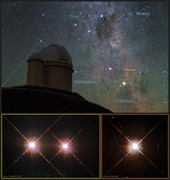
Proxima Centauri b is a potentially habitable exoplanet orbiting the red dwarf star Proxima Centauri, located just over 4 light-years from Earth.
Set reading age
View for Kids
Easy to read and understand
View for Students
Clear, detailed explanations
View for Scholars
Deep dives and big ideas
Proxima Centauri b is a super cool planet! 🌎✨ It's located about 4.24 light-years away from Earth in the Alpha Centauri star system, which is like our Sun's neighbor! This planet orbits a star called Proxima Centauri, which is a red dwarf star. Proxima Centauri b is special because it's in the "habitable zone," where it could have water and maybe even support life! This planet was discovered in 2016, and scientists are still very curious about what it’s like. Would you want to visit it someday? 🚀
The discovery of Proxima Centauri b was made by scientists using a super-sensitive tool called the European Southern Observatory's HARPS instrument. 🛠️ This special tool helps astronomers find planets around other stars by measuring tiny movements in the star caused by the planet's gravity. The exciting announcement about Proxima Centauri b was made on August 24, 2016. It was a big surprise for astronomers because finding a planet so close to Earth is rare. People all around the world were thrilled! 🎉
Proxima Centauri b is an rocky exoplanet, meaning it is made of solid materials like Earth! 🌍It is about 1.17 times the size of Earth, making it a little bigger than our home planet. Its surface temperature could be just right for water to exist if it has an atmosphere. Proxima Centauri b is also located in a star system with two other stars, Alpha Centauri A and B. This adds to the excitement of learning about how planets interact in their solar systems! 🪐
In the future, scientists will continue to study Proxima Centauri b using powerful telescopes to learn more about it! 🔭They hope to discover if the planet has an atmosphere and if it's suitable for life. Additionally, researchers want to understand more about the star, Proxima Centauri, and how it affects the planet. There are many questions to answer, and scientists around the world are excited to be part of this mission to uncover the secrets of Proxima Centauri b! 🔍
Proxima Centauri b takes only about 11.2 Earth days to complete one orbit around its star, Proxima Centauri. 🔄That means one year there is quite short! However, it’s very close to its star, much closer than Earth is to the Sun. This could affect how the planet rotates. Scientists think it might be “tidally locked,” which means one side always faces the star, like the Moon does with Earth! 🌙That could create extreme temperatures on each side of the planet!
Since Proxima Centauri b is located in the habitable zone, there is a chance that life could exist there! 🤞Scientists believe that if the planet has liquid water, it might support simple life forms, just like we have on Earth. However, we still need more information. Special space telescopes are being built to study Proxima Centauri b and look for signs of life, such as oxygen or other gases. What kind of creatures do you think could live there? 👀
As of now, no missions have gone to Proxima Centauri b yet, but scientists are working on plans! 🚀One idea is to send tiny probes, like small robots, to travel to the star system. These missions could take many years because even the fastest spaceships would take about 20 years to get there! One popular idea is the "Breakthrough Starshot" project, which aims to send tiny light sail spacecraft to Proxima Centauri and capture images of the planet. How cool would that be? 🌌
Proxima Centauri b and Earth have some similarities and differences! 🌍Unlike Earth, which takes one year to orbit the Sun, Proxima Centauri b only takes about 11.2 days to orbit its star. It is also a bit larger than Earth, making it a super-Earth! However, we are not sure if Proxima Centauri b has the same type of life-sustaining atmosphere as ours. While Earth has water, plants, and animals, Proxima Centauri b is still a question mark! 👽Scientists are eager to find out if it could support life like our home!
The atmosphere on Proxima Centauri b is still a mystery! 🌬️ An atmosphere could protect the planet and keep it warm, just like Earth's atmosphere does. However, if the planet has too strong a magnetic field or if it does not have an atmosphere at all, it might be too harsh for life. Scientists are excited to find out more about Proxima Centauri b's climate, which could be super different from what we experience on Earth, making it an exciting topic for future research! ☁️


DIY is a creative community where kids draw, build, explore ideas, and share.
No credit card required