Polylactic Acid Facts For Kids
Polylactic acid (PLA) is a biodegradable thermoplastic made from renewable resources, primarily used in packaging, 3D printing, and medical applications due to its eco-friendly properties.
Select reading age

Polylactic Acid Facts For Kids
Videos & Quizzesincluded
About this topic
Polylactic acid, or PLA, is a special kind of plastic that's friendly to the planet! 🌍It’s made from plants, like corn or sugarcane, and changes how we think about plastics. First discovered in 1845 by a scientist named Henri Braconnot, it has become very popular in recent years. PLA is often used for making everyday items like water bottles, food containers, and even 3D printing materials. It breaks down faster than regular plastics, making it a better choice for our Earth! 🌱Knowing about PLA helps us understand how materials can be both useful and better for the environment.
Explore with ChatDinoKey Points
PLA has some interesting properties!
PLA is super versatile and can be used in many ways!
Looking ahead, PLA could change the world of materials even more!
Scientists are busy researching how to improve PLA!
PLA is made up of tiny building blocks called "monomers."
Making PLA involves several steps!
Unlike regular plastics, PLA is better for the environment!
PLA is not the only bioplastic out there!
Photos of Polylactic Acid

Polylactic Acid — photo 1

PLA filament for use in 3D printing
 Image by F. Kesselring, FKuR Willich, licensed under Creative Commons Attribution-Share Alike 3.0 de
Polylactic Acid — photo 3
Polylactic Acid — photo 4

Polylactic Acid — photo 5

Polylactic Acid — photo 6
![The degradation of PLA and PET at the sea surface and seafloor over time. The degradation of PLA closely mirrors that of PET, suggesting PLA degrades similarly to petroleum-based plastics in seawater.[62]](https://upload.wikimedia.org/wikipedia/commons/thumb/f/fc/Degradation_of_PLA_in_Seawater.png/960px-Degradation_of_PLA_in_Seawater.png)
The degradation of PLA and PET at the sea surface and seafloor over time. The degradation of PLA closely mirrors that of PET, suggesting PLA degrades similarly to petroleum-based plastics in seawater.[62]

PLA has SPI resin ID code 7
🌟 Properties
PLA has some interesting properties! 🌟It is strong and can hold its shape, which is why it’s great for making containers and cups. It is also lightweight, making it easy to carry. PLA can withstand heat, but not as much as other plastics. At around 60°C (140°F), it might start to bend! 😲One cool fact is that PLA can be clear like glass, or colorful! 🎨These unique properties make PLA enjoyable to use in many products, while being eco-friendly at the same time.
Go deeper🎨 Applications
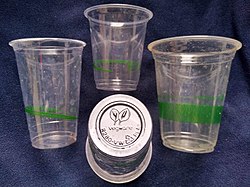
PLA is super versatile and can be used in many ways! 🎨It’s commonly found in food containers, cutlery, and bags that break down more easily than regular plastics. Businesses even use PLA for disposable cups and plates. It’s widely used in 3D printing because it’s easy to work with and creates strong designs! ✨Scientists also use PLA in medicine, like making sutures or drug delivery systems, because it’s safe for the body. With PLA, we can create products that not only work well but also help our planet stay clean and green!
Go deeper🔮 Future Trends
Looking ahead, PLA could change the world of materials even more! 🔮As people learn about the benefits of eco-friendly plastics, demand for PLA products will likely grow. New technologies might make it cheaper and easier to produce. More companies might also switch to using PLA, helping reduce plastic pollution worldwide! 🌊Imagine a future where toys, utensils, and everything in between can be made from clean, plant-based materials! 🌻With continued research and innovation, PLA is set to be a big part of a greener planet! 💚
Go deeper🔬 Current Research
Scientists are busy researching how to improve PLA! 🔬They want to make it even better for the environment and find new ways to use it. Researchers are also studying how PLA can become stronger and withstand higher temperatures! This means that PLA could be used in more products like clothing or heat-resistant containers in the future. 🌈Another exciting focus is how to make PLA from food waste, like leftover corn or sugarcane. This could help reduce waste while producing more eco-friendly products! 🌽
Go deeper🏗️ Chemical Structure
PLA is made up of tiny building blocks called "monomers." 🏗️ These monomers link together to form long chains, which give PLA its unique properties. The chemical formula of polylactic acid is (C3H4O2)n. The "n" means the chains can be very long, depending on how many monomers are linked! This structure makes PLA strong yet flexible. The carbon and hydrogen in PLA come from renewable sources like corn starch. When sunlight or heat hits it, PLA can change back into carbon dioxide and water! 💧Knowing the chemical structure helps us understand how powerful and useful PLA can be.
Go deeper🍃 Production Process
Making PLA involves several steps! 🍃First, corn or sugarcane is harvested and processed to get a sweet substance called glucose. Then, bacteria work on the glucose to change it into lactic acid. This is where the name “polylactic acid” comes from! Next, the lactic acid molecules bond together to form long chains of PLA through a process called polymerization. Finally, PLA is cooled down and made into pellets, which can be transformed into various shapes! 🏭This fun process turns natural plants into cool, safe products we can use every day.
Go deeper🌿 Environmental Impact
Unlike regular plastics, PLA is better for the environment! 🌿Because it comes from plants, it uses renewable resources. Plus, it breaks down into natural materials when disposed of properly. This means that, if we compost it, it won’t harm animals or plants. However, composting requires a special facility that gets very hot! 🥵If we throw PLA in regular trash, it doesn’t break down as easily. It’s important for us to know how to recycle and compost PLA products correctly to help protect our planet! 🌈
Go deeper🌱 Comparison With Other Bioplastics
PLA is not the only bioplastic out there! 🌱For example, there’s also PHA (polyhydroxyalkanoate), made from bacteria instead of plants. While PLA is often cheaper and easier to make, PHA is more flexible and can break down in different environments. ⚖️ Another bioplastic is starch-based plastic, which is made directly from corn starch, making it eco-friendly, too! But it can be less durable than PLA. Choosing which bioplastic to use depends on what you need it for, so understanding their differences is super important! 🌍
Go deeper