An ocean current is a continuous, directed movement of seawater influenced by various forces such as wind, temperature, salinity, and the Earth's rotation.

Set reading age
View for Kids
Easy to read and understand
View for Students
Clear, detailed explanations
View for Scholars
Deep dives and big ideas
🌊 Ocean currents are like rivers that flow through the ocean! They move water from one place to another, helping ships and sea creatures travel. Did you know that there are large and small currents? Some currents are fast and strong, while others are slow and gentle. Ocean currents affect the weather and climate. For example, the Gulf Stream, a warm current from the Gulf of Mexico, makes places like Europe warmer. Without currents, the oceans would feel very different!
There are two main types of ocean currents: surface currents and deep-water currents. 🌊Surface currents are found on the top layer of the ocean and are usually warm. They move because of the wind blowing across the water. Deep-water currents, on the other hand, are found far beneath the surface and move differently. 🌍They are influenced by the Earth's rotation and temperature. Together, these currents create a giant system that helps the ocean breathe!
An ocean current is a steady movement of seawater in a specific direction. 🤔Imagine pouring water down a slide – that’s kind of how ocean currents work! They are formed by the wind blowing across the surface of the water. Additionally, temperature differences between warm and cold water create currents as well. 🌞❄️ The movement caused by these currents is essential for many ocean habitats and helps transport nutrients, which are important for marine life!
Sailors and ships often use ocean currents to their advantage! ⚓️ By understanding currents, they can save time and fuel while traveling across the ocean. Many famous explorers, like Christopher Columbus, used currents to navigate and discover new lands. 🌎Today, ships and boats are built to follow these currents for better journeys. Knowing about ocean currents helps sailors get to their destinations faster!
Humans can change ocean currents, sometimes in harmful ways. 🌍Pollution, climate change, and construction can all have effects on ocean water's temperature and salinity. For example, melting ice from climate change can alter currents, affecting weather patterns. 🥶It's important for us to take care of our oceans and avoid polluting them so ocean currents can continue their important work!
Several factors affect how ocean currents move! 🌪️ First, the wind plays a big role; stronger winds create faster currents. Second, the Earth's rotation affects currents with something called the Coriolis effect, which causes currents to curve. 🌎Third, temperature and salinity (how salty the water is) impact the density of the water, making some areas sink and others rise. All these factors work together to keep ocean currents flowing around the globe!
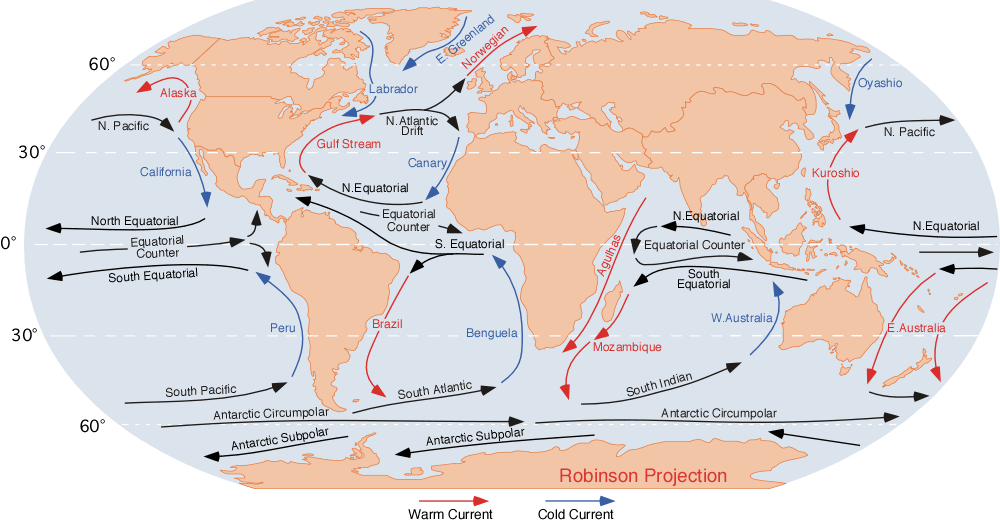
Some currents are famous around the world! 🌏The Gulf Stream is one of the most well-known and carries warm water from the Gulf of Mexico up to the eastern United States and Europe. The Antarctic Circumpolar Current cools water around Antarctica, while the Kuroshio Current moves warm water near Japan. 🌊Each of these currents plays a unique role in the ocean, influencing heating and cooling patterns across different regions!
Ocean currents create a wonderful home for marine life! 🐠Many fish and sea animals rely on these currents to travel, find food, and reproduce. For instance, baby turtles use currents to swim from their nests to the open ocean. 🐢Currents also help to move nutrients like plankton, which are food for small fish. Without ocean currents, many sea creatures would struggle to survive, making the ocean a less vibrant place.
As our planet warms due to climate change, ocean currents may change, too. 🌡️ Scientists are studying how these currents will behave in the future. Some currents may become stronger, while others weaken or shift direction. This can impact weather patterns and marine life! 🌊Understanding ocean currents helps us learn how to protect our planet, and we all can play a part in caring for our oceans!
Ocean currents are super important for regulating the climate! 🌡️ Warm currents bring heat to colder areas, which helps keep temperatures balanced. For example, the North Atlantic Drift carries warm water to Northern Europe, making it milder than other regions at similar latitudes. ❄️ By moving heat across the planet, ocean currents help to distribute warmth and affect weather patterns, making summer cooler or winter warmer.


DIY is a creative community where kids draw, build, explore ideas, and share what they make, all in a safe, moderated space.
Only $0 after trial. No credit card required