All Articles

Nuclear Magnetic Resonance

Nuclear Magnetic Resonance Facts For Kids

Nuclear Magnetic Resonance (NMR) is a physical phenomenon where atomic nuclei in strong magnetic fields produce signals used to analyze the structure of different substances.

🎨 Reading age for 6-8
Background blob
Nuclear Magnetic Resonance
Facts for Kids!

Do more with AI

Introduction

Nuclear Magnetic Resonance (NMR) might sound complicated, but it’s really cool! 🌀It helps scientists look at tiny things like atoms and molecules! Imagine a superhero that can see inside objects - that's what NMR does! It uses powerful magnets and radio waves to take pictures of molecules. 🌍NMR is super helpful in chemistry and even medicine! Albert Einstein, a famous scientist, helped us understand how these tiny particles work. NMR can tell us what different substances are made of by looking at the signals they give off when placed in a magnetic field! 🔬

Images of Nuclear Magnetic Resonance

Splitting of nuclei spin energies in an external magnetic field

Splitting of nuclei spin energies in an external magnetic field

An intuitive model. Nuclei with spin have magnetic moments (spin magnetic moments). By itself, there is no energetic difference for any particular orientation of the nuclear magnet (only one energy state, on the left), but in an external magnetic field there is a high-energy state and a low-energy state depending on the relative orientation of the magnet to the external field, and in thermal equilibrium, the low-energy orientation is preferred. The average orientation of the magnetic moment will precess around the field. The external field can be supplied by a large magnet and also by electrons and other nuclei in the vicinity.Image by Darekk2, licensed under Creative Commons Attribution-Share Alike 3.0

An intuitive model. Nuclei with spin have magnetic moments (spin magnetic moments). By itself, there is no energetic difference for any particular orientation of the nuclear magnet (only one energy state, on the left), but in an external magnetic field there is a high-energy state and a low-energy state depending on the relative orientation of the magnet to the external field, and in thermal equilibrium, the low-energy orientation is preferred. The average orientation of the magnetic moment will precess around the field. The external field can be supplied by a large magnet and also by electrons and other nuclei in the vicinity.

A Hahn echo decay experiment measuring dephasing time.Image by Gavin W Morley, licensed under Creative Commons Attribution-Share Alike 3.0

A Hahn echo decay experiment measuring dephasing time.
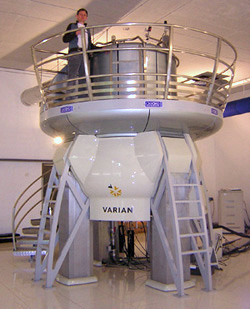
900 MHz, 21.2 T NMR Magnet at HWB-NMR, Birmingham, UK

900 MHz, 21.2 T NMR Magnet at HWB-NMR, Birmingham, UK

Medical MRIImage by Jan Ainali, licensed under Creative Commons Attribution 3.0

Medical MRI

Schematic of in situ NMR

Schematic of in situ NMR

Splitting of nuclei spin energies in an external magnetic field

Splitting of nuclei spin energies in an external magnetic field

An intuitive model. Nuclei with spin have magnetic moments (spin magnetic moments). By itself, there is no energetic difference for any particular orientation of the nuclear magnet (only one energy state, on the left), but in an external magnetic field there is a high-energy state and a low-energy state depending on the relative orientation of the magnet to the external field, and in thermal equilibrium, the low-energy orientation is preferred. The average orientation of the magnetic moment will precess around the field. The external field can be supplied by a large magnet and also by electrons and other nuclei in the vicinity.Image by Darekk2, licensed under Creative Commons Attribution-Share Alike 3.0

An intuitive model. Nuclei with spin have magnetic moments (spin magnetic moments). By itself, there is no energetic difference for any particular orientation of the nuclear magnet (only one energy state, on the left), but in an external magnetic field there is a high-energy state and a low-energy state depending on the relative orientation of the magnet to the external field, and in thermal equilibrium, the low-energy orientation is preferred. The average orientation of the magnetic moment will precess around the field. The external field can be supplied by a large magnet and also by electrons and other nuclei in the vicinity.

A Hahn echo decay experiment measuring dephasing time.Image by Gavin W Morley, licensed under Creative Commons Attribution-Share Alike 3.0

A Hahn echo decay experiment measuring dephasing time.

900 MHz, 21.2 T NMR Magnet at HWB-NMR, Birmingham, UK

900 MHz, 21.2 T NMR Magnet at HWB-NMR, Birmingham, UK

Medical MRIImage by Jan Ainali, licensed under Creative Commons Attribution 3.0

Medical MRI

Schematic of in situ NMR

Schematic of in situ NMR

Spin-spin Coupling

Spin-spin coupling is like a dance between particles! 💃When protons are near each other, they can influence each other’s spins. This interaction creates a special pattern in NMR signals that helps scientists understand how atoms are arranged. Imagine two friends spinning together! The way they move can change how others spin around them. This coupling can help chemists determine if atoms are bonded together, telling a great story about the structure of the molecule! 📖Learning about these interactions is essential for understanding chemistry better! 🌟

Advanced Nmr Techniques

Scientists are always discovering new ways to use NMR! 🔬Advanced NMR techniques can explore molecules in ways we’ve never seen before. For example, they can look at how proteins fold or how drugs work in our bodies! 🎇They are using special techniques like 2D NMR and even multi-dimensional NMR to get clearer pictures. These advanced methods can uncover hidden details and structures in complex molecules! 🗺️ This information can lead to advancements in many fields, including biochemistry, material science, and even environmental studies! 🌳

Basics Of Magnetic Fields

Magnetic fields are all around us! 🌍They come from magnets, like the ones on your refrigerator, and they can move through space even when we can't see them! ✨The Earth itself has a magnetic field, which is why some animals can navigate without maps. NMR uses super strong magnets that are much stronger than your fridge magnets! 😲When a magnetic field is created, it influences how tiny particles called nuclei behave. This helps scientists understand the materials they are studying better and it’s key to making NMR work! 🔍

Fundamentals Of Quantum Spin

Let's talk about quantum spin! ⚛️ Every tiny particle, like protons in atoms, has a property called "spin." It’s not like a real spin you do when you twirl, but more like a little magnet inside them! ⚡Protons can either spin in one direction (up) or the opposite direction (down). This is important because it helps scientists understand how atoms behave. When you put protons in a magnetic field, they align with the field, just like how a compass needle points north! 🧭This spinning makes NMR possible and helps chemists get the coolest information!

Principles Of Nmr Spectroscopy

NMR Spectroscopy is like a special detective tool! 🔍It helps scientists solve the mystery of what’s inside a substance by collecting information from the signals produced by nuclei. When a sample is placed in a strong magnet, the nuclei resonate at specific frequencies, creating a unique pattern, kind of like a musical note! 🎶Each different type of atom has its special frequency, which helps scientists figure out what they are looking at. NMR Spectroscopy is a fundamental technique in many areas of science, from chemistry to medicine! 🧪

Applications Of Nmr In Chemistry

NMR is like a toolbox for chemists! 🧰They use it to identify different substances, understand how molecules work, and study reactions. For example, it can help them find out if a medicine works well or how to make it better. NMR can also help in figuring out if a food is safe to eat. 🍏Scientists use the information from NMR to discover new materials, create better medicines, and even explore how our bodies work at the molecular level! These applications make NMR super important for science and everyday life! 🧪

Future Directions In Nmr Research

The future of NMR research is bright and full of possibilities! 🌅Scientists are excited about new technologies that will make NMR even better. They might create machines that are faster or more powerful, which could help uncover new medicines and materials. 🤖Researchers want to explore NMR in unusual places, like in living cells or even in space! 🚀This could lead to groundbreaking discoveries! With ongoing improvements and creativity, NMR will continue being a fantastic tool for making the world a better place. Let’s see where NMR takes us next! 🔮

Chemical Shift And Its Significance

Have you heard of the term “chemical shift”? 🎈It’s like finding your way in a magical maze! When atoms are in different environments, their magnetic signals change. This change in frequency is called the chemical shift! It is important because it helps scientists figure out what kinds of atoms are in their sample. For example, carbon atoms in a chain will have slightly different signals than carbon in a ring. The little shifts tell us about the structure and bonds between atoms! This info is vital to knowing how substances react with one another! 🧬

Energy Levels And Transition States

In NMR, particles don’t just sit still! 🌈They can change energy levels like jumping between steps on a ladder! When we put them in a strong magnetic field, the protons can absorb energy, which makes them jump to a higher energy level. 🎉When they go back down, they release energy in the form of radio waves! This is a super neat way for scientists to learn about molecules! The signals they give off can tell us lots about what they are made of, and studying these “jumps” is a crucial part of NMR. 📩

Medical Applications: Mri Explained

Did you know NMR is used in medicine? 🏥It’s true! It helps doctors know what’s happening inside our bodies. One amazing application is MRI, or Magnetic Resonance Imaging! 🎈An MRI machine uses NMR to take detailed pictures of our organs, like the brain and heart. It’s a non-invasive way to see inside without using X-rays! Patients lie down in a big tube, and the machine makes loud noises, but don’t worry, it’s perfectly safe! 💤Thanks to NMR, doctors can find problems faster and help us stay healthy! ❤️

Nuclear Magnetic Resonance Quiz

Q1
Question 1 of 10

Learn more about Nuclear Magnetic Resonance

Ready to create?

Drop Files here
Make

To create a safe space for kid creators worldwide!

Create

Vibe Coding

Kids GPT

All Tools

Kibu

Resources

Worksheets

SafeTube

Blog

FAQ

Account

Pricing

Log-in

Sign-up

Data Deletion

Company

About

Community Guidelines

Privacy Policy

Terms of Service

2025, URSOR LIMITED. All rights reserved. DIY is in no way affiliated with Minecraft™, Mojang, Microsoft, Roblox™ or YouTube. LEGO® is a trademark of the LEGO® Group which does not sponsor, endorse or authorize this website or event. Made with love in San Francisco.