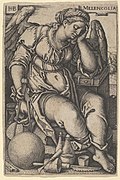
Melencolia I holds cultural importance as a Renaissance masterpiece that encapsulates the complex relationship between creativity, intelligence, and melancholy.

Set reading age
View for Kids
Easy to read and understand
View for Students
Clear, detailed explanations
View for Scholars
Deep dives and big ideas
"Melencolia I" is a famous engraving created by the artist Albrecht Dürer in 1514. 🖼️ It shows a woman with a sad expression sitting amidst various objects, like a magic square and different tools. This artwork is mysterious and thought-provoking, leaving people wondering about its meaning. Dürer was from Germany and used detailed techniques to create beautiful images. This engraving is part of a group of artworks called "Emblema," which explore complex ideas and emotions. Dürer's "Melencolia I" is considered one of the greatest prints in art history! 🎨✨
Today, "Melencolia I" remains relevant because it speaks to universal emotions everyone experiences! 😢People often face difficult feelings, and Dürer’s work serves as a reminder that it’s okay to feel sad sometimes. Many modern artists and writers still grapple with these emotions, using Dürer's themes in their own creations. Social media has also brought attention to mental health, encouraging open discussions about feelings and emotions. By recognizing and understanding sadness, we can learn more about ourselves and support each other, making Dürer’s timeless work truly important in modern life! 💖
Albrecht Dürer was born in 1471 and lived in the Holy Roman Empire, an area that includes modern-day Germany and Austria. 📜In the early 1500s, Europe was experiencing the Renaissance, a time of great change and creativity. Many artists explored new ways to express their ideas. Dürer was inspired by this movement and used his deep understanding of perspective and anatomy to create art that amazed people. "Melencolia I" reflects the feelings of the time, as many were curious about sadness and human emotions, marking a shift from focusing solely on religion to exploring personal themes. ⏳
Dürer was a master of engraving, a technique that involves carving designs onto metal plates. 🛠️ For "Melencolia I," he used fine lines and shading to create incredible detail. He also played with light and shadow, making the scene look three-dimensional! Dürer included many objects like a compass, a set square, and a block of stone that are all carefully placed. Each element tells a story, adding depth and meaning. To make this artwork even more impressive, Dürer used a method called "cross-hatching," where layers of lines create shading and texture. 🖋️
The themes in "Melencolia I" have made their way into literature, too! 📚Writers have often mentioned Dürer's work when discussing feelings of sadness or creativity. For example, poets like John Keats and Samuel Taylor Coleridge wrote about the beauty and pain of being human, drawing inspiration from art like Dürer's. In modern times, authors may refer to "Melencolia I" to illustrate a character's struggles or moods, showing how art and literature can connect over shared feelings. This shows that Dürer’s insights into melancholy still resonate in stories today! ✍️
"Melencolia I" touches on important psychological themes! 🧠It explores emotions like sadness, creativity, and uncertainty. The engraving hints at how people struggle with their feelings, especially when trying to create or achieve something. Some psychologists think that feeling melancholic can help us reflect on our lives and inspire new ideas. This piece is like a mirror that shows our own worries and hopes, reminding us that everyone feels sad sometimes. Understanding our emotions is important, and Dürer’s art encourages us to think about how we feel and why. 🌈
Dürer’s "Melencolia I" had a big impact on artists who came after him. 🎉Many were inspired to explore deeper human emotions in their work, including sadness and introspection. Some artists in the Baroque period, like Rembrandt, used similar techniques and explored the theme of melancholy. In the Romantic movement, painters like Caspar David Friedrich focused on emotions and nature as seen through a melancholic lens. The ideas from Dürer’s engraving still influence artists today, showing how important it is to express feelings through art! 🎨🌍
Melancholy, the feeling explored in "Melencolia I," has played a big role in culture for centuries! 🌍Many songs, books, and movies explore themes of sadness and introspection. For example, famous musicians like Beethoven have used their experiences of melancholy to create beautiful music. In literature, novels such as “The Bell Jar” by Sylvia Plath illustrate characters who struggle with sadness, similar to the emotions seen in Dürer’s engraving. This connection between sadness and creativity shows how important it is to express our feelings through various forms of art and storytelling. 🎶📖
"Melencolia I" is rich in symbols! The woman represents the concept of melancholy, which is a deep sense of sadness 🥺. The objects around her hold special meanings—like the magic square that puzzles the mind, suggesting intellect and creativity. The hourglass represents the passage of time and how it can make us feel sorrowful. The tools symbolize human potential and achievement, while the dog represents loyalty. Some art historians believe that the engraving explores the balance between creativity and sadness, making it a complex piece that invites viewers to think deeply about their own feelings. 🤔


DIY is a creative community where kids draw, build, explore ideas, and share.
No credit card required