Laminar Flow Facts For Kids
Laminar flow is a type of fluid motion where layers of fluid move steadily in parallel lines with minimal mixing and turbulence.
Select reading age
Laminar Flow Facts For Kids
Videos & Quizzesincluded
About this topic
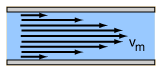
Laminar flow is a special way that liquids or gases move. Imagine a smooth slide at a water park! 🎢The water glides down quietly and evenly. This is similar to laminar flow, where fluid particles move in parallel layers, without mixing or swirling. It usually happens at lower speeds and in smooth, straight paths. A key place where we study laminar flow is in laboratories, where scientists conduct experiments. For example, many rivers show laminar flow when the water is calm. 🌊Understanding laminar flow helps engineers and scientists design better machines and systems in our daily lives!
Explore with ChatDinoKey Points
The main principle of laminar flow is that fluids move in organized layers.
Scientists and engineers use laminar flow in many exciting ways!
Laminar flow has some cool characteristics!
Laminar flow and turbulent flow are like two sides of a coin!
There are fun real-world examples of laminar flow all around us!
Scientists use math to better understand laminar flow!
To study laminar flow, scientists use different tools to measure how fluids move!
Laminar flow plays a huge role in engineering and design!
Photos of Laminar Flow

A sphere in Stokes flow, at very low Reynolds number. An object moving through a fluid experiences a drag force in the direction opposite to its motion.

In the case of a moving plate in a liquid, it is found that there is a layer (lamina) that moves with the plate, and a layer of stationary liquid next to any stationary plate.

Hyperbolic rotation represents theoretical laminar flow in a corner with rectangular hyperbolas for streamlines.
🚗 Principles Of Laminar Flow
The main principle of laminar flow is that fluids move in organized layers. These layers glide past one another without bumping or mixing. Think of it like cars lined up in a parade 🚗, moving smoothly and not crashing into each other. Laminar flow happens in certain conditions, such as when the fluid moves slowly and is very thick, like honey. 🍯It can also happen in narrow spaces like pipes. The rule behind this behavior is called viscosity, which is how thick or sticky a liquid is. Low-viscosity fluids, like water, flow more quickly and smoothly!
Go deeper🏥 Applications Of Laminar Flow
Scientists and engineers use laminar flow in many exciting ways! For example, in hospitals, doctors use laminar flow hoods to keep the air clean while making medicines. 🏥They don't want germs to mix with the medicines! In aviation, aircraft designs make use of laminar flow to reduce drag, which helps planes fly more efficiently ✈️. In automobiles, streamlined designs speed up cars by reducing resistance to the air. These applications show how important laminar flow is in our lives!
Go deeper😍 Characteristics Of Laminar Flow
Laminar flow has some cool characteristics! 😍First, it's quiet, like a whisper. Shhh! You don't hear loud splashes. It has a steady, smooth motion, which means particles travel in the same direction at similar speeds. Also, no mixing occurs, so you can see clear layers, like in a cake! 🎂This type of flow often creates uniform pressure, which is important in many applications. Lastly, laminar flow is most common in places where the fluid moves slowly, like slow-moving streams or through thin tubes.
Go deeper💰 Laminar Flow Vs. Turbulent Flow
Laminar flow and turbulent flow are like two sides of a coin! 💰While laminar flow is smooth and orderly, turbulent flow is wild and chaotic. In turbulent flow, fluids swirl, mix, and create waves. 🌊Imagine a raging river with big waves and splashes; that's turbulent flow! When fluids move fast or hit obstacles, they switch from laminar to turbulent flow. For example, a fast-moving train might create turbulence in the air around it. 🚂Understanding both types helps engineers choose the best designs for different situations!
Go deeper🌍 Real-world Examples Of Laminar Flow
There are fun real-world examples of laminar flow all around us! 🌍In nature, when you pour honey or syrup, you can see layers moving smoothly without mixing. 🐝In some rivers, like the Seine in France, calm areas show laminar flow. In your kitchen, though, when you slowly pour a drink like juice, you might notice laminar flow happening in the glass! 🥤In engineering, scientists design special cars to experience laminar flow at high speeds to cut down on gas use. These examples show how laminar flow influences everyday life!
Go deeper📏 Mathematical Modeling Of Laminar Flow
Scientists use math to better understand laminar flow! 📏This math helps predict how fluids move. One common equation used is called the Navier-Stokes Equation. 🧮It considers factors like speed, density, and viscosity. By using this equation, scientists can create models or simulations to see how laminar flow behaves in various conditions. For example, researchers can create computer programs that show how syrup flows when you pour it. 🍁These models help engineers design better systems and machines.
Go deeper🛠️ Measurement Techniques For Laminar Flow
To study laminar flow, scientists use different tools to measure how fluids move! 🛠️ One tool is a flow meter, which tells us how fast the fluid is flowing. It helps keep track of the speed in pipes or channels. Another method is using dye to visualize the smooth layers of laminar flow, like putting food coloring in clear water. 🎨The colorful patterns show how the fluid behaves. Additionally, researchers might use high-speed cameras to record the flow and analyze it later. 📽️ These techniques help better understand laminar flow!
Go deeper🏗️ Impact Of Laminar Flow On Engineering And Design
Laminar flow plays a huge role in engineering and design! 🏗️ When designing airplanes, engineers aim for laminar flow over the wings because it helps them fly smoothly and saves fuel. ✈️ In medicine, clean airflow in laminar flow cabinets protects patients from infections. Additionally, boats are designed to reduce drag, so they can glide smoothly over water. 🚤Architects also consider laminar flow when designing buildings to minimize wind resistance. By understanding laminar flow, engineers make better, safer, and more efficient designs that impact our world! 🌟
Go deeper