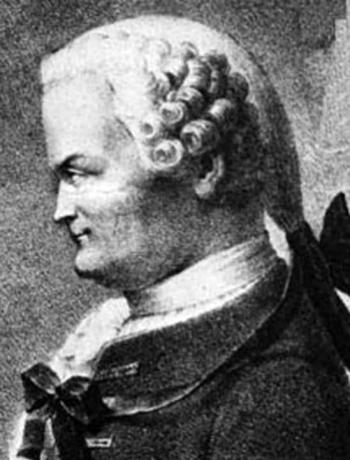
Johann Heinrich Lambert was a brilliant polymath from the Republic of Mulhouse, contributing significantly to fields like mathematics, physics, philosophy, astronomy, and engineering.

Set reading age
View for Kids
Easy to read and understand
View for Students
Clear, detailed explanations
View for Scholars
Deep dives and big ideas
Johann Heinrich Lambert was a brilliant thinker born on August 26, 1728, in Mulhouse, which is now part of France 🇫🇷. He was a true polymath, meaning he was an expert in many areas! Lambert loved to explore mathematics, physics, astronomy, and even philosophy. His ideas helped shape the way we understand the world. He lived during a time when people were discovering amazing things about nature and the universe. Lambert passed away on September 25, 1777, but his work continues to inspire scientists and mathematicians today! 🌟
Today, Lambert's work remains important in mathematics, physics, and philosophy 🌟. His ideas helped create new fields of study, such as non-Euclidean geometry, which scientists use to describe complex surfaces in our universe. The techniques he invented for map projections still help us navigate the world properly 🌍. By building on his discoveries, modern scientists and mathematicians can continue uncovering new truths about nature, making Lambert's contributions ever-relevant in our lives today!
Lambert's legacy is still felt in science and mathematics today ✨. His discoveries inspired many famous scientists, including mathematician Carl Friedrich Gauss and astronomer Johann Gottlieb Galle. Schools and universities around the world teach about Lambert's work, ensuring that new generations learn from his brilliance. He is remembered as a pioneer who dared to explore new ideas. Lambert's spirit of curiosity continues to drive people to discover and invent, showing us that knowledge has no limits!
Lambert was also an ingenious inventor and engineer 🔧! He created a unique instrument called the "spherical triangle" to help calculate angles in different shapes. This invention helped simplify complex calculations. Lambert even designed special map projections to represent the curved surface of the earth on flat maps 🗺️. These innovations paved the way for better navigation and cartography. His creativity in engineering made it easier for explorers and scientists to understand our planet!
Johann Heinrich Lambert wrote several important books that shared his discoveries with the world 📚. Some of his famous works include "Photometria," which studied light and brightness, and "Anmerkungen über die Linien und Flächen," focusing on geometry. These writings were groundbreaking at the time and are still cited by researchers today. By sharing his knowledge, Lambert encouraged others to think critically and passionately about the world, making his publications valuable sources even now!
Johann Heinrich Lambert is celebrated for his amazing contributions to various fields 🎖️! In honor of his work, some mathematical concepts and theorems bear his name, like "Lambert's W function." Many organizations, universities, and scholars recognize him as one of the great thinkers of the 18th century. He left a profound mark on science and philosophy, reminding us all that curiosity can lead to incredible discoveries. The impact of his work is still honored in schools today!
Lambert grew up in a humble family in Mulhouse 🌍. His father was a craftsman, and Johann's early education came from his interest in reading and learning. As a child, he was curious about how things worked and loved solving problems. By the age of 25, he moved to the city of Basel, Switzerland 🇨🇭, where he studied more advanced subjects. He didn't go to a formal school, but learned from books and discussions with other scholars. His determination and spirit of inquiry helped him become one of the most innovative thinkers of his time!
While Lambert made many great contributions, not everyone agreed with his ideas. Some scientists and mathematicians disagreed about his concepts in geometry and physics, leading to debates about his theories 🤨. For example, his thoughts on non-Euclidean geometry were not widely accepted until many years later. Despite the controversies, Lambert's determination to share his ideas encouraged further discussions and explorations, ultimately shaping our understanding of these subjects.
Lambert wasn't just a scientist; he also had deep philosophical ideas 🤔. He thought about questions like "What is truth?" and "How do we know what we know?" His book "Philosophical Letters" explored these topics, influencing many philosophers after him. He believed in using reason and logic to better understand the world. Lambert's thoughts taught others to think critically and seek knowledge, making him an important figure in philosophy, too!
Johann Heinrich Lambert made many important discoveries in mathematics. He is famous for proving that π (pi, the number used in circles) is an irrational number 📏! That means it cannot be expressed as a simple fraction. Lambert also worked on different types of geometry, including non-Euclidean geometry, which explores shapes and angles in new ways. He created techniques for measuring areas and volumes of different objects. His work laid the foundation for many future mathematicians who followed in his footsteps!
In addition to mathematics, Lambert was fascinated by physics and astronomy 🌌. He studied how light travels and even introduced the concept of "brightness," which helps us understand how bright stars and planets appear in the sky. Lambert created a special map to show the paths of stars, called a star map. He also worked on theories of gravity and motion, contributing to our understanding of how objects move in space. His research helped shape the world's knowledge about the universe!


DIY is a creative community where kids draw, build, explore ideas, and share.
No credit card required